
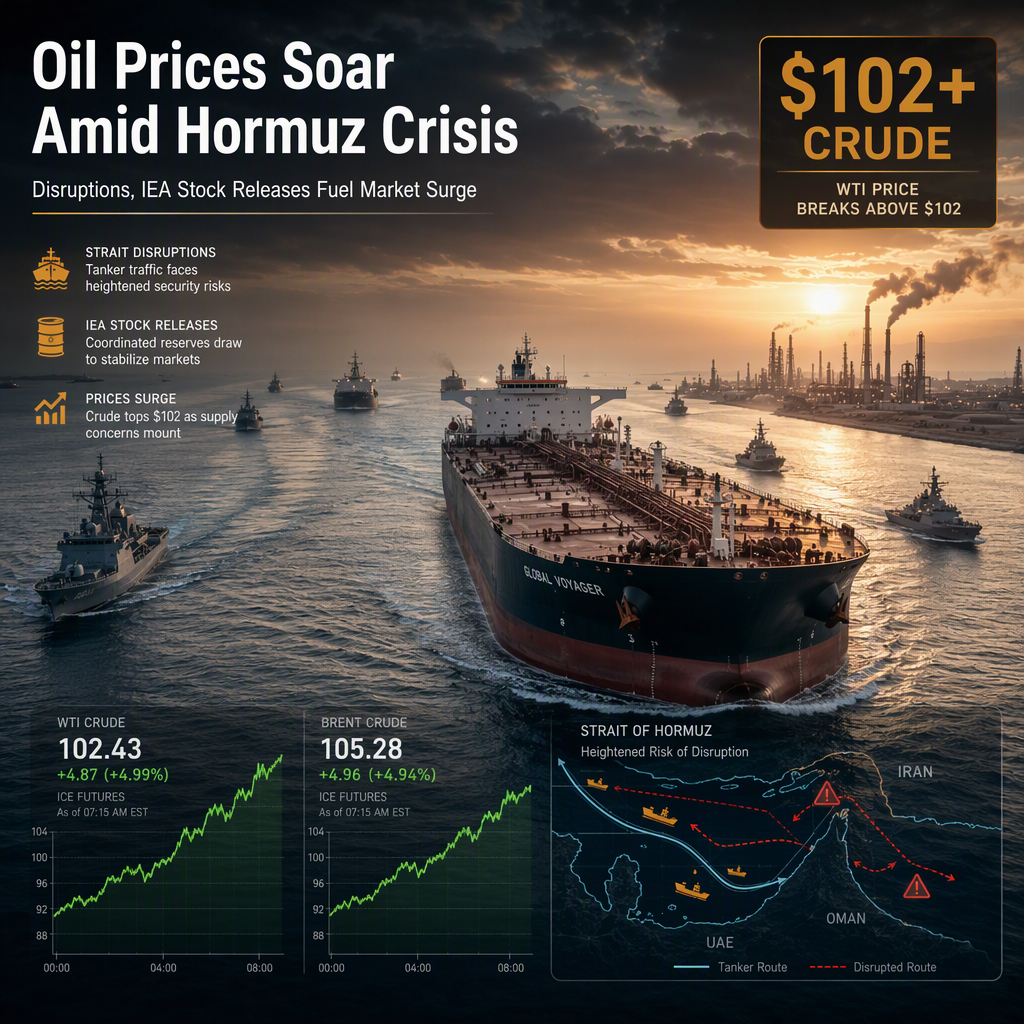
Oil prices have risen above $102, supported by heightened supply risks and escalating tensions involving Iran, according to the Danske Research Team [1]. European diesel prices experienced a sharp increase after International Energy Agency (IEA) members decided to accelerate the release of previously announced oil stocks, prioritizing diesel due to tight market conditions and disruptions linked to the Iran conflict [1]. The IEA clarified that the accelerated release would not exceed the 400 million barrels already committed, with approximately 100 million barrels still set to reach the market. This move primarily brings forward already pledged volumes rather than introducing new supply, which left markets disappointed [1].
Crude flows through the Strait of Hormuz fell to their lowest level in over two months, with only seven commodity vessels transiting on Tuesday, as reported by Kpler, following a spike in tanker attacks last week—the highest since the Iran war began [1]. Flows through the Strait were down 27% from the wartime high recorded the previous week. However, increased exports from the Gulf of Oman and the Red Sea have partially offset the decline, maintaining overall regional crude exports [1].
The oil market also reacted to reports that the US is considering strike options against Iran ahead of the mid-term elections, further supporting the upward movement in oil prices [1].
CONCLUSION
Oil prices have climbed above $102, driven by supply disruptions in the Strait of Hormuz, a surge in European diesel prices, and the acceleration of IEA oil stock releases. While alternative export routes have mitigated some supply losses, market sentiment remains cautious due to ongoing geopolitical tensions and limited new supply.