
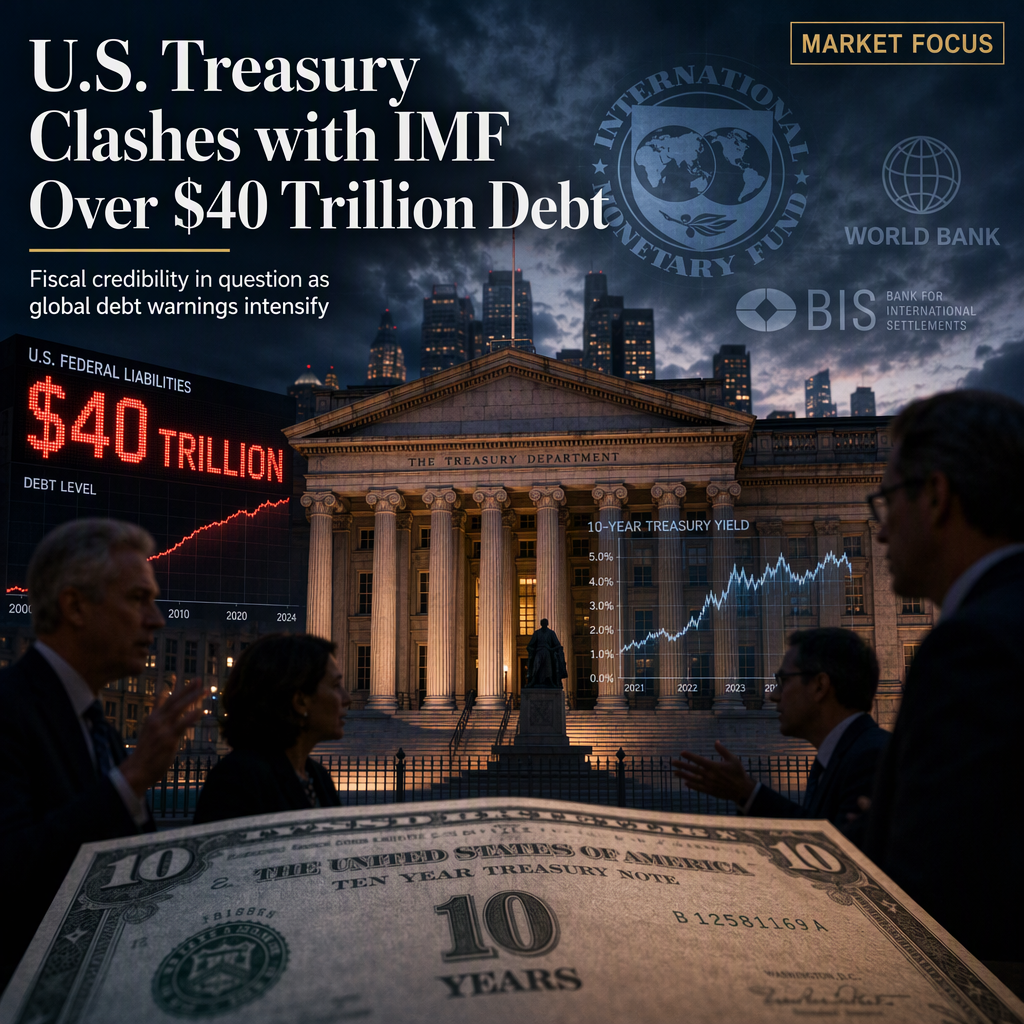
A public exchange has emerged between the U.S. Treasury and the International Monetary Fund (IMF) regarding the sustainability of U.S. federal debt, which has now surpassed $40 trillion. Treasury counselor David Zervos criticized the IMF's track record in economic forecasting, suggesting the institution should 'check its own record before criticizing U.S. fiscal policy' and referencing several past IMF misjudgments, including its outlooks on global growth in 2008, Southeast Asia in 1997, Russia in 2022, and Argentina after its $57 billion bailout [1].
The dispute was triggered by IMF Managing Director Kristalina Georgieva's remarks at the IMF-World Bank annual meetings in Bangkok, where she warned that strong U.S. economic growth alone would not be sufficient to reduce the country's mounting debt to sustainable levels and called for additional fiscal measures [1]. Georgieva's comments were in response to U.S. Treasury Secretary Scott Bessent's earlier assertion that the U.S. could 'grow our way out' of a rising debt-to-GDP ratio, following the breach of the $40 trillion debt mark [1].
The debate comes as 10-year Treasury yields remain above 5%, intensifying scrutiny of the U.S. fiscal outlook and raising concerns among economists about the risk of an unsustainable debt spiral. While many economists warn about the dangers posed by rising interest payments and high deficits, there is division over whether the U.S. could face a true fiscal crisis [1].
Other institutions, such as the Institute of International Finance, have also highlighted the global risks associated with rising debt servicing costs, noting that global debt reached $365 trillion in the first half of the year. The IIF warned that a 'vicious cycle between elections and short-term quick fixes' is undermining the ability of governments to fund public services [1].
Georgieva has issued similar fiscal warnings to other major economies, including France, emphasizing the need for fiscal consolidation [1].
CONCLUSION
The exchange between the U.S. Treasury and the IMF underscores heightened concerns over the sustainability of U.S. federal debt, now exceeding $40 trillion, and the broader implications of rising global debt costs. While the Treasury questions the IMF's credibility, the IMF maintains that fiscal measures are necessary beyond relying on economic growth. The ongoing debate signals continued market focus on U.S. fiscal policy and global debt risks.