
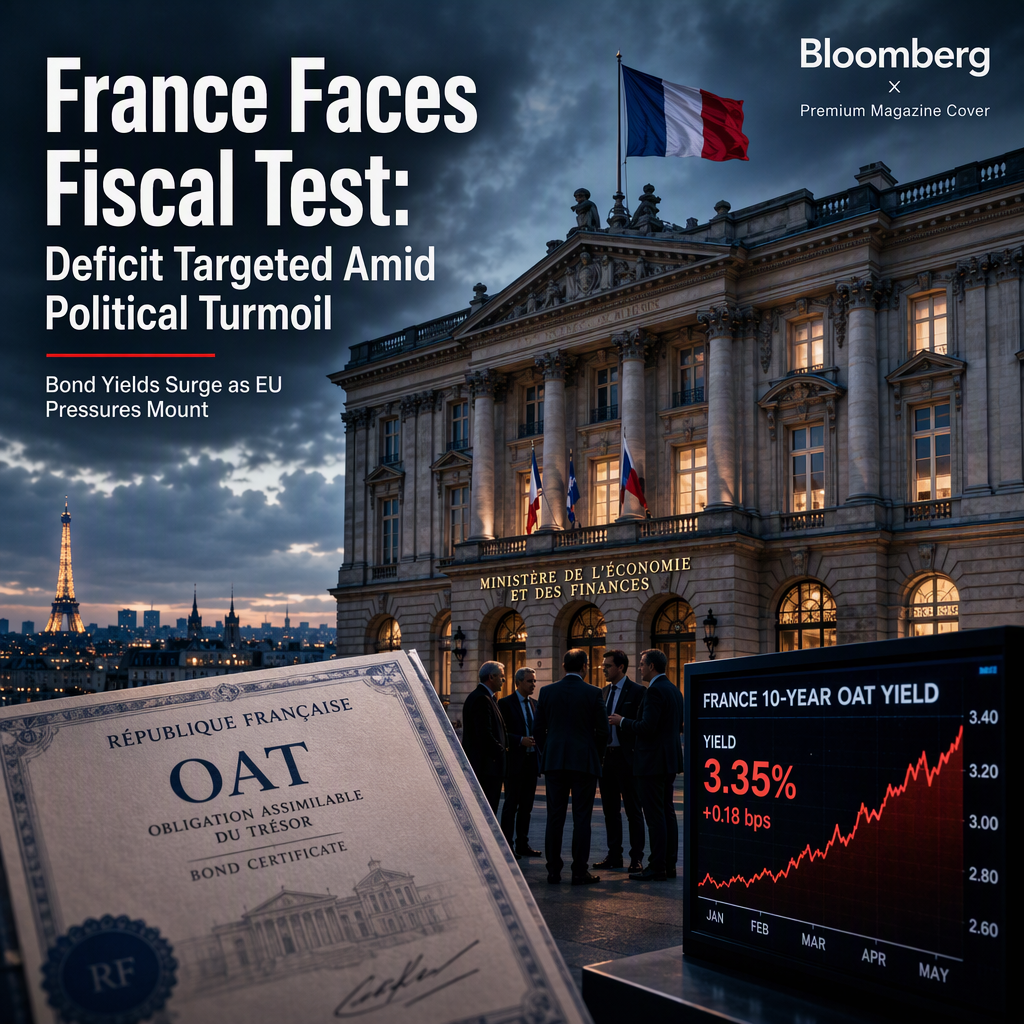
France is currently facing significant budgetary challenges, with its national deficit standing at 5.1% of GDP last year, well above the European Union's recommended threshold of 3% [1]. The country is under the EU's excessive deficit procedure, which calls for Paris to bring its deficit closer to the 3% target. Political turmoil and uncertainty regarding the adoption of the government's budget have contributed to market concerns, leading to a surge in French government bond yields (OATs) to post-2008 highs [1]. These elevated yields reflect heightened anxiety about France's fiscal management and political stability, raising fears of a potential sovereign debt crisis that could affect the broader euro zone [1].
Banque de France Governor Emmanuel Moulin, speaking at the IMF Meetings in Bangkok, emphasized that the rise in government borrowing costs is primarily due to political uncertainty rather than a deterioration in France's fiscal position [1]. He stated, "It's really about political uncertainty and the question whether the budget will be adopted with [delivering] a 5% deficit, which is the objective of the government. And I think to reassure markets, it is important that there is a budget that is voted and a budget that sticks to the 5% deficit" [1]. Moulin expressed confidence that France can reduce its deficit to 3% by 2029, despite the challenges posed by high debt servicing costs, which amount to approximately 10 billion euros more per year [1].
Moulin rejected the notion that achieving the deficit reduction would require austerity measures, stating, "I would challenge the fact that this is austerity. This is not austerity. It is just putting the house in order" [1]. IMF Managing Director Kristalina Georgieva echoed this sentiment, urging France to "get your house in order" [1]. Despite the market turbulence, Moulin reassured CNBC that he is "confident about financial stability in France and in Europe," citing the strength of the banking, insurance, and financial sectors [1].
The ongoing political instability and fiscal uncertainty have had a pronounced impact on French bond markets, with yields reaching multi-decade highs. This situation is compounded by global pressures, including inflation fears stemming from the U.S.-Iran war [1].
CONCLUSION
France faces mounting market pressure as its deficit remains well above EU targets, driving bond yields to multi-decade highs. The central bank governor remains optimistic about achieving a 3% deficit by 2029 without resorting to austerity, but political uncertainty continues to weigh on investor sentiment. The market takeaway is that fiscal consolidation is possible, but stability hinges on political resolution and budget adoption.