
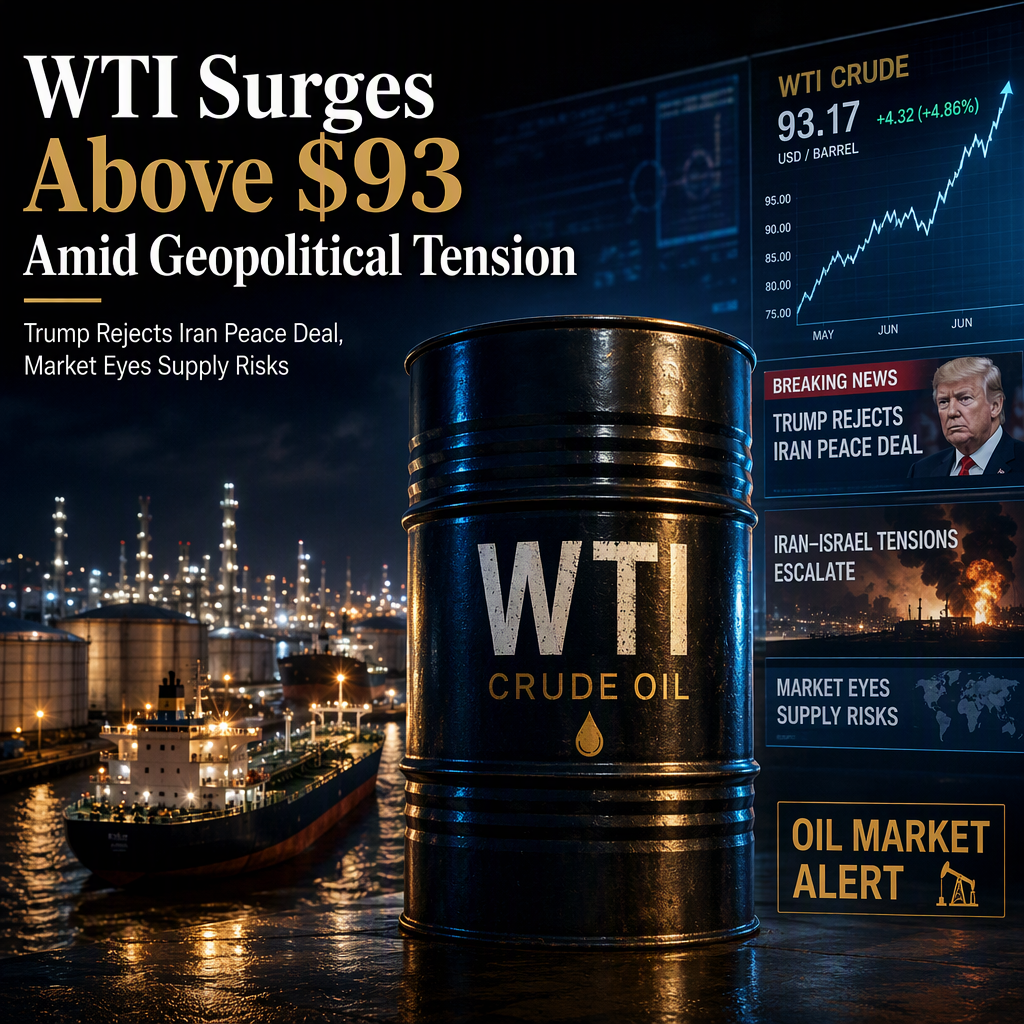
West Texas Intermediate (WTI), the US crude oil benchmark, climbed above $93.00, trading around $93.05 during early Asian hours on Monday, following US President Donald Trump's rejection of an Iranian peace proposal aimed at ending the US-Iran conflict and reopening the Strait of Hormuz [1]. Trump stated that Tehran was 'desperate to make a deal' and expects talks with Iran to resume this week, though Iran has shown no sign of softening its conditions and is awaiting a definitive US response to its seven-day proposal for reopening the strait and other demands [1].
Geopolitical tensions remain high, with Saudi-backed coalition forces in Yemen intercepting two drones launched by the Houthis toward Riyadh and a ballistic missile targeting Khamis Mushait's southern border area [1]. ANZ analysts noted that 'geopolitical risks remain elevated, as the Houthis and Iran continued their attacks on Saudi Arabia, leaving regional supply flows vulnerable' [1].
Market participants are awaiting the American Petroleum Institute (API) weekly data due later on Tuesday. A larger-than-expected crude oil inventory draw could indicate stronger demand and potentially lift WTI prices further, while a bigger build might signal weaker demand or excess supply, undermining prices [1].
Analysts at MUFG/BTMU warned that rising oil prices are adding pressure to global rates and inflation, stating that 'renewed geopolitical risks in the Middle East are occurring against an already tight oil-market backdrop, raising concerns over both supply and inflation,' which reinforces upside risks to global rate expectations [1].
From a technical perspective, WTI maintains a mildly bullish outlook in the near term, trading above the 100-day simple moving average (SMA). Immediate resistance is at the Bollinger middle band near $93.55, with further resistance at the upper Bollinger Band around $100.90. Support is seen at $92.80, with stronger demand at $86.24 and the 100-day SMA at $84.95 [1].
CONCLUSION
WTI's rise above $93.00 reflects heightened geopolitical tensions and supply concerns following President Trump's rejection of Iran's peace proposal. Analysts highlight the potential for further price gains and increased inflationary pressures, with market participants closely watching upcoming inventory data for additional direction.