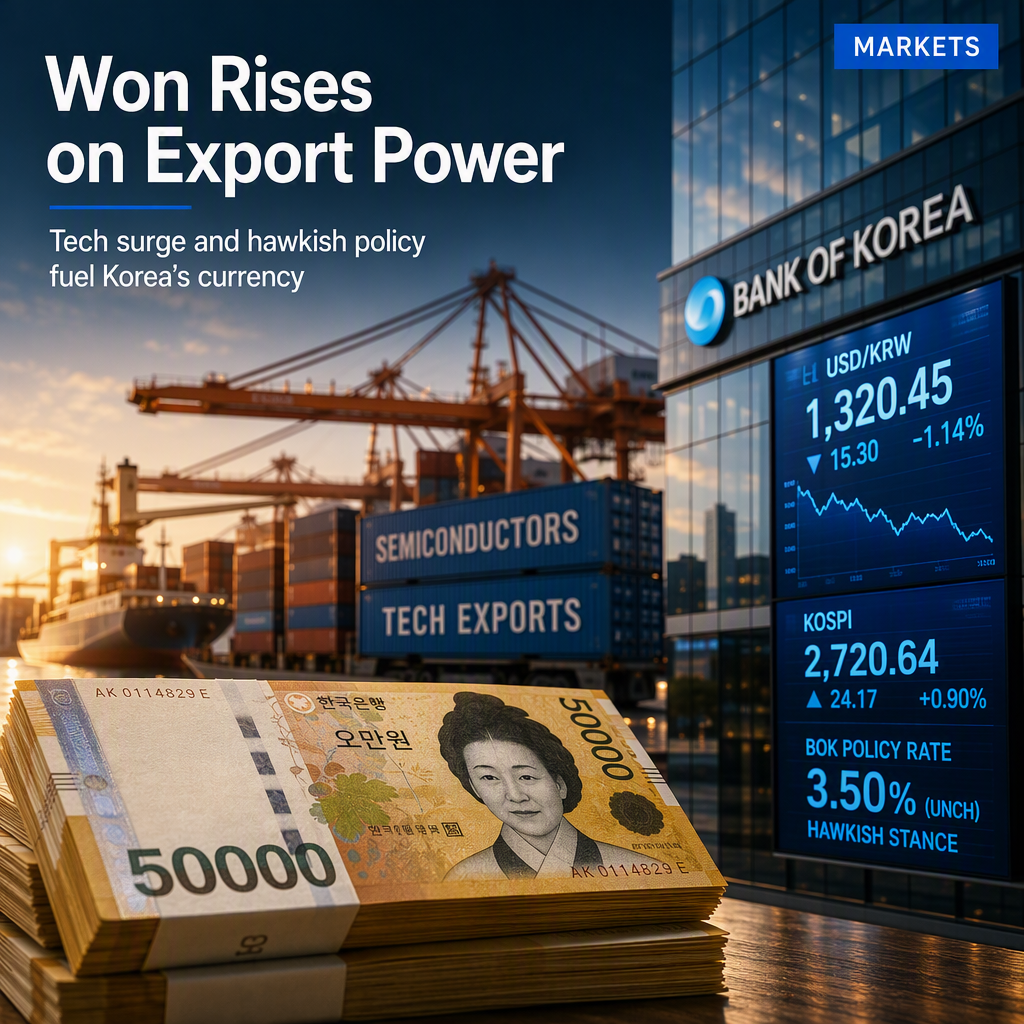
Commerzbank reports that South Korea's export boom and a substantial trade surplus, combined with a hawkish stance from the Bank of Korea (BoK), are providing strong support for the Korean Won (KRW) [1]. South Korea's exports surged 68.7% year-on-year in August, surpassing the consensus estimate of 62.6%, and accelerating from a 63.0% increase in July. This marks the 15th consecutive month of export expansion, with the growth driven predominantly by the technology sector. Notably, semiconductor exports soared 209% year-on-year to USD 46.7 billion, while computer exports jumped 420% [1].
The robust export performance has reinforced the BoK's optimism, leading to an upgrade of its 2026 GDP growth forecast to 3.3% from 2.6% previously in August [1]. The August trade surplus reached nearly USD 35 billion, further strengthening Korea's external position. Commerzbank notes that recent changes in FX flows, such as increased corporate repatriation and more hedging by the National Pension Service (NPS), are allowing a greater portion of the surplus to support KRW appreciation than in the past [1].
On the monetary policy front, headline CPI inflation rose to 3.1% year-on-year in August (consensus: 3.2%), up from 2.8% in July. This increase was anticipated due to base effects, and the below-consensus print is seen as somewhat reassuring. Core inflation, which excludes agriculture and oil, climbed to 3.1% from 2.5%, partly due to a low base [1]. After back-to-back 25 basis point rate hikes in July and August, the BoK is expected to hold rates steady in October. The central bank forecasts headline CPI at 2.7% in 2026 and 2.3% in 2027, with core inflation at 2.5% for both years [1].
Commerzbank expects further KRW appreciation to be more gradual following a sharp USD/KRW decline from around 1,550 at the start of July, projecting consolidation between 1,360 and 1,400 in the near term. Despite the recent moderation in inflation, the BoK is unlikely to change its tightening tone, as inflation remains above the 2% target and export growth continues to be exceptionally strong [1].
CONCLUSION
South Korea's strong export performance, large trade surplus, and the Bank of Korea's hawkish stance are expected to support further, albeit more gradual, appreciation of the Korean Won. Market participants should monitor ongoing FX flow dynamics and BoK policy signals, as these factors are likely to influence KRW movements in the near term.