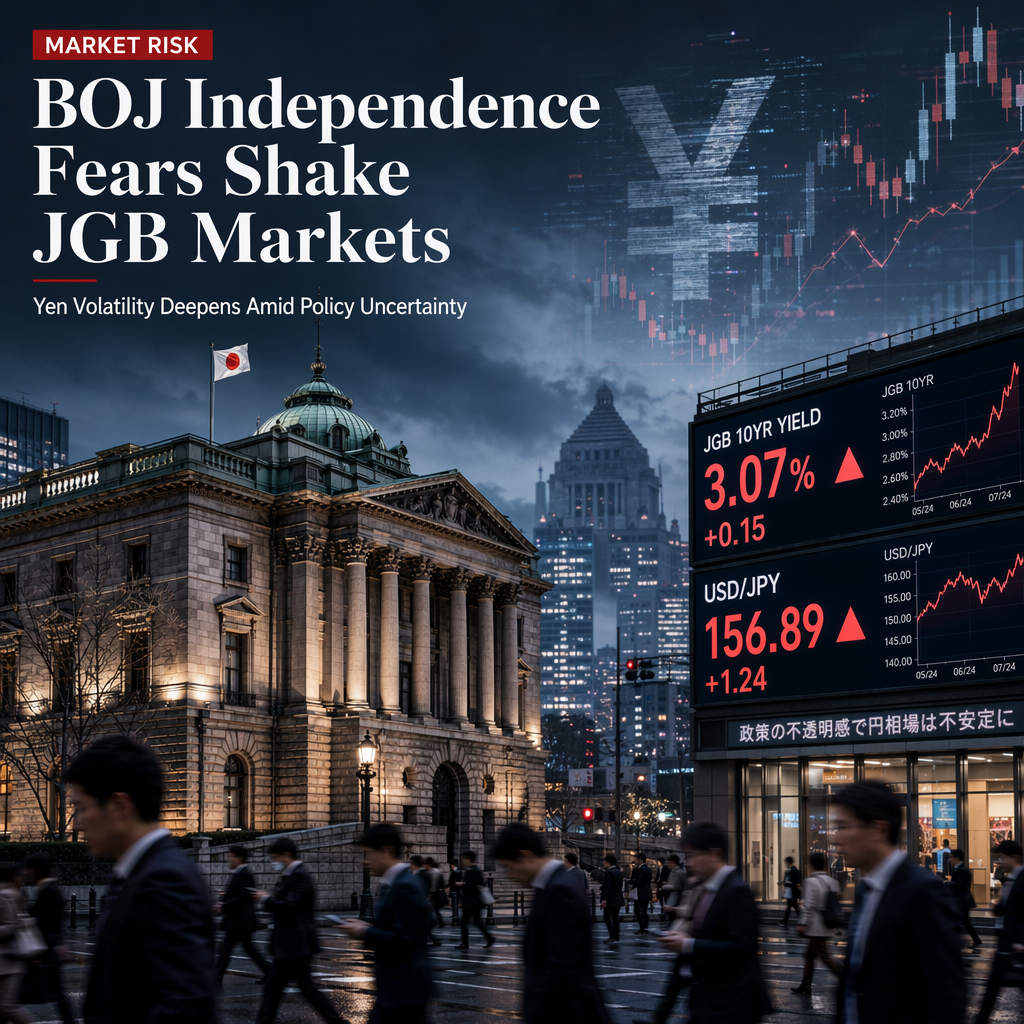
Questions regarding the Bank of Japan's (BOJ) independence have led to a notable rise in yields on long-term Japanese government bonds (JGBs), as market participants express concern that government influence could delay or soften the central bank's response to persistent inflation pressures [1]. A recent draft of a basic economic policy document has heightened market perceptions that the government may intervene in the BOJ's monetary policy, raising fears that the central bank's autonomy could be compromised [1]. This has resulted in traders demanding higher yields to compensate for increased uncertainty and risk, with technical analysis indicating that long-term JGB yields have broken above key resistance levels and some strategists now projecting yields could approach 3% if fiscal concerns escalate [1].
Market strategists advise investors to closely monitor government policy statements and BOJ communications for any signs of policy shifts or intervention, as these could significantly impact bond markets and yield curves [1]. The overall sentiment in the JGB market is cautious, with a growing risk premium being priced in due to concerns over the BOJ's policy autonomy [1].
Meanwhile, the Japanese Yen has exhibited significant intraday volatility against the US Dollar, with USD/JPY trading in a range between 161.00 and 162.84 throughout July, following a two-month climb from below 158.00 [2]. Despite a brief rally in the Yen after the June US Producer Price Index (PPI) fell 0.3% month-on-month and slowed to 5.5% year-on-year, the currency quickly gave back gains as the market refocused on the persistent interest rate differential between the Federal Reserve (3.75%) and the BOJ (1.00%) [2]. The Yen's weakness has been further compounded by the Japanese Finance Ministry's record 11.7 trillion Yen intervention between late April and late May, suspected stealth operations in early July, and a lack of advance signaling for further interventions [2].
External factors, such as renewed American strikes on Iran, a re-declared blockade of the Strait of Hormuz, and elevated crude oil prices, have also weighed on the Yen by increasing Japan's energy import bill and keeping the safe-haven bid with the US Dollar rather than the Yen [2].
CONCLUSION
Rising concerns over the BOJ's independence are driving up long-term JGB yields as investors demand higher risk premiums, while the Yen remains volatile but ultimately weak due to persistent rate differentials and external geopolitical pressures. Market participants are advised to closely monitor both government and BOJ communications for signs of policy shifts or intervention. The overall market sentiment is cautious, with heightened uncertainty surrounding Japanese monetary policy and currency stability.