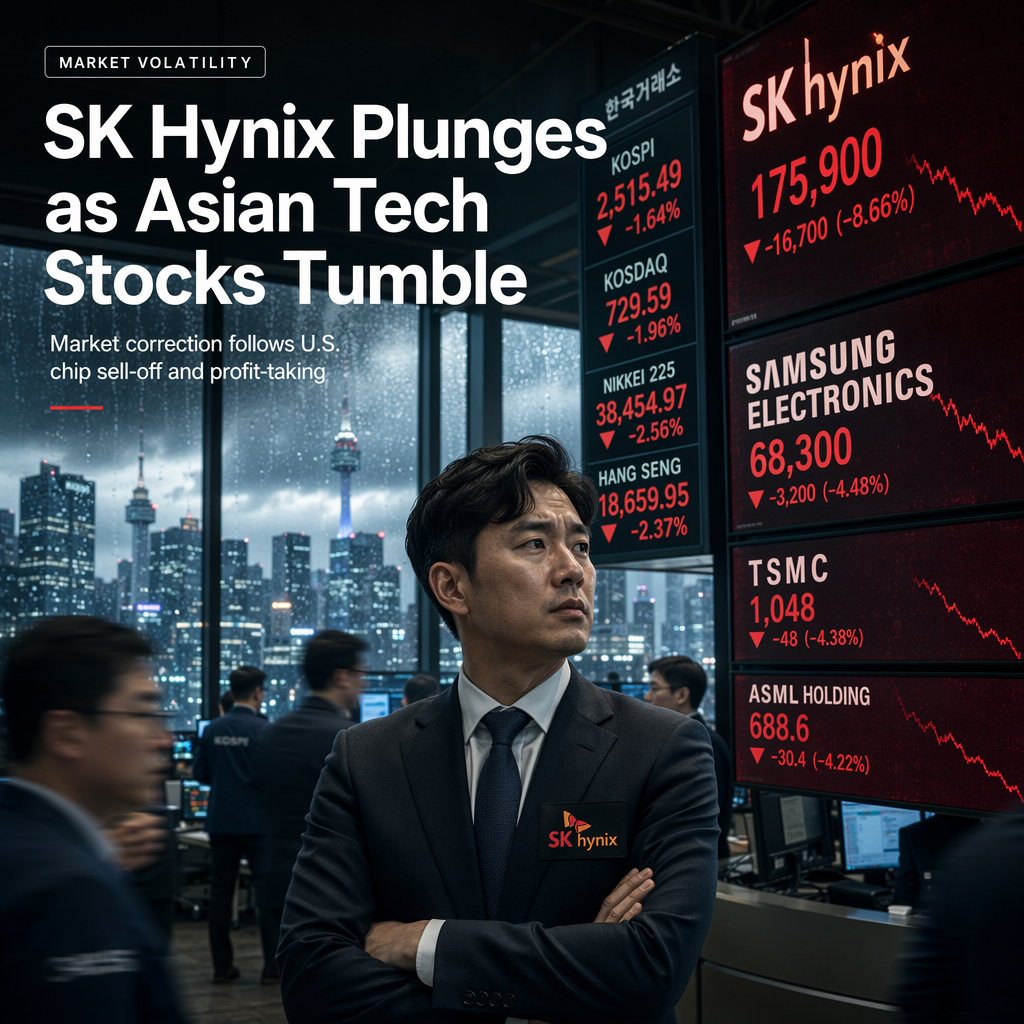
Asian semiconductor stocks experienced a sharp decline on Thursday, with SK Hynix shares plunging over 9% in Seoul. This drop reversed the previous session's 8% rally and followed the company's steepest one-day decline on Monday, as investors took profits amid increasing concerns about AI spending [1]. The volatility in SK Hynix shares has persisted since its U.S. listing last week [1].
Other major South Korean tech stocks also suffered significant losses: Samsung Electronics fell more than 7%, Seoul Semiconductor dropped over 5%, LG Innotek lost about 1%, and Samsung SDI was down more than 2% [1]. The sell-off extended across Asia, with Japan's Advantest falling more than 6%, SoftBank Group sliding nearly 7%, Tokyo Electron losing over 5%, and Renesas Electronics declining 4% [1].
The regional downturn was triggered by a sell-off in U.S. semiconductor shares overnight. Micron Technology sank 8%, Intel lost more than 4%, and both Lam Research and Advanced Micro Devices fell about 3% [1]. This occurred despite strong results from ASML, which raised its full-year sales guidance for the second time this year, forecasting revenue of 43 billion to 45 billion euros—above analysts' expectations—and announced plans to ramp up production of its extreme ultraviolet lithography machines [1].
Louis Kondratev, a trader at XFUNDs, attributed the pullback to the crowded nature of semiconductor trades following a prolonged AI-driven rally. He noted that semiconductors now comprise roughly 20% of the S&P 500, compared to just over 8% during the dot-com bubble of 2000 and a historical average of 2% to 5% [1]. Kondratev cautioned that while earnings momentum has been robust, it is concentrated in semiconductors and may slow as investors reassess high valuations [1].
CONCLUSION
The sharp sell-off in Asian semiconductor stocks, led by SK Hynix, reflects growing investor caution after a strong AI-driven rally and recent profit-taking. Despite robust earnings and positive guidance from ASML, concerns about valuations and the sustainability of gains have triggered a broad market correction in the sector. Market participants are now closely watching for signs of stabilization and reassessment of semiconductor valuations.