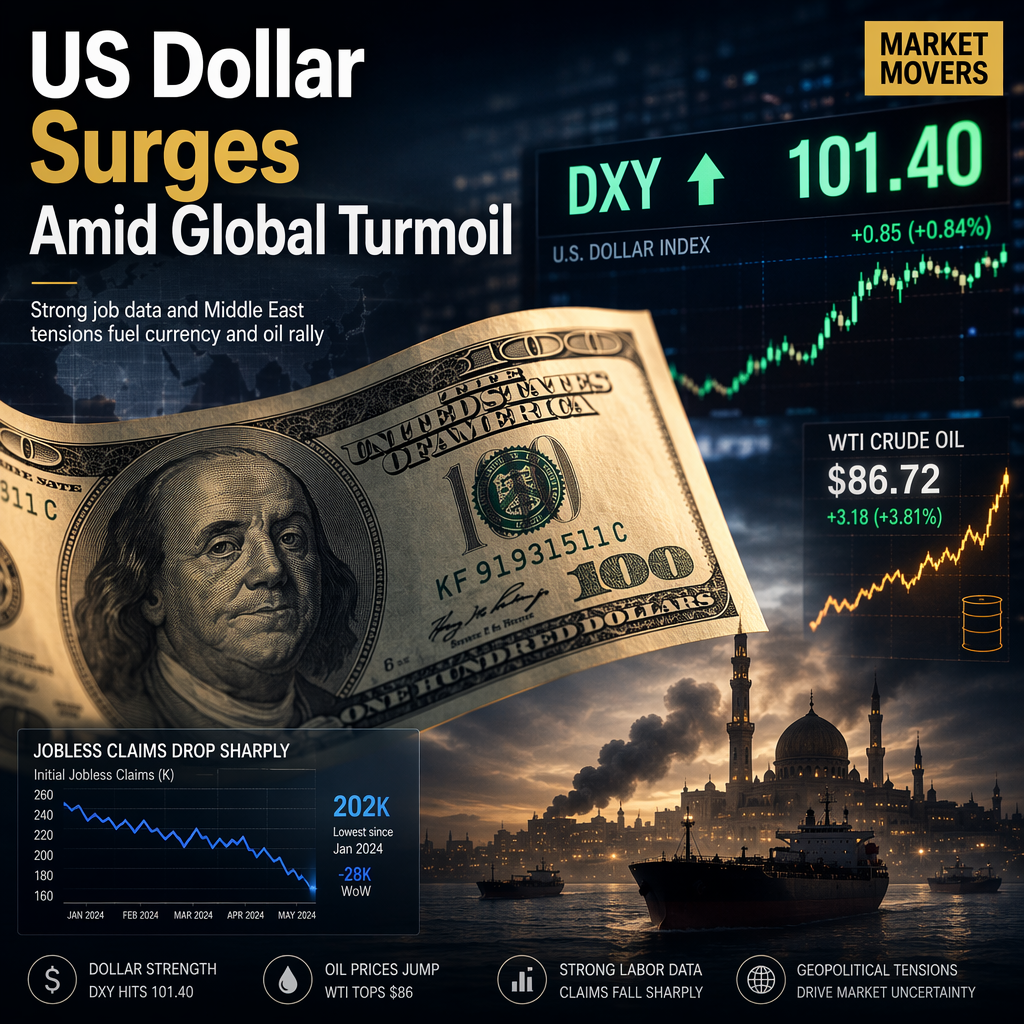
The US Dollar strengthened significantly on Thursday, driven by robust United States labor data and escalating geopolitical tensions in the Middle East, which also led to a surge in oil prices [1]. Initial Jobless Claims in the US fell to 187,000 for the week ending July 18, well below the 212,000 forecast and the revised 209,000 from the previous week. This marks the lowest level since 1969, reinforcing expectations that the Federal Reserve may maintain its restrictive monetary policy stance for a longer period [1].
Market sentiment deteriorated following comments from US President Donald Trump, who stated he was close to deciding whether to launch a larger military operation against Iran. This, combined with attacks on Saudi tankers in the Red Sea and concerns about potential disruptions to the Bab el-Mandeb Strait and the Strait of Hormuz, pushed oil prices higher [1]. The US Dollar Index (DXY) rose approximately 0.3% above 101.40, supported by stronger Treasury yields, geopolitical uncertainty, and expectations that higher energy costs could keep inflation elevated [1].
Currency market movements reflected the broad strength of the US Dollar. The USD was the strongest against the New Zealand Dollar, gaining 0.76%, and also posted gains of 0.44% against both the Euro and the Canadian Dollar, 0.41% against the British Pound, and 0.01% against the Japanese Yen [1]. EUR/USD traded lower near 1.1380, losing around 0.3%, after the European Central Bank kept its three key interest rates unchanged and maintained a data-dependent approach, leaving the door open for further tightening if energy-driven inflation pressures persist. However, this decision failed to provide lasting support to the Euro as broad USD demand dominated [1]. GBP/USD fell below 1.3320, declining around 0.4% as the Pound struggled against the stronger Greenback, with investors also cautious ahead of the upcoming UK Retail Sales report [1].
Overall, the combination of strong US labor data and heightened geopolitical risks has reinforced the US Dollar's safe-haven appeal and contributed to volatility in both currency and commodity markets [1].
CONCLUSION
Stronger-than-expected US labor data and rising Middle East tensions have fueled a rally in the US Dollar and oil prices. The market is now anticipating that the Federal Reserve may keep monetary policy restrictive for longer, while geopolitical risks continue to drive volatility across currencies and commodities.