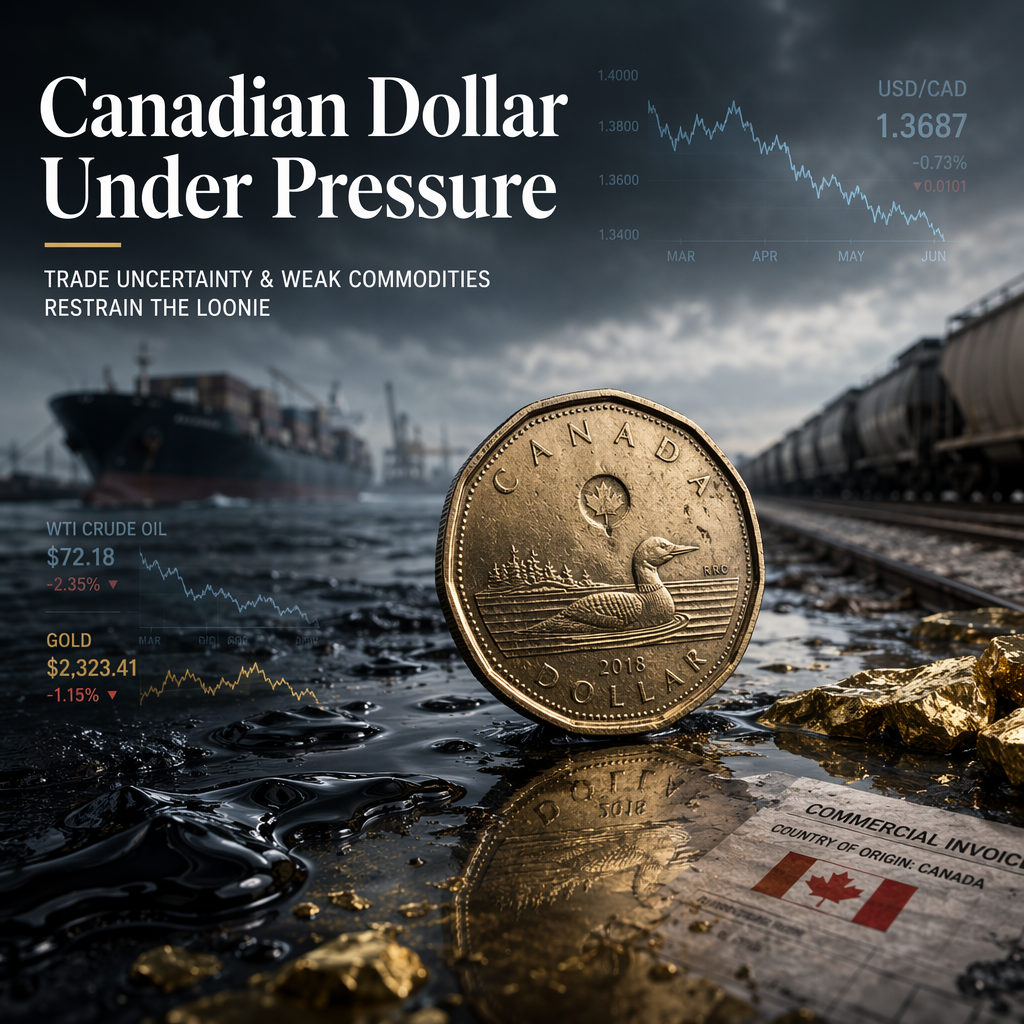
The Canadian Dollar (CAD), also known as the loonie, is currently constrained in the near term, according to Stéfane Marion and Kyle Dahms of the National Bank of Canada (NBC) [1]. Despite a rebound in Canadian GDP projected for Q2 and resilient full-time employment figures, the CAD has not received significant cyclical support. The USD/CAD exchange rate recently climbed above 1.42 in June, marking its highest level since spring 2025, a period when Washington introduced sweeping tariffs on its trading partners [1]. NBC forecasts the USD/CAD rate to ease to 1.33 by Q2 2027 [1].
Several factors are limiting the upside for the Canadian Dollar. These include lower Canadian inflation compared to the U.S., weaker gold and oil prices, and ongoing uncertainty surrounding the Canada-United States-Mexico Agreement (CUSMA) [1]. The subdued inflation reduces the likelihood that the Bank of Canada will adopt a more restrictive policy bias similar to the Federal Reserve [1]. Additionally, unresolved CUSMA issues and commodity price weakness continue to restrain CAD appreciation [1].
NBC analysts note that sticky U.S. inflation and renewed supply-chain pressures may incentivize Washington to restore greater certainty around North American trade before the U.S. mid-term elections, potentially leading to a resolution by year-end [1]. Ottawa's pro-growth policy agenda, described as the most aggressive in over a decade, could help revive investment and support a stronger loonie in 2027 [1].
A meaningful appreciation of the Canadian Dollar is expected to require a combination of a more dovish Fed repricing, stabilization in gold and oil prices, stronger Canadian growth, and greater clarity on CUSMA's future. NBC anticipates these conditions will materialize by the end of 2026, setting the stage for a stronger CAD in 2027 [1].
CONCLUSION
The Canadian Dollar remains under near-term pressure due to weak commodity prices, subdued inflation, and trade agreement uncertainty. While domestic growth is improving, significant appreciation is unlikely until external conditions and policy clarity improve. NBC expects a more favorable environment for the loonie by 2027, contingent on trade resolution and commodity stabilization.