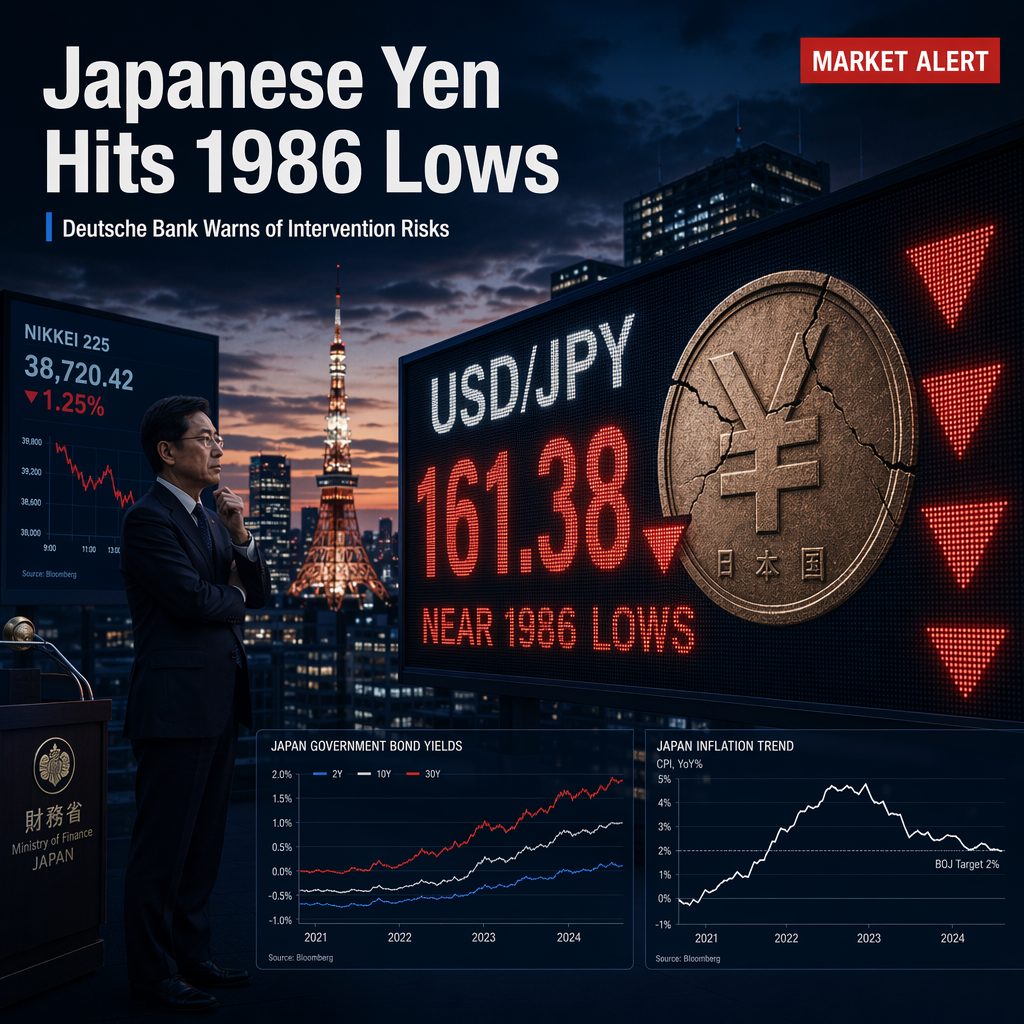
Deutsche Bank’s Jim Reid reports that the Japanese Yen is trading at its weakest levels since 1986, with USD/JPY quoted at 161.38 after reaching 161.80 in late US trading [1]. This significant depreciation has sparked increased market speculation about potential official intervention, particularly given the poor liquidity conditions during the holiday period, which could amplify any moves [1]. Despite the Yen's weakness, the Nikkei index remains broadly unchanged, indicating limited immediate equity market reaction [1].
Japanese government bond yields for maturities between 10 and 30 years have risen by 4 to 8 basis points this morning, following the release of Japanese inflation data [1]. The headline Consumer Price Index (CPI) rose by 1.5% year-on-year in May, slightly higher than the 1.4% recorded in the previous month, but all inflation measures were in line with expectations, providing no surprises for the market [1].
The combination of the Yen's multi-decade lows and in-line inflation data has kept market participants focused on the possibility of intervention, with Deutsche Bank highlighting that the current environment—especially poor holiday liquidity—could provide an opportunity for authorities to act and potentially trigger a larger market move [1].
CONCLUSION
The Japanese Yen's approach to its weakest levels since 1986 has heightened speculation about possible intervention, especially amid thin holiday trading. While inflation data and the Nikkei index remain stable, the risk of official action is elevated, making the currency market highly sensitive to developments. Investors should closely monitor for any signs of intervention that could impact Yen volatility.