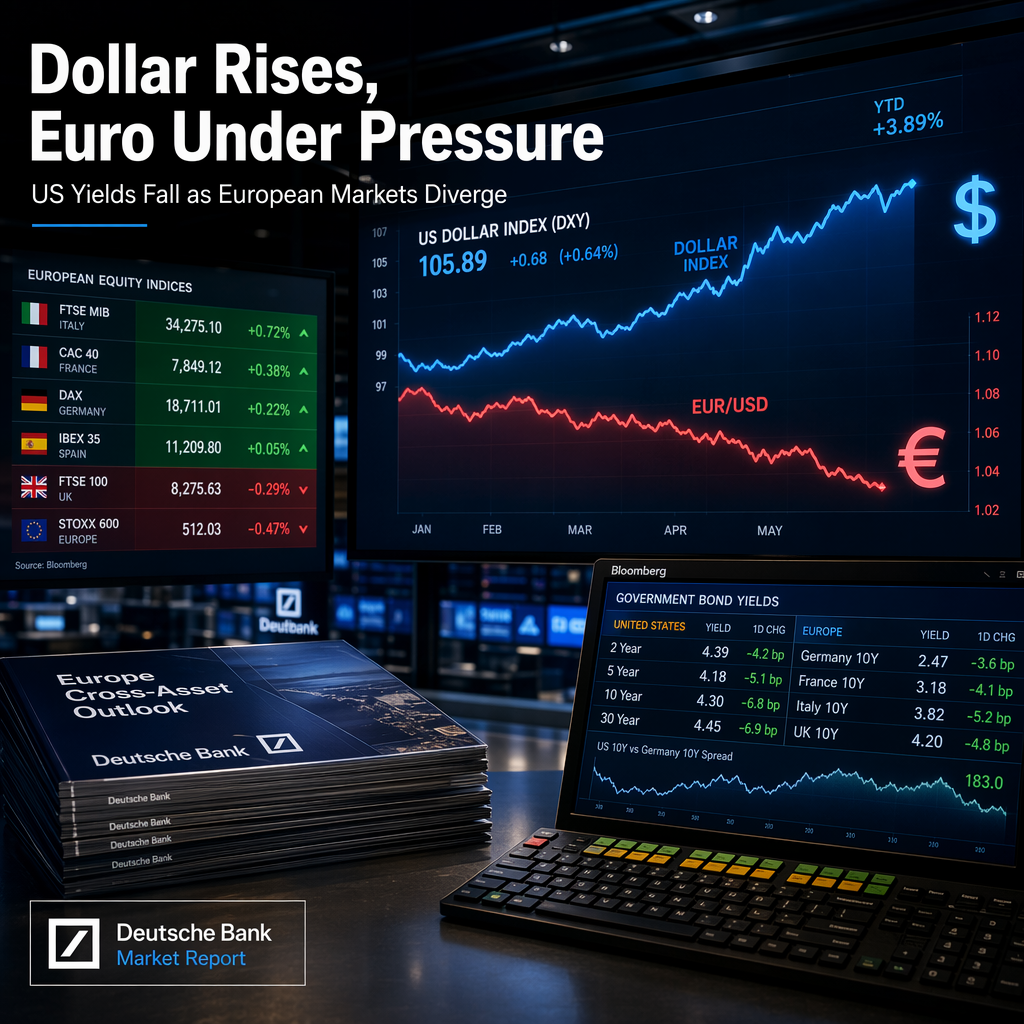
Deutsche Bank reports that the US Dollar Index rose by 0.65% to 100.98, exerting downward pressure on the EUR/USD pair, which slipped to 1.144 [1]. This movement occurred as US Treasuries partially retraced prior losses driven by the Federal Reserve, with the 10-year Treasury yield declining by 3.4 basis points to 4.45% and the 2-year yield falling marginally by 0.6 basis points to 4.18%, continuing the trend of curve flattening [1].
The release of US weekly initial jobless claims showed a slight increase, coming in at 226,000 for the week ending June 13, compared to expectations of 225,000 [1]. In Europe, government bond yields remained broadly steady, with the 10-year bund yield essentially unchanged at 2.93% (+0.1bps), while yields on 10-year OATs and BTPs rose slightly by 1.2bps and 1.1bps, respectively [1].
Equity markets in Europe displayed mixed performance. The STOXX 600 index ended a five-day winning streak, declining by 0.34%, and the UK's FTSE 100 fell by 1.04% [1]. In contrast, Italy’s FTSE MIB rose by 0.18% to reach an all-time high, France’s CAC 40 gained 0.44% to its highest level since the Iran conflict began, and Germany’s DAX advanced by 0.37% [1].
No forward-looking statements or analyst opinions beyond Deutsche Bank's commentary on current market moves were provided in the source article.
CONCLUSION
The strengthening US dollar and falling Treasury yields have weighed on the euro, while European bond yields remained steady and equity markets showed mixed results. The market reaction was moderate, with some indices hitting new highs despite the broader pullback. Investors appear to be digesting steady economic data and shifting yield dynamics.