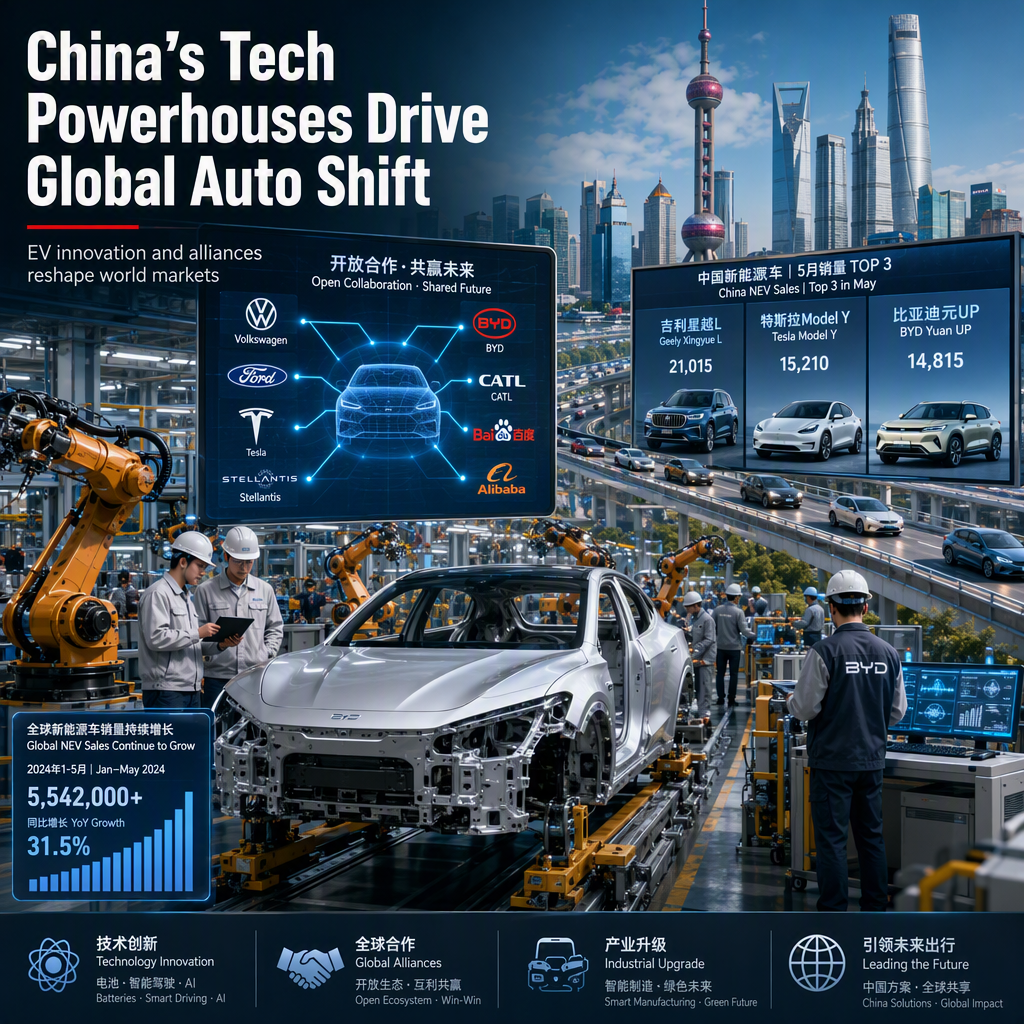
Global companies are increasingly integrating Chinese technology into their operations, particularly in artificial intelligence, electric vehicle (EV) batteries, and automotive software, as China's technological capabilities, scale, and supply-chain depth become harder to ignore [1]. Apple has partnered with Alibaba and Baidu for AI in China, while Ford is collaborating with CATL for battery technology at a $3.5 billion plant in Michigan [1]. Volkswagen has teamed up with Xpeng to develop smart EVs, and Stellantis is expanding its partnership with Leapmotor [1]. Analysts highlight that China has shifted from being primarily a market for global companies to a critical source of technological capability and innovation [1].
Despite ongoing U.S. efforts to restrict Chinese technological advancement, including blacklisting Huawei and imposing curbs on advanced chips and investments, Chinese firms have built dominant positions in several technology sectors [1]. In 2025, Chinese automakers such as BYD, Changan, and Chery accounted for nearly 63% of the global EV market, while battery makers including CATL, BYD, CALB, and Gotion held close to 70% market share, according to Counterpoint Research [1]. Analysts attribute this dominance to cost, scale, manufacturing depth, supply-chain integration, and rapid innovation [1].
Domestically, China's car market is increasingly dominated by electric vehicles, with new energy vehicles (battery and hybrid-powered) accounting for 65.1% of new passenger car sales in July 2026, up from 54% a year earlier, according to the China Passenger Car Association [2]. However, sales for the category dropped by 12.5% year-to-date through July, while overall passenger car sales fell by 20.3% [2]. Geely's Xingyuan electric hatchback was the top-selling model in the six months through July, with nearly 197,500 units sold, while Tesla's Model Y ranked second with over 180,000 units sold [2]. BYD, despite being a major player, saw its passenger car sales drop by more than 10% in the first half of the year, with its most popular model, the Yuan UP SUV, ranking fifth in sales [2].
Volkswagen was the only traditional foreign automaker to make the top 10 best-selling models in China, with its gasoline-powered Lavida in ninth place [2]. The competitive landscape has seen survivors emerge, with Geely and Tesla maintaining strong sales, while BYD slipped in rankings despite its significant market presence [2].
Analysts cited in the articles suggest that global companies will continue to engage with Chinese firms due to their technological strengths, even as they balance geopolitical risks with commercial realities [1].
CONCLUSION
Chinese technology and EV makers are playing an increasingly pivotal role in both global and domestic automotive markets, driven by innovation, scale, and supply-chain integration. Despite regulatory headwinds and shifting sales dynamics, global companies are deepening partnerships with Chinese firms, while domestic competition intensifies among leading EV brands. The market is likely to see continued reliance on Chinese tech, even as sales growth faces new challenges.