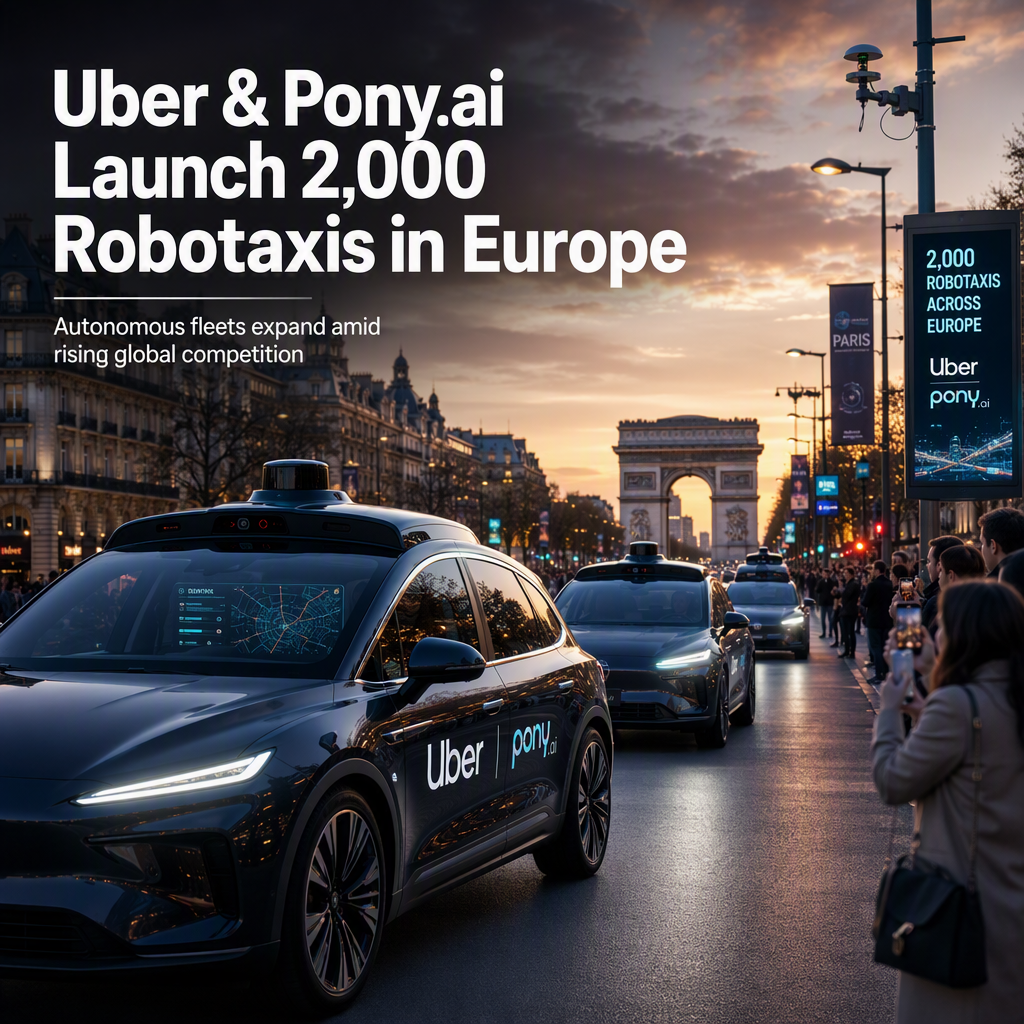
Uber and China's Pony.ai have announced a partnership to deploy 2,000 robotaxis across Europe, with plans to expand their collaboration into the Middle East as well [1]. The companies revealed that the rollout will include four additional European cities, though they did not specify which cities or provide an exact timeline for the deployment [1]. This initiative follows the commercial launch of robotaxi services in Zagreb, Croatia, in late March 2026, which Uber and Pony.ai claim is the first such service in Europe [1].
Uber, aiming to become a leading commercialization platform for autonomous vehicles, is leveraging this partnership to increase its global robotaxi coverage [1]. CEO Dara Khosrowshahi emphasized the importance of building a large vehicle fleet to collect data, demonstrate safety to regulators, and boost operational efficiency, stating that Uber's strategy involves gathering a 'super set of data' to accelerate autonomous vehicle development with its partners [1].
The announcement comes amid intensifying competition in the autonomous vehicle sector. Alphabet-backed Waymo currently leads globally with a fleet of around 5,000 vehicles, primarily in the U.S., and is expanding its presence in Europe and Asia [1]. Chinese competitors Baidu Apollo Go and WeRide are also increasing their autonomous ride operations in Europe, with Uber participating in several of these initiatives, including a planned robotaxi pilot in Madrid and partnerships in Abu Dhabi and Dubai [1].
Additionally, Uber's Japanese subsidiary has signed an agreement with a local taxi operator to manage daily fleet operations for a test deployment of robotaxis in Tokyo later this year [1]. Pony.ai is scheduled to release its quarterly earnings on Tuesday [1].
CONCLUSION
Uber's partnership with Pony.ai to deploy 2,000 robotaxis in Europe marks a significant expansion of its autonomous vehicle ambitions and intensifies competition in the sector. The move underscores Uber's strategy to become a global leader in autonomous vehicle commercialization, leveraging data and partnerships to accelerate development. Market impact is expected to be high as Uber strengthens its position in the rapidly evolving robotaxi market.