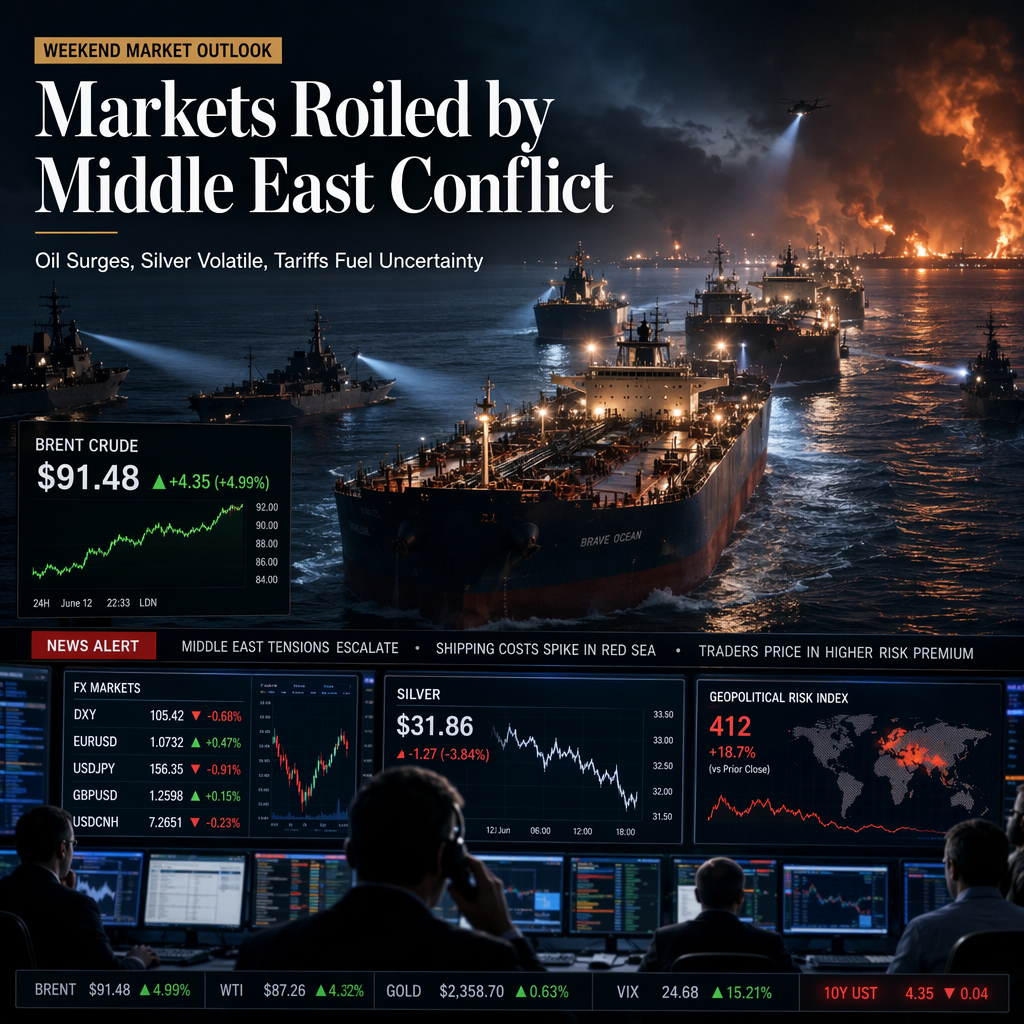
Financial markets are experiencing heightened volatility as escalating conflict in the Middle East and a new wave of US tariffs dominate investor sentiment heading into the weekend. Silver (XAG/USD) edged up above $58.00 in early European trading on Friday, recovering moderately after a sharp 4.3% reversal on Thursday, which left the metal vulnerable to further depreciation. The risk-averse environment, triggered by rising US Treasury yields and a stronger US Dollar, has weighed on yieldless precious metals like silver. XAG/USD traded at $58.33, holding within a horizontal range, with technical indicators suggesting a neutral near-term bias. Bulls would need to breach resistance at $60.70-$60.90 and early July highs around $62.50 to confirm a trend shift, while support is seen at $56.50 and further down at $54.77 and $50.26 [1].
Oil prices have rallied, with Brent crude approaching the key $100 level, following attacks on vessels in the Red Sea by Yemen’s Iran-backed Houthi rebels. This has increased concerns about a blockade of a vital oil supply corridor, boosting inflation fears and sending US Treasury yields to multi-month highs. US President Trump has warned of a "massive attack" on Iran, potentially further entangling the conflict and increasing demand for the safe-haven US Dollar [1][3]. The USD/CAD pair softened below 1.4100, trading near 1.4075, as high crude oil prices supported the commodity-linked Canadian Dollar. Technical analysis shows USD/CAD holding above the 100-day SMA, but slipping under the 20-day Bollinger SMA, with the 14-day RSI at 47.9 indicating directionless momentum [3].
The US announced late Thursday new tariffs on more than 50 trading partners, aiming to combat forced labor in goods production. A US official stated that these tariffs are not simply replicating those struck down by the Supreme Court in February, but are intended to address unfair advantages. Analysts at Commerzbank believe the tariff reshuffle is unlikely to significantly impact FX markets in the near term, as the new tariffs replace expiring general tariffs of 10% and the White House has published a 55-page list of exemptions. However, they caution that policy risks linger and further surprises may occur [2]. Strategists at Scotiabank note a constructive tone from US officials regarding Canada, suggesting that the latest tariff measures may not undermine US/Canada trade relations in the long run and that talks could progress towards a broader agreement before year-end, helping to temper market anxiety [3].
Preliminary readings of the US S&P Global PMI are expected later on Friday, which could influence the US Dollar if outcomes are stronger than expected [3]. Market sentiment remains unfavorable, with investors closely monitoring developments in the Middle East and the impact of US trade policy [1][2][3].
CONCLUSION
The combination of escalating Middle East tensions, surging oil prices, and new US tariffs has created a risk-averse market environment, strengthening the US Dollar and pressuring precious metals and FX pairs. While analysts see limited immediate FX impact from the tariff reshuffle, ongoing geopolitical risks and policy uncertainty continue to drive volatility. Investors remain cautious, awaiting further economic data and developments in both trade and regional conflict.