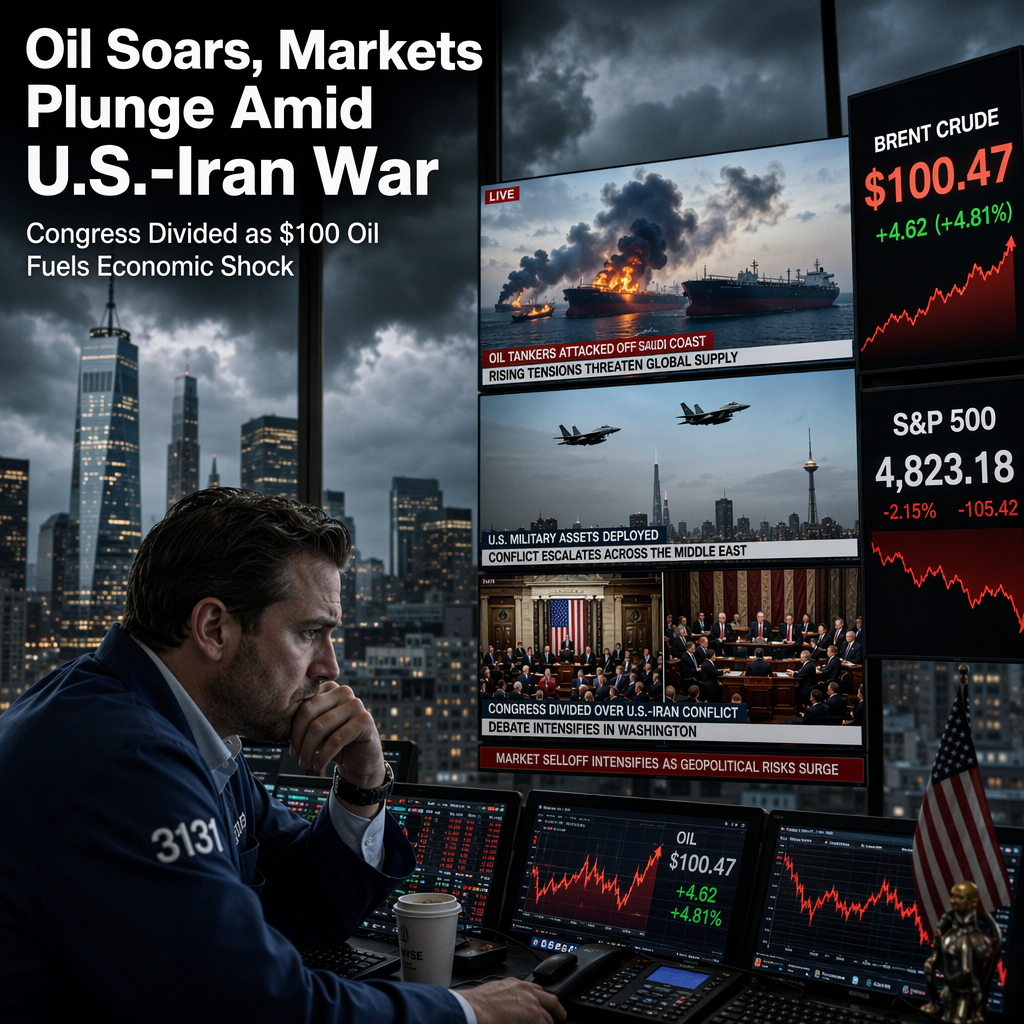
On Thursday, U.S. equities fell sharply as Brent Crude prices surged above $100 per barrel, following the U.S. conducting strikes against Iran for the 12th consecutive night and reports of a tanker attack off the coast of Saudi Arabia [1][2]. The S&P 500 headed for its largest decline in a month, with the index now down about 2% since the U.S. began consecutive strikes on July 12 [1]. Western Texas Intermediate Crude futures jumped 6% to $92 per barrel, marking a more than 28% increase from lows earlier in the month [1]. Gasoline prices in the U.S. also rose, reaching an average of $4.09 per gallon according to AAA [2].
The escalation in the Middle East conflict has led investors to reassess their previously short-sighted outlook, as both oil prices and Treasury yields climbed. The 10-year Treasury yield broke through 4.7%, its highest level since January 2025, and 30-year rates remained solidly above 5% [1]. Steve Sosnick, chief strategist at Interactive Brokers, commented, 'It's too hard to ignore $100 oil. It's too hard to ignore 10-year rates that are above 4.70%. It's too hard for the stock market to ignore 30-year rates that are solidly above 5%' [1].
In Congress, lawmakers split on advancing war powers resolutions to force President Donald Trump to abandon the war with Iran. The Senate voted 47-49 to kill a joint resolution under the War Powers Act, while the House passed a concurrent resolution 214-208 expressing disapproval of the conflict [2]. These were the first votes since Trump informed Congress he had restarted hostilities after a breakdown in peace negotiations [2]. The conflict's revival comes just months before the U.S. midterm elections, raising political stakes for the majority Republicans [2]. Senator Chris Van Hollen, who offered the Senate resolution, stated, 'There is no good way out of a bad war. This is an opportunity for this Congress to finally take responsibility' [2].
Market participants and strategists have been betting on President Trump finding an 'off-ramp' to end the war, with JPMorgan equity strategists previously advising investors to use equity weakness from the Iran conflict as a buying opportunity, anticipating an eventual deal [1]. However, they cautioned that risks of renewed flareups remain [1].
The recent escalation has revived concerns about stagflation, as seen in March when the S&P 500 fell over 7.5% at its low and oil surged nearly 70% [1]. While previous de-escalation announcements and renewed faith in the artificial intelligence trade led to a market rebound in April and May, the current situation has reignited fears of prolonged conflict and its economic consequences [1].
CONCLUSION
The renewed U.S.-Iran conflict has triggered a sharp rise in oil prices and a significant selloff in U.S. equities, with Congress deeply divided on efforts to end the war. Market sentiment has turned negative as investors confront the reality of $100 oil and rising Treasury yields, while political uncertainty adds to the volatility. The outlook remains cautious, with risks of further escalation and economic fallout persisting.