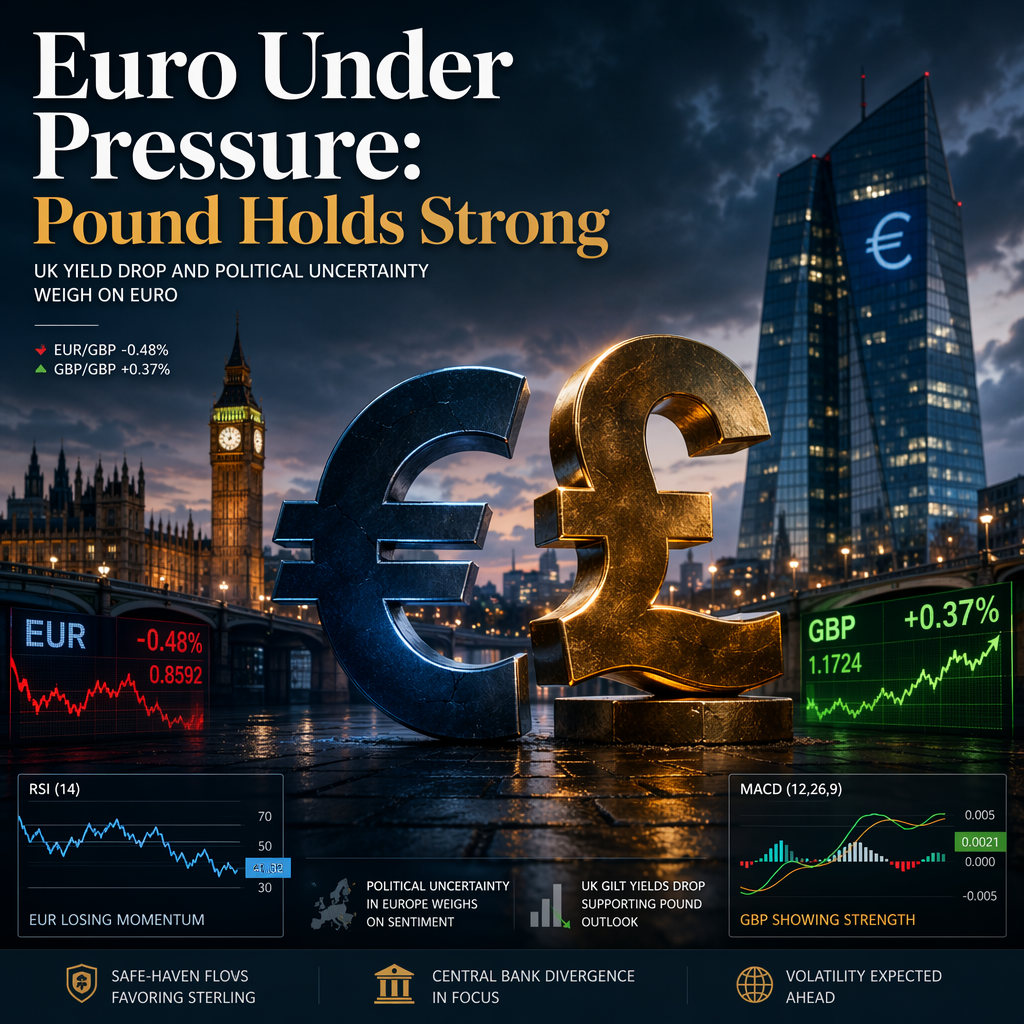
The Euro (EUR) traded flat against the British Pound (GBP) on Wednesday, with the pair holding below 0.8450 and showing a clear bearish trend, although technical indicators such as the four-hour Relative Strength Index (RSI) and the Moving Average Convergence Divergence (MACD) suggest a potential bullish divergence and possible correction in the near term [1]. The EUR/GBP traded at 0.8548, with price action forming an ending wedge and initial support at the one-year lows of 0.8533, while upside attempts remain capped below the descending trendline from mid-June highs around 0.8565 [1].
On the fundamental side, geopolitical tensions have resurfaced after US President Donald Trump ended the US-Iran ceasefire, leading to a rebound in oil prices and a decline in risk appetite, which has weighed on the Euro's recovery prospects [1]. European Central Bank (ECB) board member José Luis Escrivá stated that the ECB should keep all options open but would typically 'look through one-off energy price shocks,' with the Euro showing little reaction to these comments [1].
Meanwhile, the British Pound has been supported by lower 10-year Gilt yields, contained fiscal concerns, and weaker UK inflation, making it the top-performing G10 currency since the Middle East conflict began at the end of February [2]. According to MUFG’s Derek Halpenny, GBP volatility has remained limited despite political developments, such as Nigel Farage's resignation and decision to recontest his Clacton seat, which he described as a protest against ongoing investigations into his finances [2]. Halpenny notes that GBP volatility is more closely tied to the expected economic policies of incoming Prime Minister Andy Burnham, with the retracement in UK yields and improved investor confidence further supporting the Pound [2].
The Euro was the strongest against the Japanese Yen on the day, but overall, the Pound's resilience is attributed to domestic factors rather than yield spreads, which have played a lesser role in driving GBP performance compared to other G10 currencies [1][2].
CONCLUSION
The Euro remains under pressure against the Pound, with technical signals hinting at a possible correction but fundamental headwinds persisting. The British Pound's strength is underpinned by lower yields, contained fiscal risks, and political developments, making it the top G10 performer since late February. Market sentiment remains cautiously positive for GBP, while the Euro faces challenges from geopolitical tensions and subdued recovery prospects.