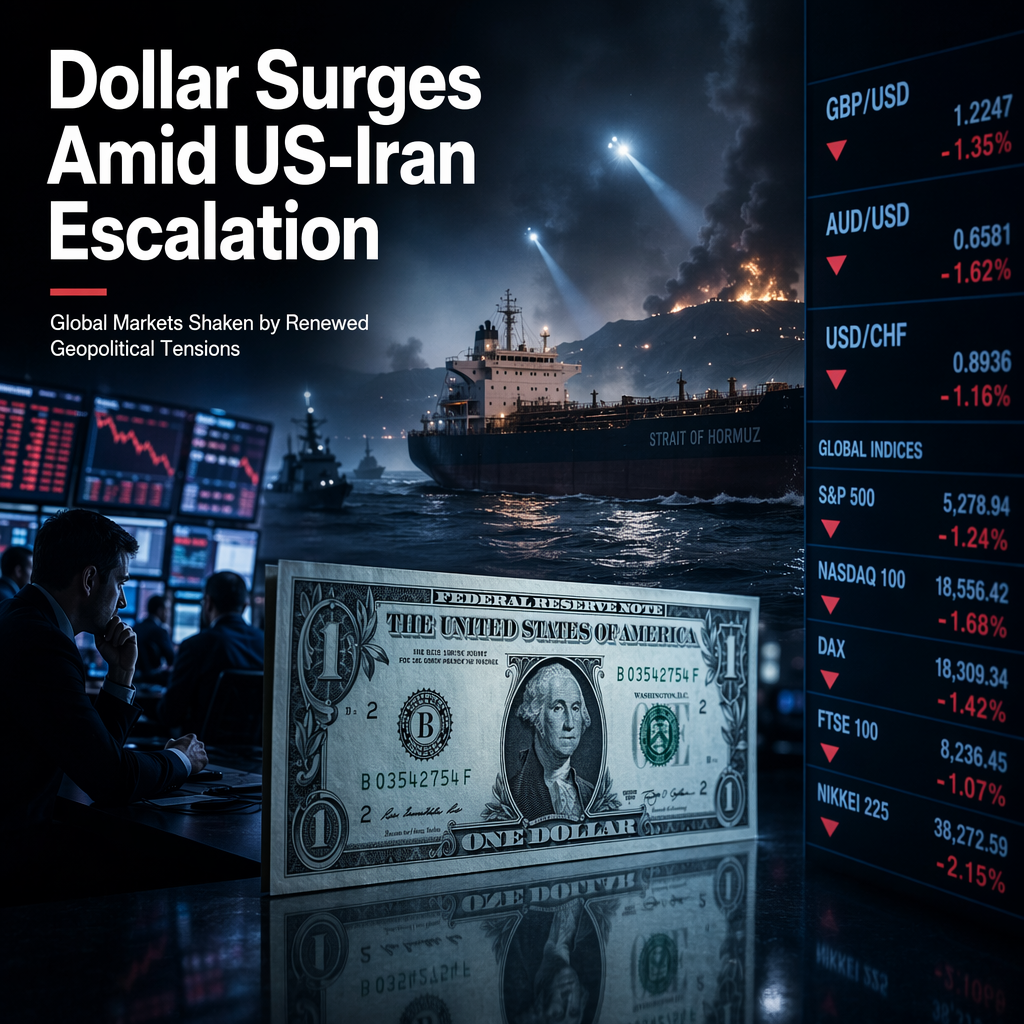
Renewed geopolitical tensions between the United States and Iran have triggered a risk-off sentiment in global markets, leading to notable currency movements and increased demand for safe-haven assets. US President Donald Trump declared at the NATO summit in Turkey that the ceasefire with Iran is over and stated he no longer wishes to negotiate with Tehran, describing them as 'scum' [1][2][3]. This announcement followed reciprocal attacks earlier in the day and the US revocation of Iran’s authorization to export crude [1]. Tehran responded by asserting control over the Strait of Hormuz, a critical passage for nearly 20% of global energy supply, and struck commercial ships passing through the chokepoint, citing unauthorized passage [2][3]. US strikes targeted Iranian military infrastructure in response [3].
The market reaction has been significant, with the US Dollar (USD) strengthening against major currencies. The Swiss Franc (CHF) depreciated nearly 0.7% against the USD this week, with the USD/CHF pair stabilizing at the upper range of the 0.8000s [1]. The British Pound (GBP) fell 0.13% to near 1.3340 against the USD, while the Australian Dollar (AUD) dropped 0.13% to around 0.6920 [2][3]. S&P 500 futures declined almost 1% to near 7,430, reflecting a risk-off mood [2][3]. Oil prices advanced as investors grew concerned about potential global supply disruptions [3].
Additional economic data contributed to currency moves. Switzerland’s unemployment rate unexpectedly rose to a nearly five-year high at 3.1% in June, up from 3% in May, further pressuring the CHF [1]. The AUD initially found support from Reserve Bank of Australia (RBA) Assistant Governor Sarah Hunter, who reiterated the central bank’s commitment to returning inflation to target while maintaining sustainable employment [3].
Investors are now awaiting the release of the Federal Open Market Committee (FOMC) Minutes from the June policy meeting, scheduled for 18:00 GMT. Market participants are keen to gain insight into the Fed’s decision to abandon forward guidance, as Chair Kevin Warsh indicated that forward guidance was not well suited to the current policy environment [1][2][3].
According to the latest currency performance table, the AUD was the strongest against the Japanese Yen but weakened against the USD, EUR, GBP, and CHF [3].
CONCLUSION
Escalating US-Iran tensions have driven investors toward safe-haven assets, strengthening the US Dollar and weakening risk-sensitive currencies such as the GBP, AUD, and CHF. Equity futures and oil prices have also reacted negatively, reflecting heightened market uncertainty. The upcoming FOMC minutes are expected to provide further direction for markets amid ongoing geopolitical risks.