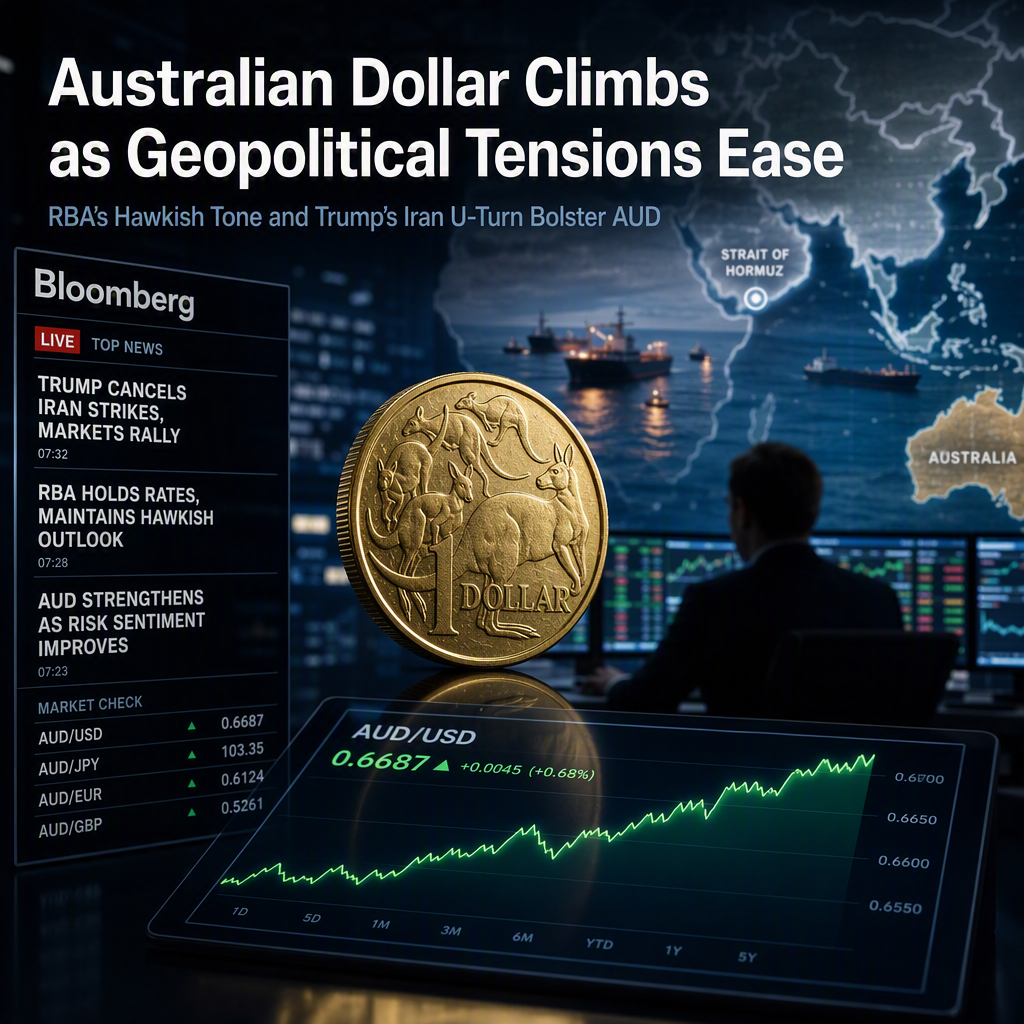
The Australian Dollar (AUD) gained ground against the US Dollar (USD), with the AUD/USD pair rising to near 0.7040 during the early Asian session on Monday. This move was attributed to improved risk sentiment following reports that US President Donald Trump cancelled planned military strikes against Iran. According to Bloomberg, Trump called off the strikes in anticipation of a potential deal on Iran's nuclear program and the reopening of the Strait of Hormuz, citing requests from Iran and other regional countries as influencing his decision. However, uncertainty persists as Iranian officials denied requesting a pause, labeling Trump's claim as 'nothing but a new lie' and stating that their armed forces remain 'on high alert and ready for any eventuality,' according to Iran’s Mehr News Agency. Ongoing tensions in the Middle East could still drive safe-haven flows into the US Dollar, potentially limiting further gains for the AUD/USD pair [1].
Market participants are also awaiting the release of China’s Manufacturing Purchasing Managers Index (PMI) report, which is due later in the day. Developments in US-Iran relations and Chinese economic data are expected to influence risk sentiment and the direction of the Australian Dollar [1].
On the domestic front, the Reserve Bank of Australia (RBA) continues to maintain a hawkish tone. Markets have fully priced in one more rate hike this year, which would bring the Official Cash Rate (OCR) to 4.6%. RBA Governor Michele Bullock recently warned that underlying inflation remains too high and signaled that a further slowdown in domestic demand may be necessary to control prices. Bullock stated, 'The Board is prepared to act as required to achieve its mandate, including by increasing the cash rate further if needed.' RBA Assistant Governor Sarah Hunter echoed this sentiment, emphasizing the need to keep pressure on price growth to prevent higher inflation expectations from becoming entrenched. Hunter also noted that the labor market remains 'somewhat tight,' with job growth holding up 'not too badly' in the first half of the year, highlighting the resilience of employment despite softer headline price data [1].
CONCLUSION
The Australian Dollar's recent strength is supported by improved risk sentiment following Trump's cancellation of Iran strikes and the RBA's continued hawkish stance. However, ongoing geopolitical tensions and upcoming Chinese economic data could influence the currency's direction. Market participants remain cautious amid persistent uncertainty in the Middle East and inflationary pressures in Australia.