
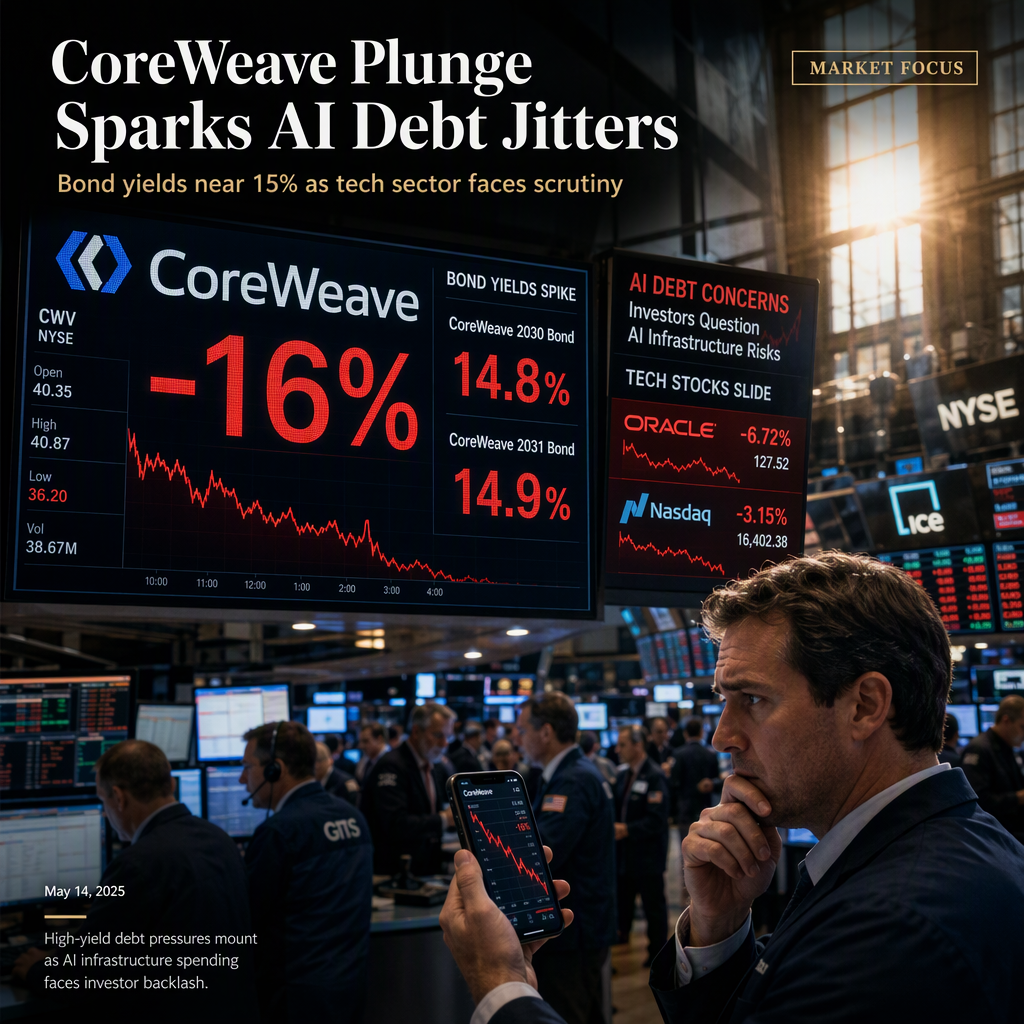
CoreWeave's shares and bonds experienced significant declines on Wednesday as investor concerns mounted over the heavy borrowing by technology companies to fund artificial intelligence infrastructure. CoreWeave's stock dropped 16%, while the yield to maturity on its 9.625% bond due in 2032 reached 14.8%, and its 9.75% bond due in 2031 was at 14.9%—both reflecting a sharp rise in borrowing costs as bond prices fell [1]. Tech investor Chamath Palihapitiya highlighted the surge in CoreWeave's bond yields on social media, noting the 2032 bond yield 'touched 15%' and closed at a new high, sparking a reaction from Elon Musk, who responded 'yikes' [1].
Luis Alvarado, co-head of global fixed income strategy at Wells Fargo Investment Institute, commented that investor sentiment has shifted from enthusiasm for AI investments to demanding higher risk compensation, as the 'era of easy money' fades. He emphasized that investors are now scrutinizing the concessions issuers offer more closely [1]. Paul Meeks, head of technology research at Freedom Capital Markets, stated that CoreWeave's balance sheet is 'relatively bad' compared to its neocloud peers due to its higher borrowing and ongoing data center construction. However, Meeks does not believe the situation is deteriorating, expecting flat margins from June to September and a significant improvement between September and December, with the next quarterly results anticipated in November [1].
The concerns over AI-related debt extended beyond CoreWeave, impacting other tech companies such as Oracle, whose shares fell nearly 7% and whose 6.25% bond due in November 2032 saw its yield rise to 7.24% [1]. The broader tech sector was affected, with the Nasdaq Composite declining 1.4% on Wednesday. The debt fears appear to be hitting smaller, less established tech stocks harder than the so-called 'Magnificent Seven' [1].
CONCLUSION
CoreWeave's sharp stock and bond declines underscore growing investor anxiety about the sustainability of AI-driven borrowing in the tech sector. The market reaction has spilled over to other companies like Oracle and weighed on the broader tech market, signaling heightened scrutiny of debt levels and risk premiums. Forward-looking statements suggest CoreWeave's margins may improve later in the year, but for now, investor caution prevails.