
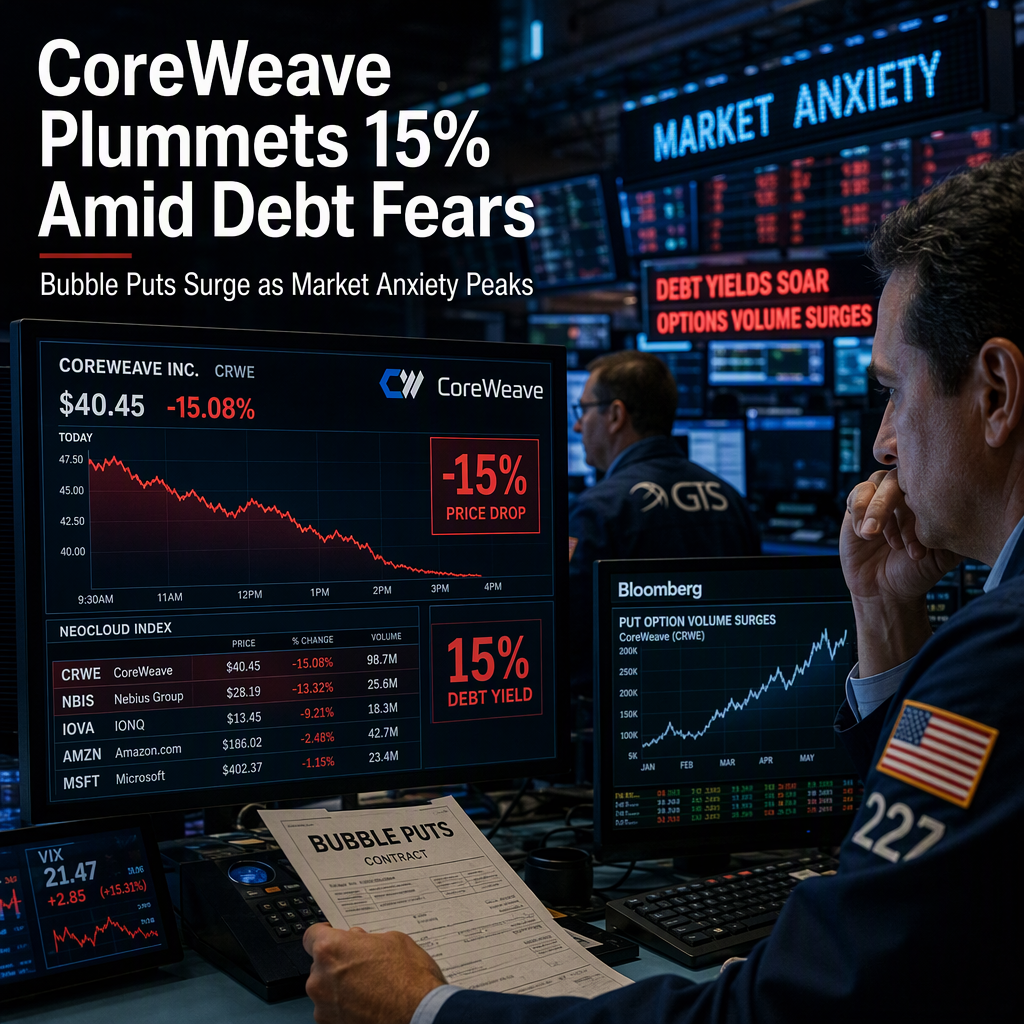
Shares of neocloud companies, including Nvidia-backed CoreWeave, experienced significant declines on Wednesday, with CoreWeave stock plunging 15% as debt yields for the company continued to reach new highs [1]. According to The Financial Times, CoreWeave is seeking additional debt financing from insurance companies, a move that did not alleviate market concerns [1]. Social Capital founder Chamath Palihapitiya highlighted the situation on X, sharing that CoreWeave's bonds hit a 15% yield, to which Elon Musk responded 'yikes' [1].
Other neocloud-related stocks, such as Nebius Group and Iren, also saw sharp declines, falling as much as 10% [1]. Options trading activity surged across these names: CoreWeave's options volume was more than seven times its 30-day average, Nebius nearly four times, and Iren twice the normal volume [1]. In CoreWeave, traders bought nearly 200,000 puts compared to 106,000 calls, indicating a strong bearish sentiment [1].
A notable options trade occurred at 10 a.m. ET, where a new position of 26,000 37.5-strike puts expiring December 18 was opened, trading near the ask price and suggesting the puts were purchased. These contracts sold for 74 cents each, totaling $1.9 million, and would require CoreWeave to drop another 42% in the next two months to be profitable [1]. Prior to this, there were just over 1,000 open contracts, indicating this is a new and significant position [1].
Scott Bauer, CEO of Prosper Trading Academy, described these as 'bubble puts,' suggesting they are being used as a hedge for exposure in highly correlated stocks or possibly the Nasdaq, rather than outright bets on a total collapse [1]. CoreWeave went public in March 2025 at $40 per share, and Bauer speculated that the new put position could be a hedge for early investors or IPO participants seeking protection [1].
CONCLUSION
The sharp decline in CoreWeave and other neocloud stocks, coupled with a surge in bearish options activity, underscores growing market anxiety over the sector's debt exposure and sustainability. The significant purchase of 'bubble puts' suggests investors are seeking protection against further downside, reflecting heightened caution in the AI infrastructure trade.