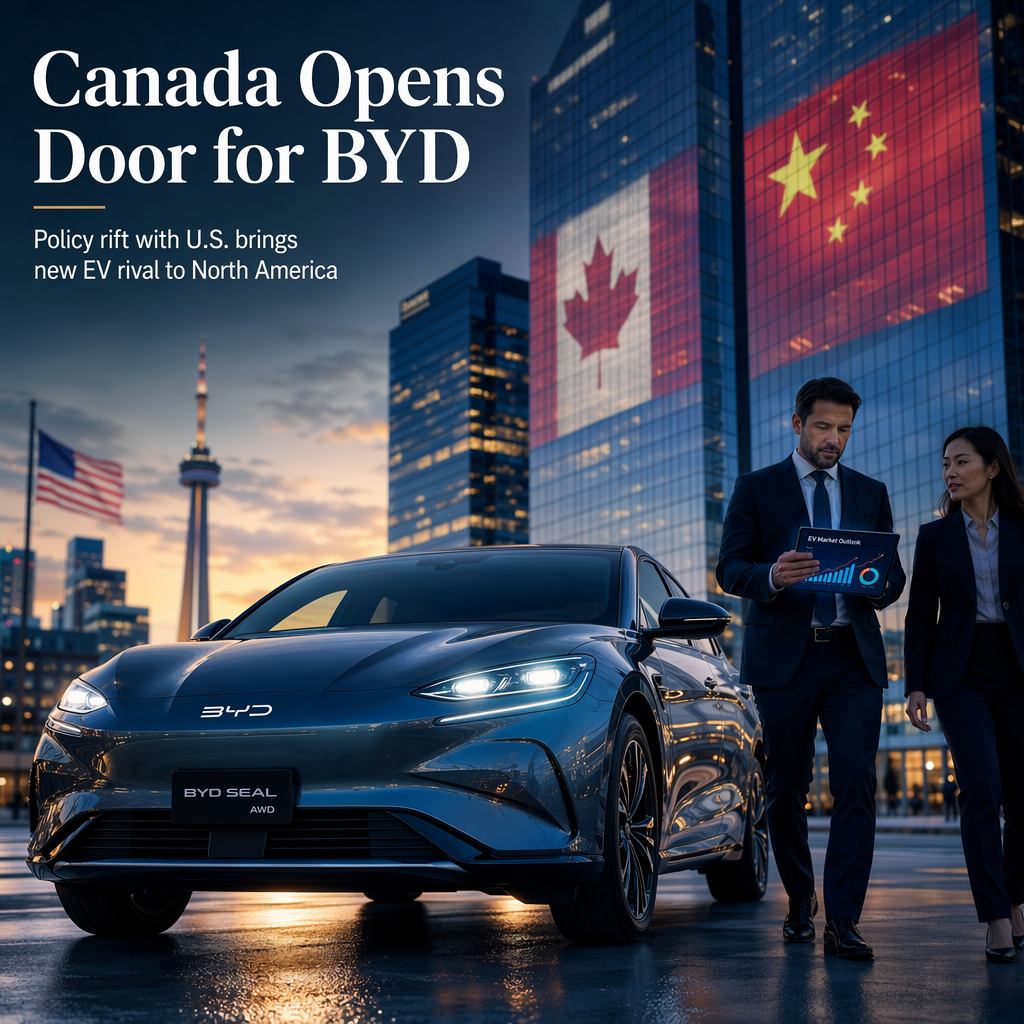
Canadian Prime Minister Mark Carney has announced that Canada will no longer fully align with the United States on tariffs imposed on Chinese-made vehicles, marking a significant policy divergence between the two North American allies as they confront China's expanding electric vehicle (EV) industry [1]. This shift comes at a time when BYD, China's leading EV manufacturer, is seeking to establish a foothold in North America, leveraging the emerging discord between Washington and Ottawa over trade policy [1].
Carney's stance is described as a response to domestic pressures and evolving international relations, signaling Canada's willingness to engage with Asian partners and attract investment from global EV leaders such as BYD. This approach has drawn criticism from U.S. policymakers, who advocate for a united front against what they consider unfair competition from China [1].
Market analysts caution that the absence of unified tariffs could intensify competition for North American automakers, who are already facing challenges related to shifting consumer demand and the ongoing transition to electric vehicles. The policy split may also influence investment decisions, disrupt supply chains, and complicate broader strategies aimed at countering China's industrial rise [1].
The coming months are expected to be pivotal as both the U.S. and Canada navigate the consequences of their differing approaches. For BYD, the current environment presents a rare opportunity to expand in a region where market access has previously been constrained by protectionist measures. Meanwhile, the U.S. and Canada must balance their economic interests with the need for a coordinated response to China's growing influence in the EV sector [1].
CONCLUSION
Canada's decision to diverge from U.S. tariff policy on Chinese EVs creates new opportunities for BYD to enter the North American market. This policy split introduces uncertainty for regional automakers and may reshape investment and competitive dynamics in the EV sector.