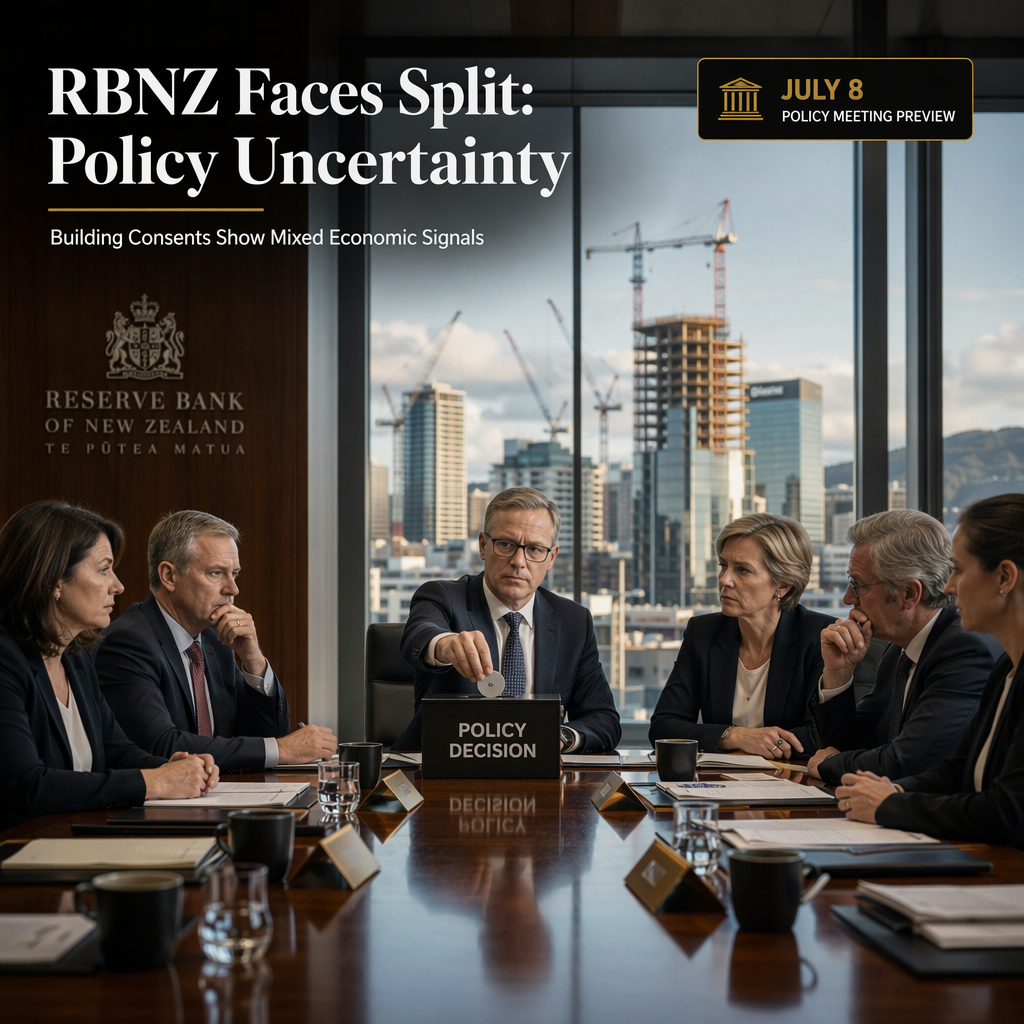
The Reserve Bank of New Zealand (RBNZ) has decided to keep its Monetary Policy Committee (MPC) at six members ahead of the November election, following a split 3-3 vote in May where external members supported a rate hike. The governor, acting as chair, cast the deciding vote to hold rates steady. The RBNZ clarified that MPC appointments are made by the Minister of Finance and that no additional internal appointment will be made before the election period. This decision comes after Angus McGregor was appointed assistant governor for financial stability, a role previously included in the MPC’s remit. The next MPC meeting is scheduled for July 8 [1].
In terms of economic data, New Zealand’s building consents for May presented a mixed outlook. The seasonally adjusted number of new dwellings granted consent declined by 4.0% month-on-month in May, following an 11% increase in April. However, on a year-on-year basis, the actual number of new dwellings granted consent rose by 19% to 39,737 in the year ended May 2026. The monthly total for May was 3,801 new consented dwellings, with stand-alone houses and townhouses/flats/units leading the figures. Regionally, Canterbury and Auckland saw the strongest consent issuance over the year [1].
The data indicate that while there was a softer monthly outcome, residential approvals remained elevated compared to the previous year. Non-residential values were reported to be weaker, framing the backdrop for the upcoming July 8 policy meeting [1].
CONCLUSION
The RBNZ’s decision to maintain its current MPC composition and the mixed signals from building consent data suggest a cautious approach ahead of the July 8 policy meeting. While residential construction activity remains robust year-on-year, the recent split vote highlights ongoing uncertainty in monetary policy direction.