
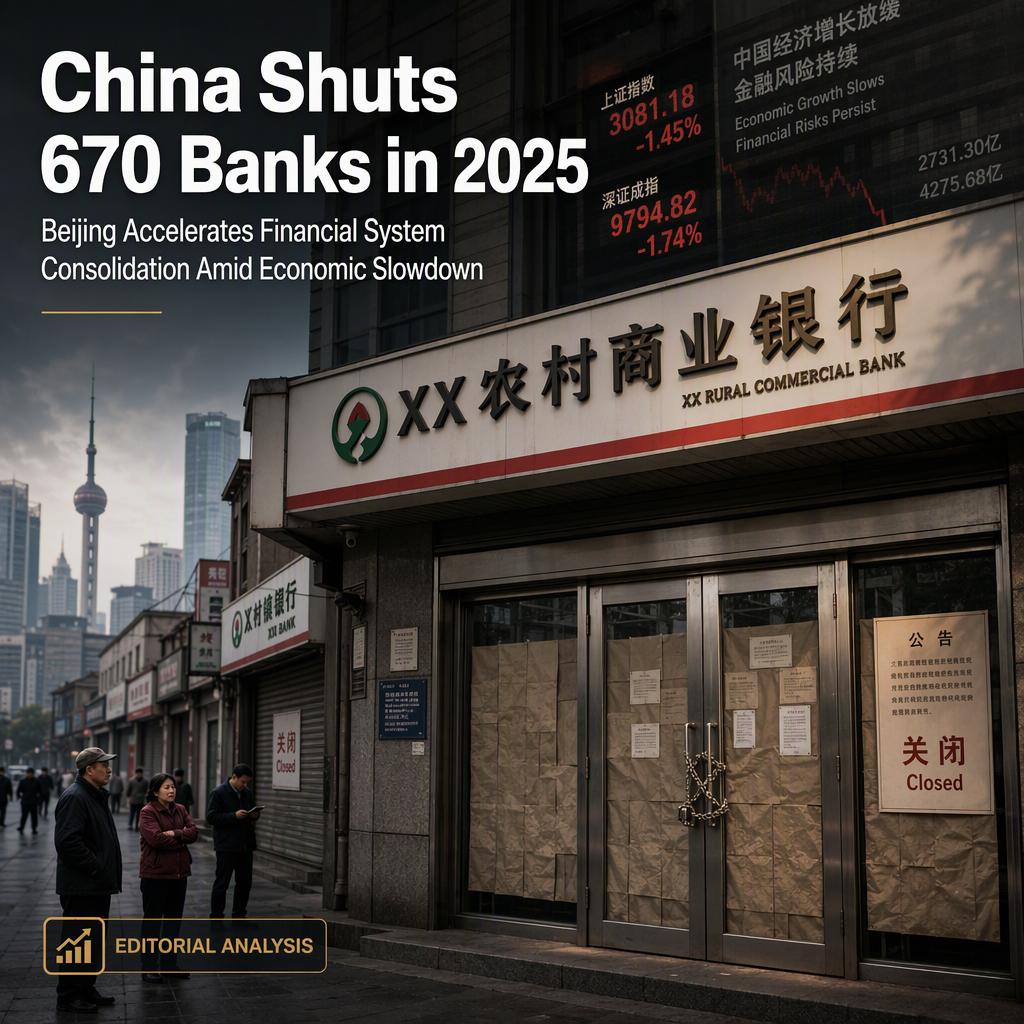
China has shut about a quarter of its banks, totaling a record 670 lenders closed in 2025, as Beijing accelerates efforts to consolidate its financial system in response to an ongoing economic slowdown [1]. The consolidation is primarily focused on smaller, mostly rural banks, which Fitch Ratings identifies as the weakest segment of China's financial system due to deteriorating asset quality, thin capital buffers, and governance shortcomings [1]. Fitch's analysis highlights that the return on assets among rural banks fell to 0.45% in the first half of the year, down from 0.56% in 2021, while non-performing loans among these lenders rose to 2.8%, significantly higher than the sector average of 1.5% [1]. These banks have greater exposure to smaller companies, property developers, and local government funding vehicles, contributing to their vulnerability [1].
The consolidation push aims to create fewer, larger, and better-capitalized institutions, with the goal of boosting oversight, curbing regulatory arbitrage, and improving transparency in the sector [1]. Fitch notes that stress at smaller lenders is unlikely to lead to system-wide contagion due to their largely localized operations and limited interbank exposure [1]. However, the rating agency cautions that structural weaknesses among smaller lenders may persist in the near term, even as competitive dynamics are reshaped [1].
This move comes against a backdrop of continued economic strain in China. The country's GDP grew 4.3% in the second quarter, marking its slowest pace since 2022, while industrial profits increased by 4.2% annually in August, their weakest pace this year [1].
CONCLUSION
China's closure of 670 banks in 2025 represents a significant step in consolidating its financial system, targeting vulnerabilities among smaller, rural lenders. While the measures are intended to strengthen oversight and stability, persistent structural weaknesses and ongoing economic challenges suggest continued caution for market participants.