
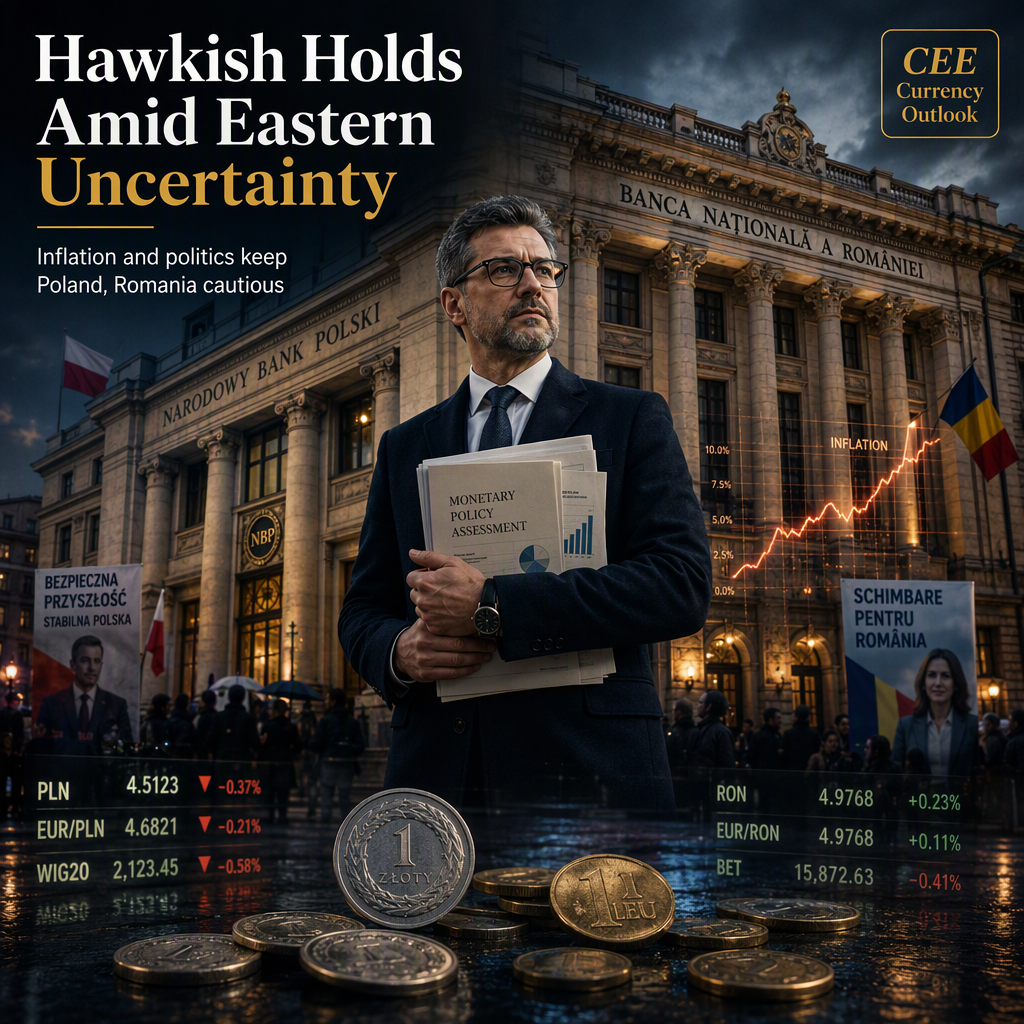
Societe Generale strategists anticipate that the National Bank of Poland (NBP) will maintain its policy rate at 3.75% in a hawkish hold, citing persistent inflation and political uncertainty as factors constraining policy flexibility. The strategists note that the case for tighter policy in Poland has strengthened following an acceleration in inflation to 4.0% in September, primarily driven by higher fuel prices. Policymakers have emphasized the need to prevent inflation from becoming entrenched, but are expected to wait for the November staff projections before considering a 25 basis point rate hike, with another 25 basis point increase possible in January. Despite the hawkish stance, Societe Generale suggests that this may provide only limited support for the Polish zloty (PLN), as money markets have already priced in significant tightening [1].
In Romania, Societe Generale expects the central bank (NBR) to keep its policy rate unchanged at 6.50%. Although inflation is gradually easing, ongoing political uncertainty, foreign exchange volatility, and elevated price pressures are seen as limiting the scope for rate cuts. The strategists highlight that with government formation still unresolved, policymakers are likely to remain cautious and signal patience. Societe Generale projects that the next rate cut in Romania may not occur until the first quarter of 2027, contingent on continued declines in inflation and the establishment of a stable government [1].
Overall, the outlook for Central and Eastern European (CEE) currencies remains under pressure due to these macroeconomic and political factors. The hawkish holds by both central banks are expected to have only a moderate impact on supporting their respective currencies in the near term, given that market participants have already anticipated these moves [1].
CONCLUSION
Societe Generale forecasts that both the Polish and Romanian central banks will maintain their current policy rates in response to persistent inflation and political uncertainty. While a hawkish stance may offer some support, market expectations of further tightening are already reflected in current pricing, limiting the immediate impact on regional currencies.