
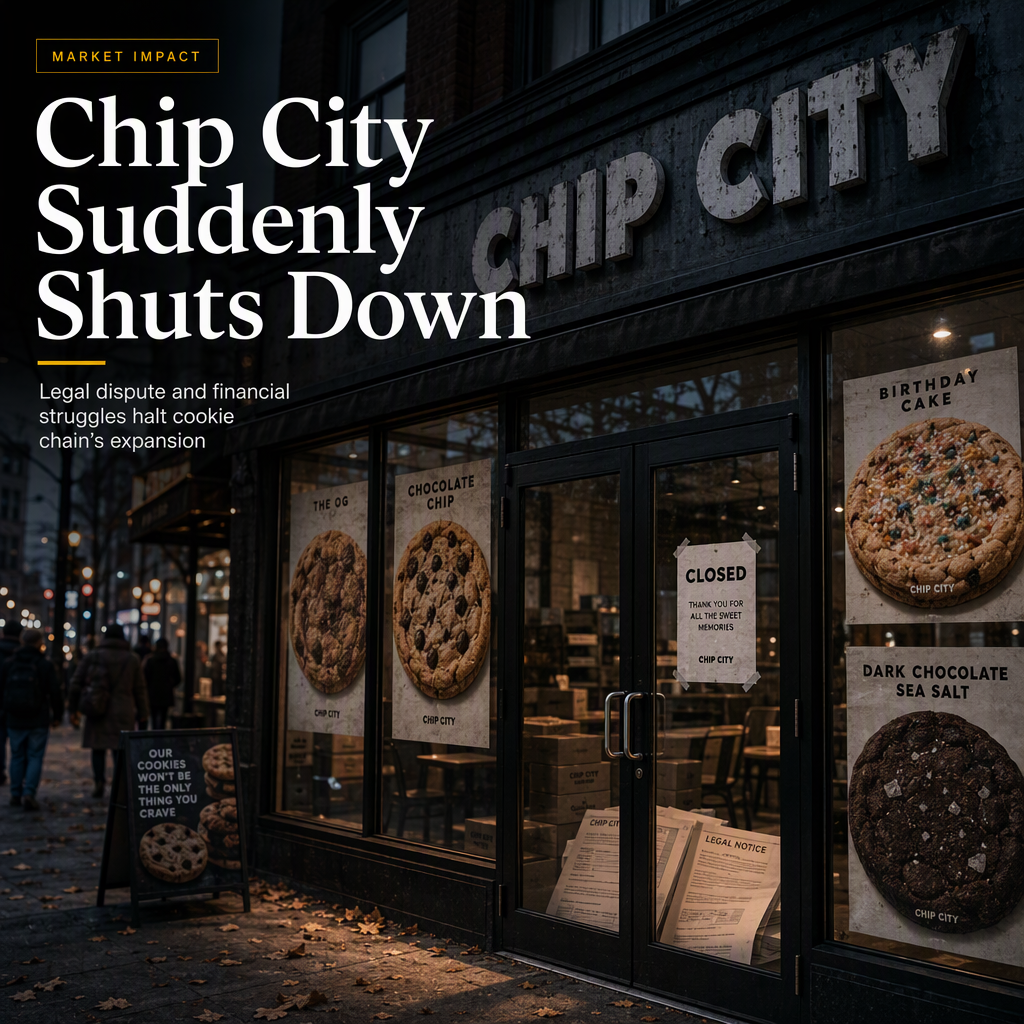
Chip City, a New York-based cookie chain known for its oversized cookies and a rotating menu of more than 180 flavors, has abruptly closed all of its locations across the United States after years of rapid expansion [1]. The company, founded in 2017 by Peter Phillips and Teddy Gailas, had grown from a single store in Astoria, Queens, to a multistate operation, expanding into New Jersey, Connecticut, Maryland, and Virginia [1]. This growth was fueled in part by a $10 million investment from Enlightened Hospitality Investments (EHI), a fund affiliated with Danny Meyer's Union Square Hospitality Group, announced in 2022 when Chip City operated 14 locations and was preparing for further expansion [1].
Despite its rapid growth and recent public focus on expansion, including the promotion of Nicolas Baizan to president to lead the company's "next phase of growth" across 39 locations, Chip City cited "significant macroeconomic headwinds" as the reason for its closure [1]. The company expressed gratitude to its employees and customers in a statement released Friday, acknowledging the difficulty of the decision [1].
The closure coincides with an ongoing legal dispute involving co-founder and former CEO Peter Phillips, who filed a lawsuit on September 28 alleging that Chip City failed to pay compensation and benefits owed to him after he stepped down as CEO in March [1]. The lawsuit also names EHI and company executives Nicolas Baizan and Fred LeFranc as defendants, with Phillips seeking compensation and benefits he claims remain unpaid. These allegations have not been proven in court [1].
Notably, Chip City's social media accounts continued to advertise its cookies, including a seasonal Crisp Apple Fritter Cookie, shortly before the closure announcement, indicating the abruptness of the shutdown [1]. Representatives for Chip City did not immediately respond to requests for comment [1].
CONCLUSION
Chip City's sudden nationwide closure marks a significant reversal for the once rapidly expanding cookie chain, highlighting the impact of macroeconomic challenges and internal legal disputes. The shutdown is likely to have a high market impact, especially given the company's recent growth trajectory and substantial outside investment. The future of the brand and its assets remains uncertain as legal proceedings continue.