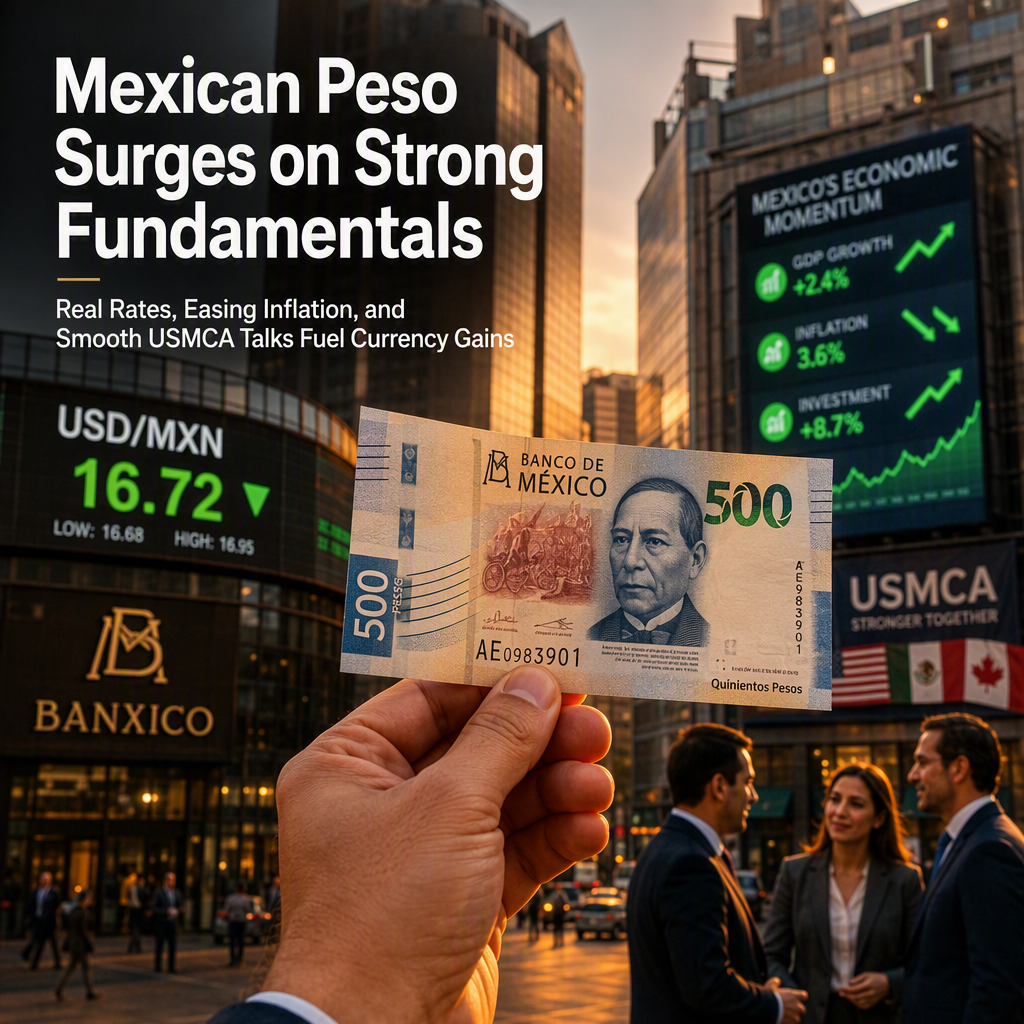
According to Michael Pfister at Commerzbank, the Mexican Peso has experienced notable appreciation, with the USD/MXN exchange rate falling below 17. This strengthening is attributed to a combination of factors, including a weaker US Dollar and Mexico's robust performance among major currencies [1]. Pfister notes that Mexico's real economy is performing significantly better, despite ongoing conflict in Iran, which has not derailed its growth trajectory [1].
Another key driver is the ongoing USMCA negotiations between Mexico and the United States, which have proceeded smoothly and without major issues, in contrast to the US's negotiations with Canada [1]. Additionally, month-on-month core inflation in Mexico has been gradually moving toward the middle of the target band, signaling an easing inflationary environment [1].
Banxico, Mexico's central bank, has paused its rate cuts, resulting in supportive real interest rates for the Peso. This monetary stance is seen as a positive factor for the currency, as higher real rates tend to attract capital flows and bolster currency strength [1].
Overall, the combination of favorable economic data, stable inflation trends, and constructive USMCA talks has contributed to the Peso's recent gains, positioning it as one of the stronger performers among major currencies [1].
CONCLUSION
The Mexican Peso's recent appreciation is underpinned by strong economic fundamentals, easing inflation, and supportive real interest rates. Smooth USMCA negotiations with the US further reinforce market confidence. These factors suggest continued resilience for the Peso in the near term.