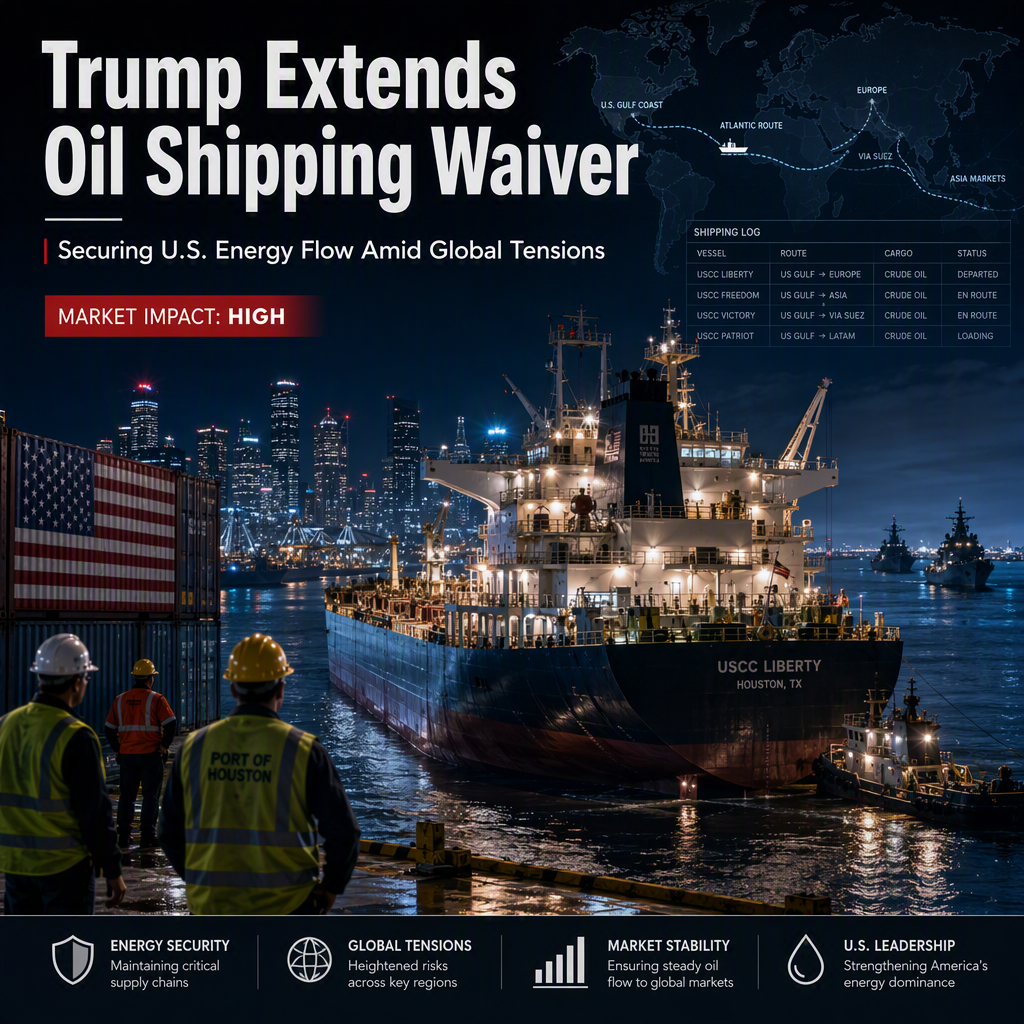
The Trump administration has extended its waiver of the Jones Act for another 90 days, narrowing its scope to only vessels hauling certain energy resources, in response to ongoing disruptions in global oil markets caused by the Iran war [1]. This marks President Donald Trump's second extension of the waiver, which was first issued for 60 days on March 17, shortly after the U.S. and Israel began military strikes on Iran [1]. The waiver was previously extended in mid-May for 90 days and will now last until mid-November, surpassing the date of the upcoming midterm elections [1].
The latest extension introduces new limitations, requiring the Pentagon to consult with the U.S. Maritime Administration to determine if the waiver applies to each individual shipping voyage [1]. These restrictions were implemented to address concerns from the U.S. maritime industry, according to a White House official [1]. Kristin Whitman, senior vice president of government relations at the American Petroleum Institute, praised the administration's decision, stating it is a 'critical action that will keep American energy moving, strengthen supply security and help protect consumers from unnecessary price volatility' [1].
The Jones Act, a 1920 law, mandates that goods transported between U.S. ports must be carried on U.S. vessels, originally intended to bolster the domestic shipping industry after World War I [1]. However, some economists, such as those at the CATO Institute, argue that the law is an outdated form of protectionism [1]. Since the initial waiver, 210 voyages have been completed that would have otherwise been unlawful, with the majority transporting gasoline and crude oil [1]. According to CATO, nearly 55 million barrels of cargo have been shipped using the waivers [1].
White House spokeswoman Taylor Rogers emphasized that the administration's actions are aimed at ensuring the military and key industries maintain uninterrupted access to critical resources [1]. She also noted that data shows the waiver has driven a significant increase in the movement of essential fuels [1].
CONCLUSION
The Trump administration's decision to extend and narrow the Jones Act waiver reflects ongoing efforts to stabilize U.S. energy supplies amid the Iran war's impact on global oil markets. The move has been met with support from the energy sector and is expected to help mitigate price volatility and supply disruptions. The market impact is high, as the waiver facilitates the continued flow of critical fuels during a period of heightened uncertainty.