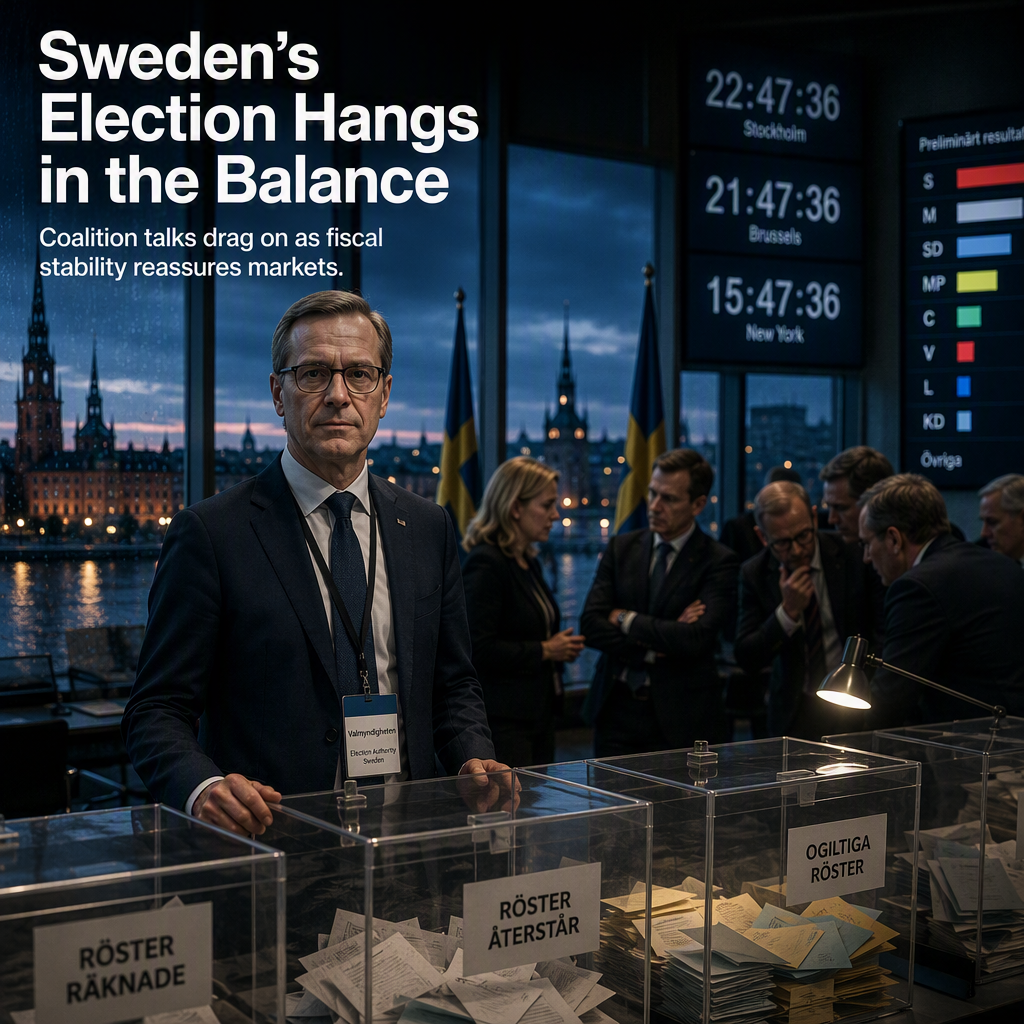
Sweden's general election, held on 13 September, remains too close to call, with the opposition centre-left and governing right-wing blocs nearly tied in the preliminary vote count, according to Nomura’s Global Markets Research team led by Josie Anderson, George Buckley, and Andrzej Szczepaniak [1]. A clearer outcome is expected once late-arriving advance-voting ballots are tallied on Wednesday, 16 September, though this process could extend into Thursday, 17 September. The legally final, certified result will not be available until roughly a week after election day [1].
Coalition negotiations are anticipated to take several weeks. For context, after the previous election on 11 September 2022, it took just over a month for the four parties involved to reach the Tidö Agreement and form a government on 14 October 2022, while the 2018 election saw a government formed only after 134 days [1].
Despite the political uncertainty, Nomura notes that Sweden’s low government debt—about 35% of GDP—and binding fiscal framework mean markets are unlikely to be concerned about debt dynamics, regardless of which bloc forms the next government [1]. The Riksbank’s monetary policy is also expected to remain unaffected by the election outcome, as it is more influenced by global energy price dynamics [1].
Looking ahead, Sweden’s fiscal policy is constrained by a target to achieve a government budget balance over a business cycle from 2027 onwards. The 2026 budget is expansionary, featuring temporary tax cuts set to expire in 2026-2027 [1]. If the centre-left forms a government, increased spending on healthcare and education is likely, along with higher taxes. The Social Democrats have proposed a tax on banks' net interest income and higher income taxes for individuals earning more than approximately 70,000 SEK per month, as stated by party leader Magdalena Andersson [1].
CONCLUSION
Sweden's election remains unresolved, with coalition talks potentially extending for weeks. However, the country's strong fiscal position and binding fiscal rules suggest limited market impact, regardless of the eventual government. Policy changes, particularly on taxation and spending, may depend on which bloc prevails.