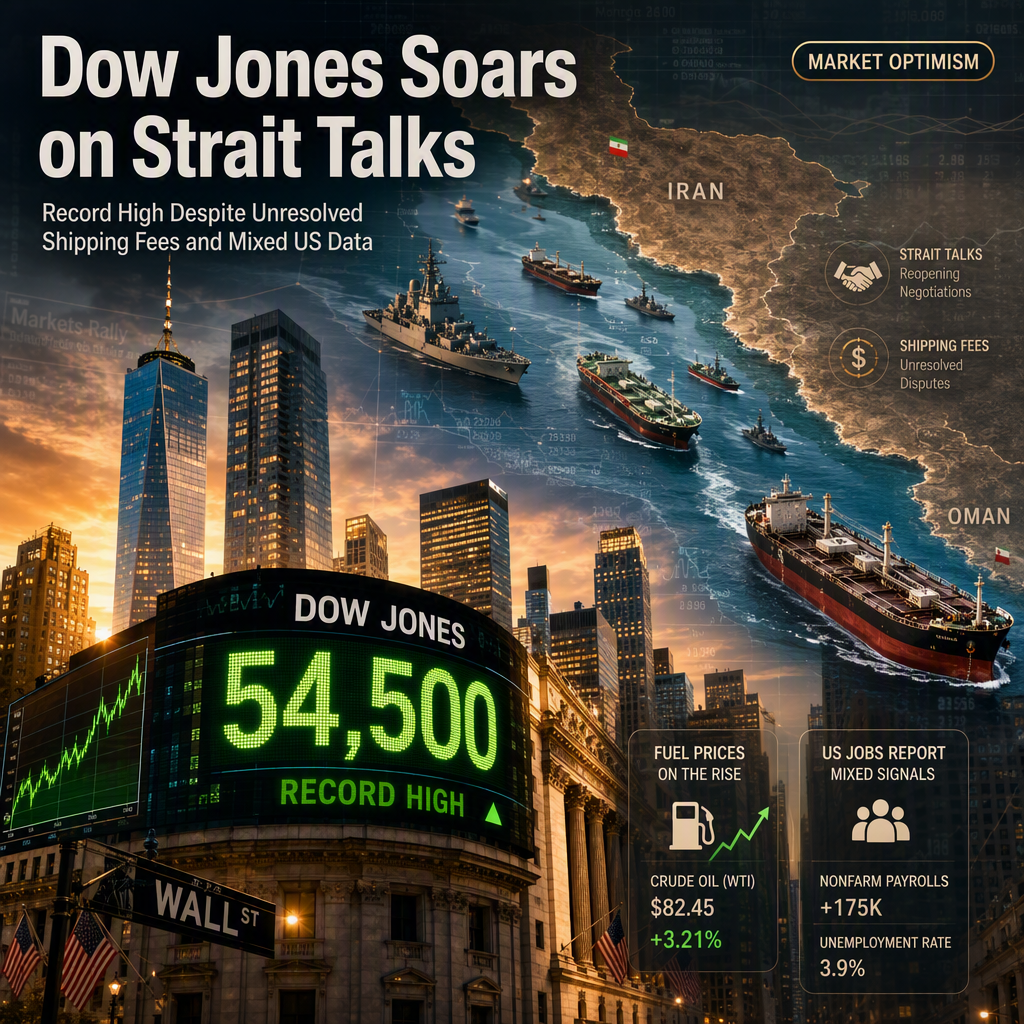
The Dow Jones Industrial Average surged to a fresh record near 54,500 on Wednesday, marking a 0.76% increase and standing approximately 1,400 points above its early July high [1]. This rally was driven by developments surrounding the potential reopening of the Strait of Hormuz, a critical shipping chokepoint, after Washington called off a new round of strikes and signaled a move toward talks [1]. The draft terms for reopening involve routing inbound traffic through Iranian waters and imposing a transit fee, which has never been charged before. Tehran is seeking a fee of 5% to 7% of cargo value, Muscat has proposed closer to 3%, and Washington opposes any fee [1]. The arrangement would be temporary, lasting 60 days, with inbound ships using a northern lane inside Iranian waters and outbound traffic coordinated through Omani waters [1]. Regional officials, however, pushed back on claims that an agreement is imminent, noting that control definitions and fee mechanisms remain unresolved [1].
Despite the five-month closure of the Strait, equities have largely ignored the disruption, now rallying on the prospect of reopening—even though the new terms would convert the previously free passage into a metered one controlled by Iran [1]. The supply situation is also notable, as US commanders reported in July that munitions were running low, and wire reports indicate the US Army is down to its last long-range precision missiles. The pause in military activity appears to be driven by inventory constraints rather than diplomatic agreement, with the reopening terms reflecting this shift [1].
On the economic front, US private payrolls added only 44,000 jobs in July, falling short of the 70,000 consensus and down from 98,000 previously [1]. The Institute for Supply Management (ISM) services survey showed the headline Purchasing Managers Index (PMI) at 54.1, slightly below the expected 54.5 but still in expansion territory. New orders strengthened to 57.2 from 55.1, while the employment index dropped to 47.4 from 51.2, entering contraction and marking the weakest reading since March [1]. Prices paid rose to 70.3 from 67.7, with the twelve-month average at its highest since April 2023, indicating firming demand, contracting hiring, and accelerating input costs [1].
Market expectations for Federal Reserve policy remain unchanged despite the soft labor print, with zero probability of a rate cut at any 2026 meeting and at least one hike expected at 59.2% probability by September 16 [1].
CONCLUSION
The Dow Jones reached a new record high as investors responded to the prospect of the Strait of Hormuz reopening under new, fee-based terms, despite unresolved negotiations. Mixed US economic data, including weak payrolls and rising input costs, did not alter market expectations for Federal Reserve policy. Overall, the market remains optimistic about relief from supply disruptions, even as underlying economic signals are mixed.