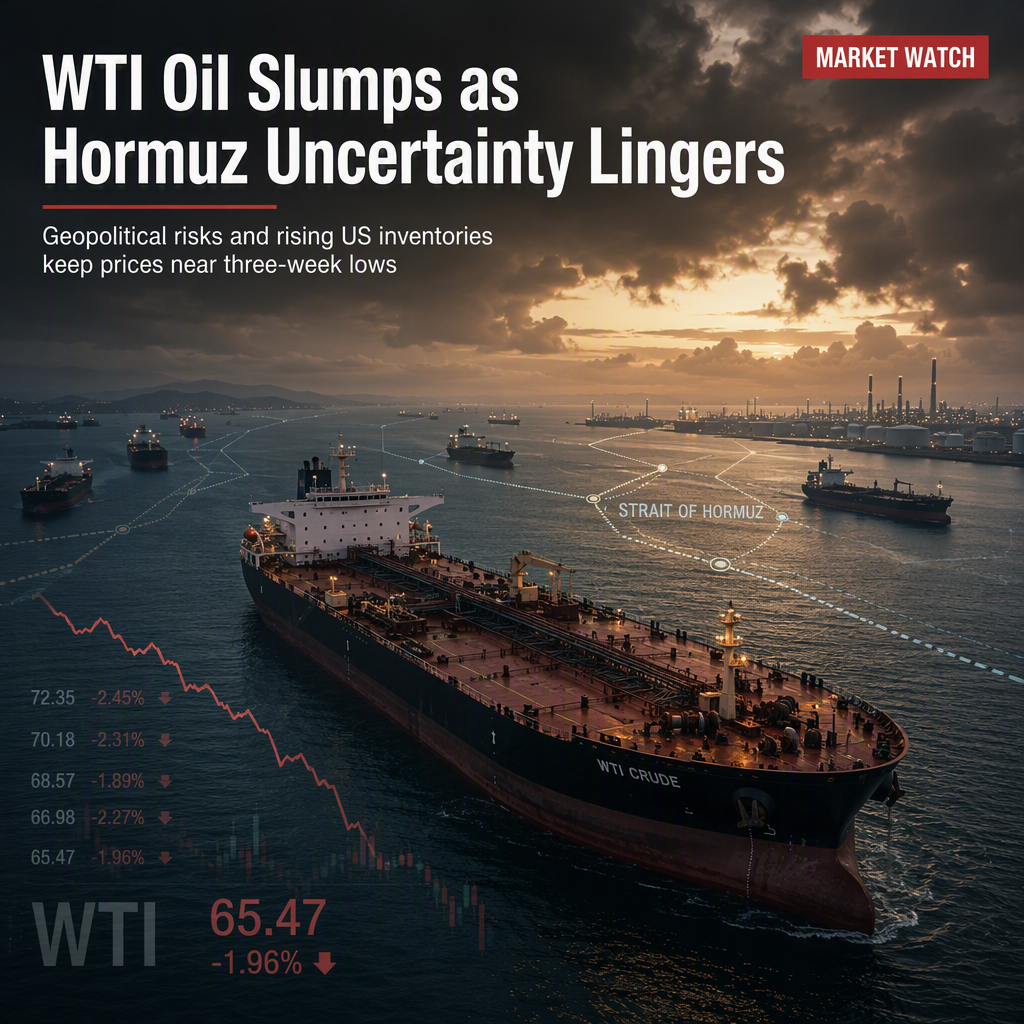
West Texas Intermediate (WTI) Crude Oil prices remain under pressure, trading around $74 per barrel and hovering near a three-week low as of Wednesday. The market is closely watching developments regarding the resumption of commercial shipping through the Strait of Hormuz, a key global oil transit route. Iran and Oman have reportedly reached an understanding on the geographic coordinates of a proposed shipping route through the waterway, with Iran’s Foreign Ministry stating that a joint statement is in the final stages of review and drafting, contingent on the absence of interference from third parties. However, an informed source told FarsNews that an agreement between Iran and Oman alone would not automatically reopen the Strait, as separate arrangements, including the fulfillment of US commitments, are still required. Until a final agreement is reached and shipping resumes, a geopolitical risk premium is expected to remain embedded in oil prices, limiting the scope for a deeper decline [1].
In addition to geopolitical factors, recent data from the US Energy Information Administration (EIA) showed that US crude oil inventories unexpectedly rose by 2.479 million barrels, in contrast to expectations for a 1.5 million-barrel decline. This follows a previous week’s drawdown of 7.167 million barrels. The surprise build in inventories adds further downward pressure on WTI prices [1].
From a technical perspective, the near-term bias for WTI remains bearish, with prices holding well below the 21-day, 50-day, and 100-day Simple Moving Averages (SMAs). Momentum indicators such as the Relative Strength Index (RSI) and Moving Average Convergence Divergence (MACD) reinforce the corrective tone, suggesting sellers still retain control. Key resistance levels are identified at the 50-day SMA near $79.58 and the 21-day SMA at $80.27, while immediate support is seen in the $67.00-$70.00 zone. A decisive break below this support could open the door to a deeper decline [1].
Overall, the combination of unresolved geopolitical risks in the Strait of Hormuz and bearish US inventory data is keeping WTI under pressure, with technical indicators suggesting limited upside in the near term [1].
CONCLUSION
WTI crude oil remains subdued near three-week lows as traders await clarity on the resumption of shipping through the Strait of Hormuz and digest a surprise build in US inventories. Until a final agreement is reached and shipping resumes, a geopolitical risk premium is likely to persist, capping any significant recovery in oil prices. Technical indicators and resistance levels suggest that sellers maintain control in the current market environment.