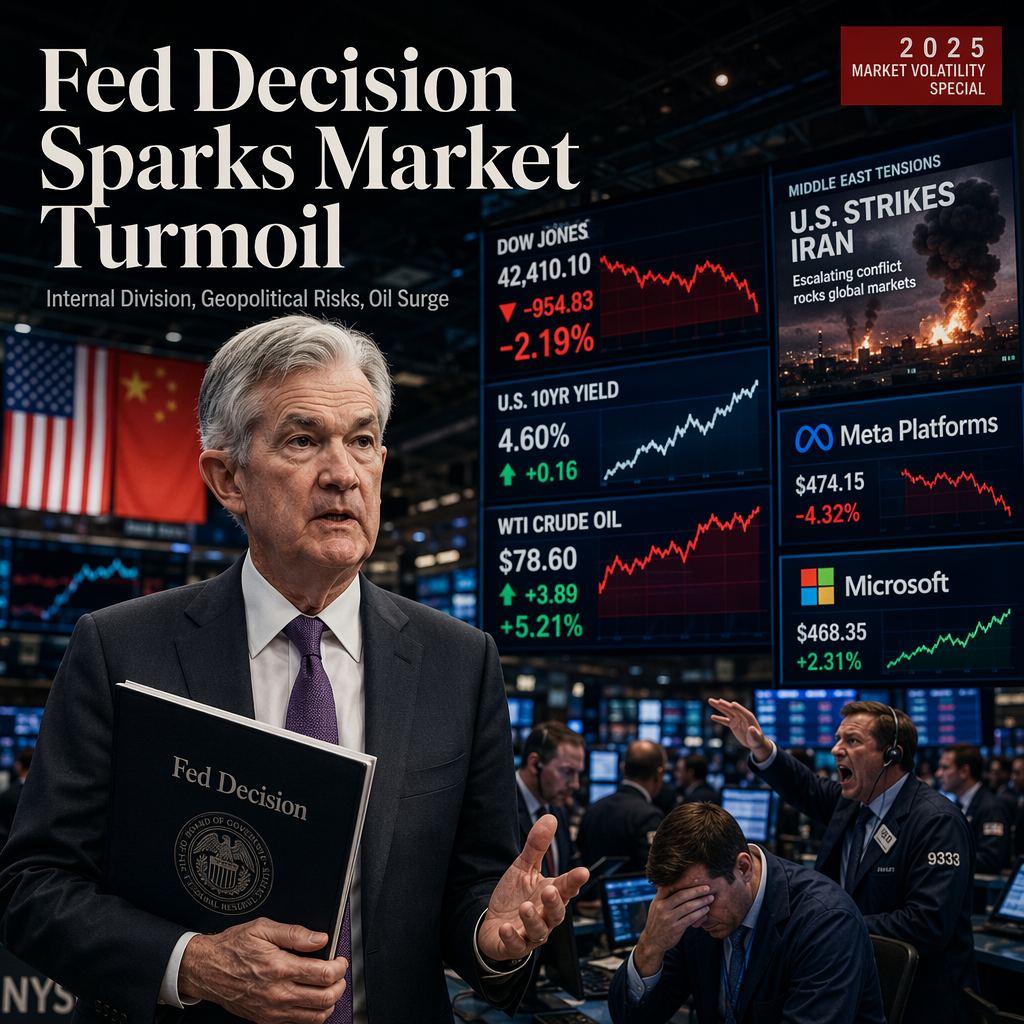
The U.S. Federal Reserve decided to keep its benchmark interest rate unchanged at 3.5%-3.75% in a closely watched meeting, with the decision passing by a split 9-3 vote, highlighting significant internal disagreement among policymakers [1]. Fed Chairman Kevin Warsh described the meeting as a 'family fight,' emphasizing that the central bank will not provide forward guidance but remains committed to achieving its 2% inflation target [1].
The market reacted sharply to the Fed's decision and the lack of clarity on future rate moves. Bond yields surged, and all three major U.S. stock indexes declined, with the Dow Jones Industrial Average suffering its steepest drop since April 2025, closing down 1,153.18 points or 2.19% [1].
Geopolitical risks further rattled markets as tensions in the Middle East escalated. U.S. Central Command launched strikes on Iran following a surprise attack, and former President Donald Trump warned of 'hitting them hard,' fueling fears of a prolonged conflict [1]. These developments sent oil prices soaring: Brent crude futures jumped 7.9% to $90.74 per barrel, and U.S. West Texas Intermediate futures rose 6.6% to $84.46 before easing slightly in early Asian trading [1].
In corporate news, Meta Platforms faced a sharp sell-off, with its stock plunging nearly 10% after missing second-quarter earnings estimates and issuing disappointing guidance. The company's free cash flow dropped to $784 million from $8.55 billion a year earlier [1]. In contrast, Microsoft shares surged 7% in after-hours trading following stronger-than-expected fiscal fourth-quarter revenue and positive capital expenditure guidance for 2026 [1].
Additionally, the ongoing competition between the U.S. and China in artificial intelligence was highlighted, with U.S. strategies aiming to prevent China from dominating the AI supply chain in Asia and globally, according to Gary Dvorchak of The Blueshirt Group [1].
CONCLUSION
The Federal Reserve's divided stance and lack of forward guidance, combined with escalating geopolitical tensions and disappointing tech earnings, triggered significant market volatility. Investors responded with a broad sell-off in equities, a spike in oil prices, and sharp moves in key tech stocks. The market remains on edge as uncertainty persists across monetary policy, geopolitics, and corporate performance.