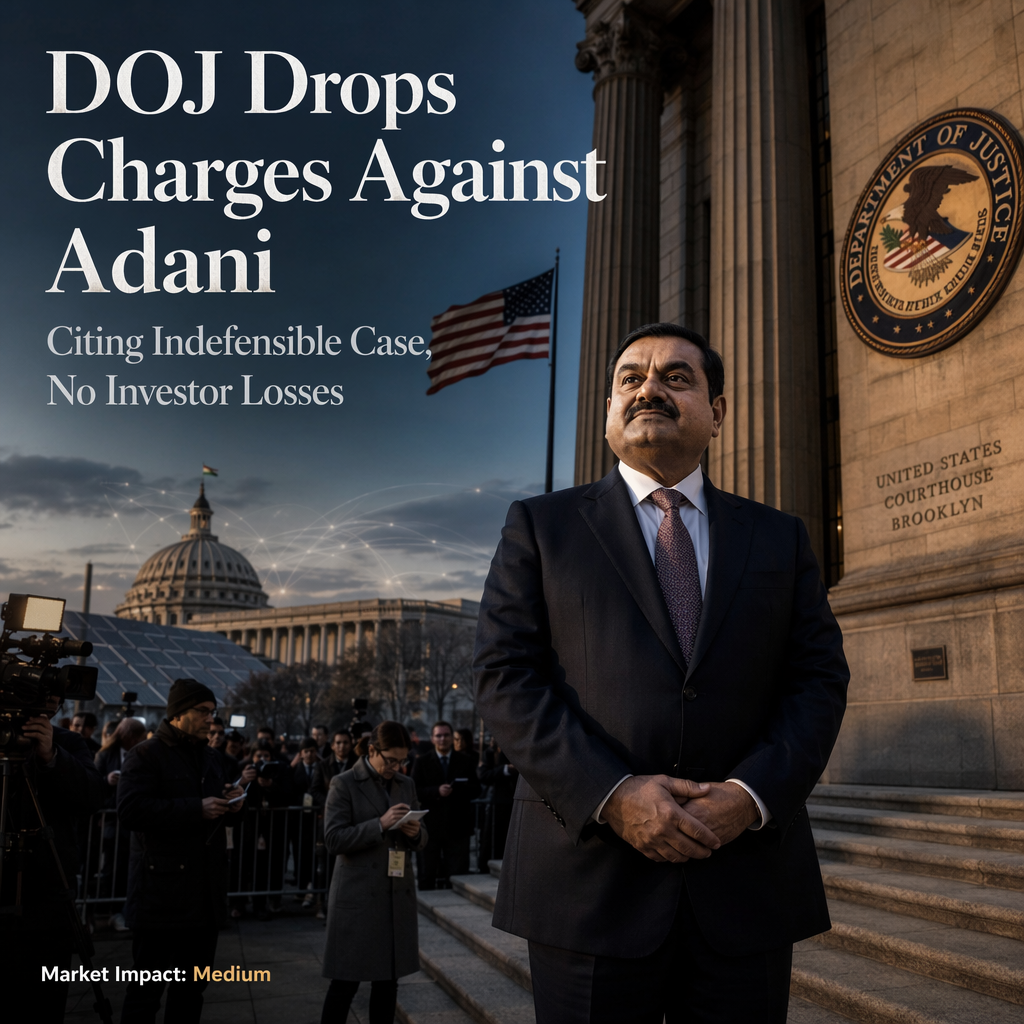
The U.S. Department of Justice (DOJ) has defended its decision to drop criminal charges against billionaire Indian businessman Gautam Adani, who was previously indicted in 2024 in Brooklyn, New York, for allegedly orchestrating a massive fraud and bribery scheme. Prosecutors had accused Adani of paying $250 million to Indian government officials to secure a bid for developing India's largest solar power plant, with contracts projected to generate $2 billion in profits over 20 years. The indictment also alleged that Adani misled U.S. investors by concealing these payments to Indian officials [1].
Trent McCotter, the principal associate attorney general, stated in a letter that the DOJ's decision to drop the charges was made before Adani's reported pledge to invest billions of dollars in the U.S. was raised, emphasizing that the case was "so indefensible" that he would have sought dismissal regardless of any investment offers or settlements. McCotter further argued that the case was fundamentally a foreign matter, with the alleged misconduct centering on Indians bribing other Indians, and noted that the word "India" appeared over 200 times in the filing. He asserted that prosecuting such cases could cause diplomatic strife and waste resources better spent on domestic concerns, stating, "India can better manage its internal systems than can prosecutors in Brooklyn and Washington" [1].
Importantly, McCotter highlighted that U.S. investors did not lose "a single penny" on the transactions that formed the basis of the charges. The government formally requested the indictment be permanently thrown out in May, citing prosecutorial discretion and a decision not to devote further resources to the criminal charges against the individual defendants. This request was signed by McCotter and Joseph Nocella, the U.S. attorney for Brooklyn, but did not include signatures from the line prosecutors assigned to the case [1].
Adani was never arrested or brought to the U.S. to face trial. His lawyer, Robert J. Giuffra Jr., declined to comment on Monday but had previously indicated that the DOJ's decision followed months of detailed communications, written submissions, expert testimony, and presentations. The DOJ's move has prompted questions from Democratic Senators Elizabeth Warren and Richard Blumenthal, who wrote to the acting Attorney General about the "reportedly 'transactional nature'" of the decision [1].
CONCLUSION
The DOJ's dismissal of criminal charges against Gautam Adani was based on the indefensibility of the case and the absence of losses for U.S. investors. While the decision has raised concerns among some lawmakers, the DOJ maintains that the matter is best handled by Indian authorities. The market impact is medium, given the high-profile nature of the case and its implications for cross-border enforcement.