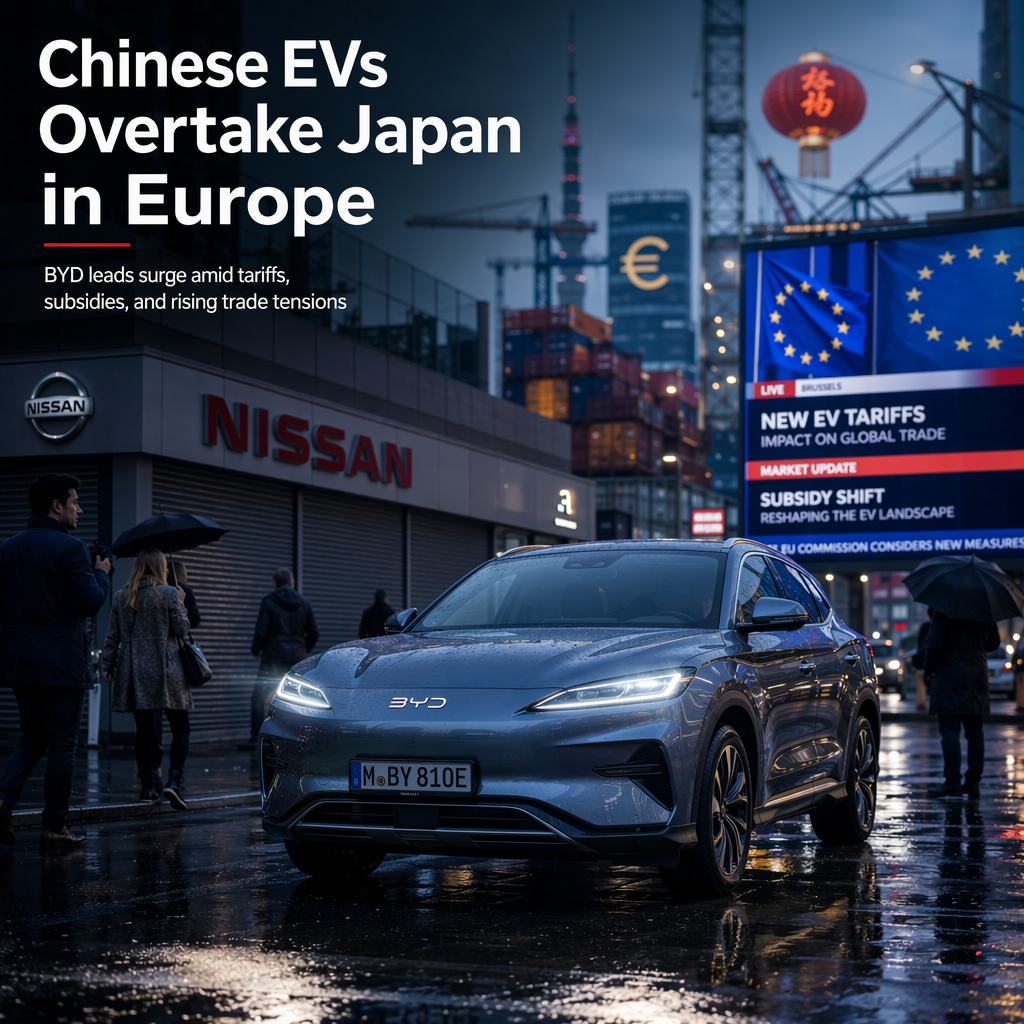
Chinese automakers have overtaken Japanese brands in Europe's passenger car market for the first time in May 2026, a shift driven largely by BYD's robust overseas performance and a 70% year-on-year jump in its first-half passenger vehicle sales [1]. This milestone comes despite the implementation of European Union tariffs on electric vehicles (EVs) from China, with renewed purchase subsidies in Europe providing a significant boost to Chinese brands, particularly BYD [1]. In contrast, Japanese automaker Nissan has been redirecting its focus to other markets, reflecting broader strategic adjustments among traditional automakers [1].
Industry sources highlight that the renewed European subsidies have favored Chinese EV makers, giving them a competitive edge over Japanese brands. Analysts attribute BYD's rapid sales growth to technical innovation and aggressive pricing strategies, which have contributed to the company's expanding market share in Europe [1]. Market sentiment in Europe is increasingly receptive to Chinese brands, especially in the EV segment, with experts advising close monitoring of BYD's performance and the evolving impact of subsidy changes on Japanese automakers [1].
Meanwhile, in China, the expiration of government subsidies has led to a significant drop in domestic auto and appliance sales, with major brands reporting lower sales figures and concerns about inventory build-up and downward price pressure [2]. This has increased calls for renewed government stimulus to support household spending and prevent a further slowdown in domestic demand [2]. Analysts warn that unless new stimulus measures are introduced, there could be more pronounced weakness in consumer sectors and greater reliance on exports, which may also impact the Chinese stock market, particularly in consumer discretionary and manufacturing sectors [2].
On the trade front, tensions between the European Union and China are escalating over Beijing's widening trade surplus with the bloc, which now exceeds $1 billion a day [3]. The EU has launched investigations into Chinese electric vehicles and other products, considering anti-dumping measures and new trade defense tools in response to what it describes as unfair competition and market access challenges [3]. While a recent EU Chamber of Commerce survey indicates a rebound in business confidence among European firms in China, regulatory hurdles and market access issues persist [3]. The outcome of upcoming ministerial dialogues and ongoing investigations is expected to have significant implications for global trade flows, supply chains, and investment strategies [3].
CONCLUSION
Chinese automakers, led by BYD, have achieved a historic breakthrough in Europe, surpassing Japanese rivals amid shifting subsidy policies and rising trade tensions. While European subsidies have fueled Chinese EV growth, the expiration of similar incentives in China has dampened domestic sales, increasing pressure on policymakers. The evolving regulatory landscape and ongoing EU-China trade negotiations will be critical for market participants to watch in the coming months.