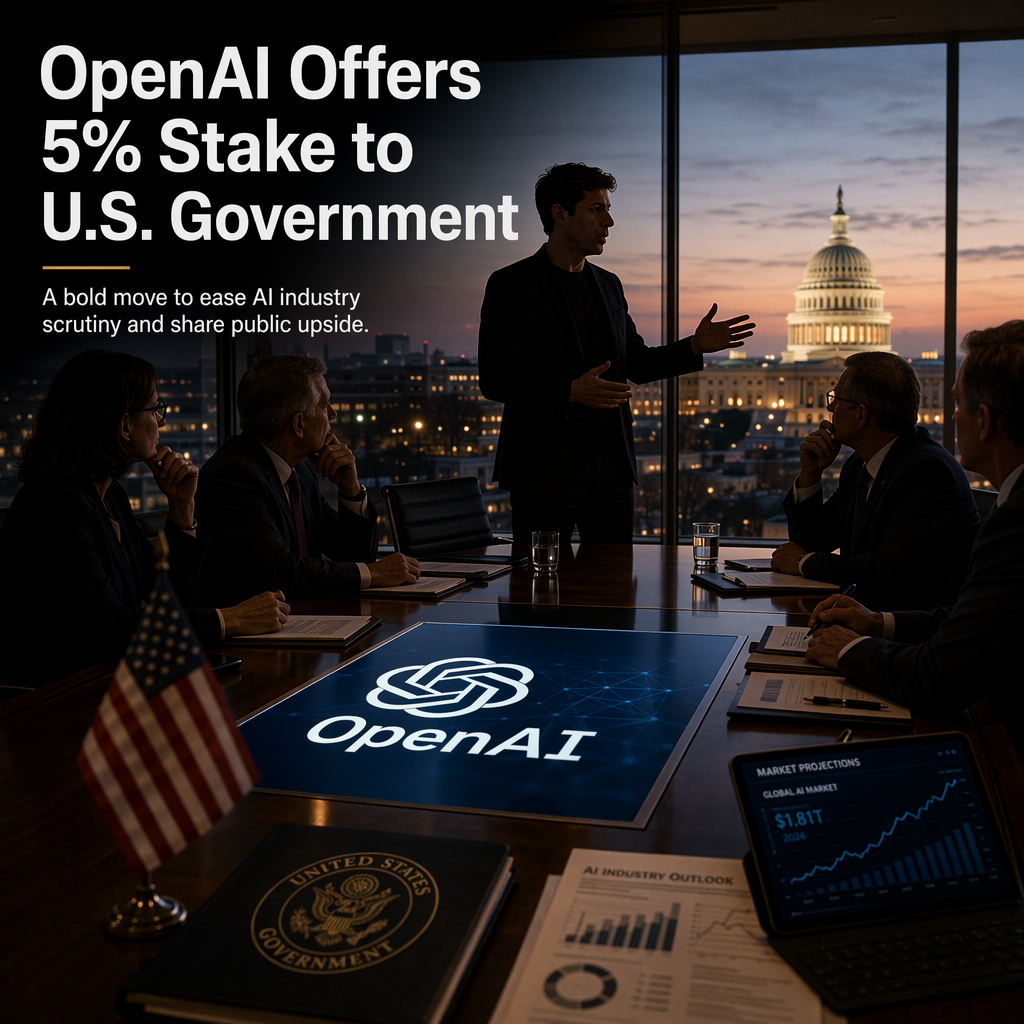
OpenAI has proposed that the U.S. government acquire a 5% stake in the company, valued at approximately $42.6 billion, following a record-breaking funding round in March that placed OpenAI's post-money valuation at $852 billion [1]. This proposal, reported by the Financial Times and cited by CNBC, is part of OpenAI CEO Sam Altman's effort to ease mounting political pressure in Washington and share the financial upside of artificial intelligence with the public [1]. Altman suggested this arrangement in early discussions with the Trump administration, envisioning a broader plan where Washington would hold 5% stakes in each of the leading U.S. AI developers, including Anthropic, Google, and Meta, through a government vehicle [1]. However, it remains unclear whether these companies would agree to OpenAI's proposal, as the White House, OpenAI, Google, and Meta did not respond to requests for comment [1]. A source familiar with the matter stated that the Trump administration and Anthropic have not discussed the government taking stakes in Anthropic [1].
The proposal comes amid increasing scrutiny of major U.S. AI firms due to cybersecurity vulnerabilities and rising competition from Chinese open-source models, which are reportedly nearly as capable and significantly cheaper than top American models [1]. Anthropic recently disabled access to its advanced Mythos and Fable models to comply with a government export control directive, but was cleared to restore access after addressing policymakers' safety concerns [1].
OpenAI's pitch follows more than a year of discussions about a possible government stake, with Altman first presenting the concept to the Trump administration in early 2025 [1]. In April, OpenAI proposed creating a "public wealth fund" to capture growth in AI companies and distribute economic benefits to the public [1]. The Trump administration has a precedent for taking stakes in private companies, including a 10% stake in Intel after an $8.9 billion investment in August last year, and investments in IBM and other quantum and critical mineral companies [1]. President Donald Trump has previously expressed regret about not securing a larger stake in Intel [1].
Pressure on U.S. AI firms is intensifying as policymakers focus on cybersecurity and global competition, with OpenAI's proposal representing a potential shift in how the government interacts with leading technology companies [1].
CONCLUSION
OpenAI's proposal for a 5% government stake highlights the growing intersection of technology and policy as Washington seeks greater oversight of AI firms. The move could have significant market implications, especially if other leading companies follow suit, but industry responses remain uncertain. The ongoing scrutiny and regulatory actions underscore the high stakes for U.S. AI developers in a rapidly evolving global landscape.