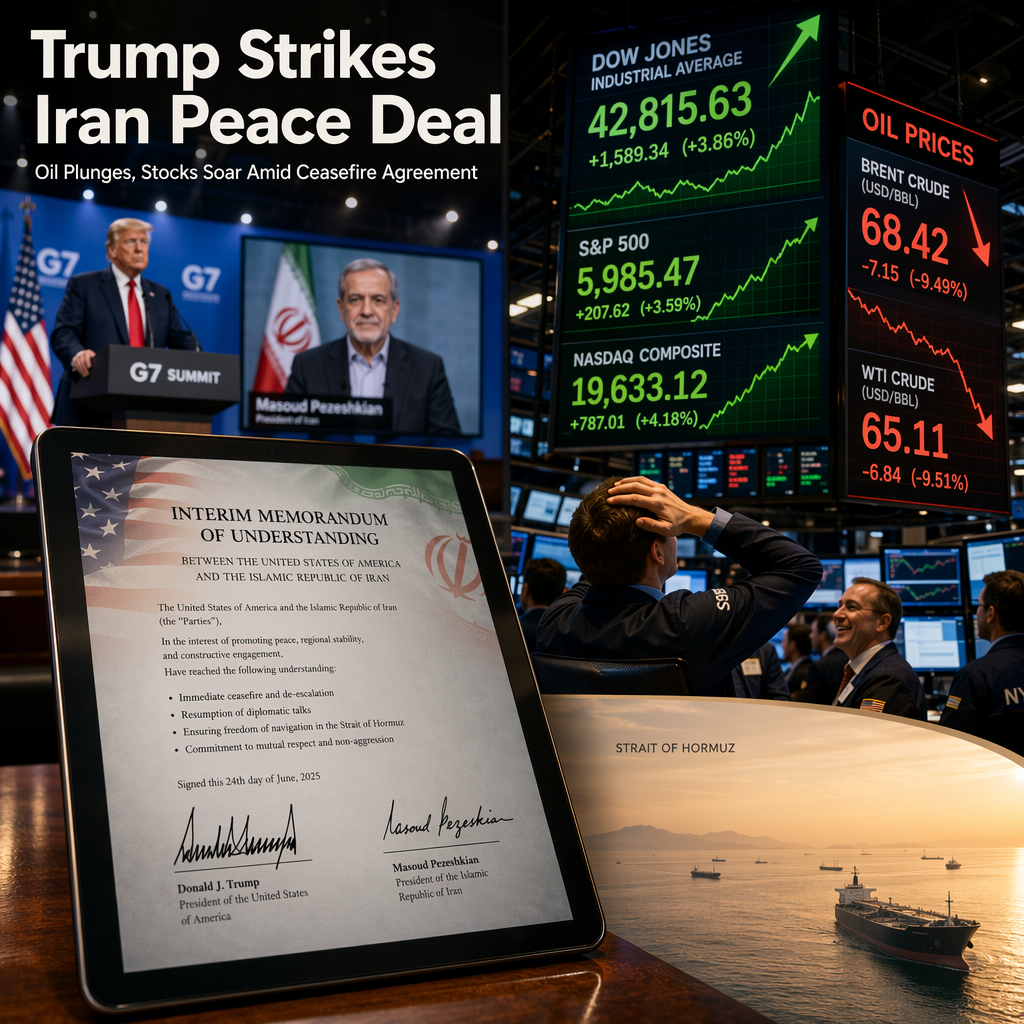
President Donald Trump and Iranian President Masoud Pezeshkian electronically signed a 14-point memorandum of understanding (MOU) to extend the ceasefire and reopen the strategically vital Strait of Hormuz, marking a significant step toward ending the war between the U.S. and Iran [1]. The interim agreement commits both sides to further negotiations over the next 60 days to reach a final deal and includes a $300 billion plan for Iran's reconstruction as well as the removal of 'all types' of U.S. sanctions against the Islamic Republic [1]. Analysts and economists have noted that the terms of the MOU appear to be heavily favorable toward Iran, with Amrita Sen of Energy Aspects highlighting the need for more clarity on the pace at which ships will be allowed through the Strait and the removal of the U.S. naval blockade [1].
The deal has prompted debate over whether the U.S. has conceded too much, with Trump responding to critics by stating that those who question his toughness on Iran are 'jealous, bad people or stupid.' He emphasized that the stock market has reached a record high and oil prices are 'tumbling' as a result of the agreement [1]. Iranian leaders, including President Pezeshkian, have framed the deal as a strategic victory, suggesting it could help address Iran's economic and political challenges and create 'a different world' in Iran and the Middle East [1].
Under the terms of the MOU, Iran will allow the safe passage of commercial ships without tolls for 60 days, after which talks with Oman and other Gulf states will determine the future administration and maritime services in the Strait of Hormuz [1]. Trump, attending a G7 meeting in France, expressed hope that the deal would deliver peace across the region and further lower oil prices [1].
Energy analysts have pointed out that while the agreement is favorable to Iran, many details remain unresolved, particularly regarding maritime arrangements and the implementation of sanctions relief [1]. The market reaction has been notable, with oil prices dropping and the stock market reaching new highs, indicating positive investor sentiment toward the deal's potential to stabilize the region and boost economic prospects [1].
CONCLUSION
The interim U.S.-Iran peace deal has triggered a sharp drop in oil prices and a record high in the stock market, reflecting strong market optimism. While the agreement is seen as favoring Iran and leaves many details to be negotiated, both sides have committed to further talks. The market takeaway is that investors are responding positively to the prospect of regional stability and economic recovery.