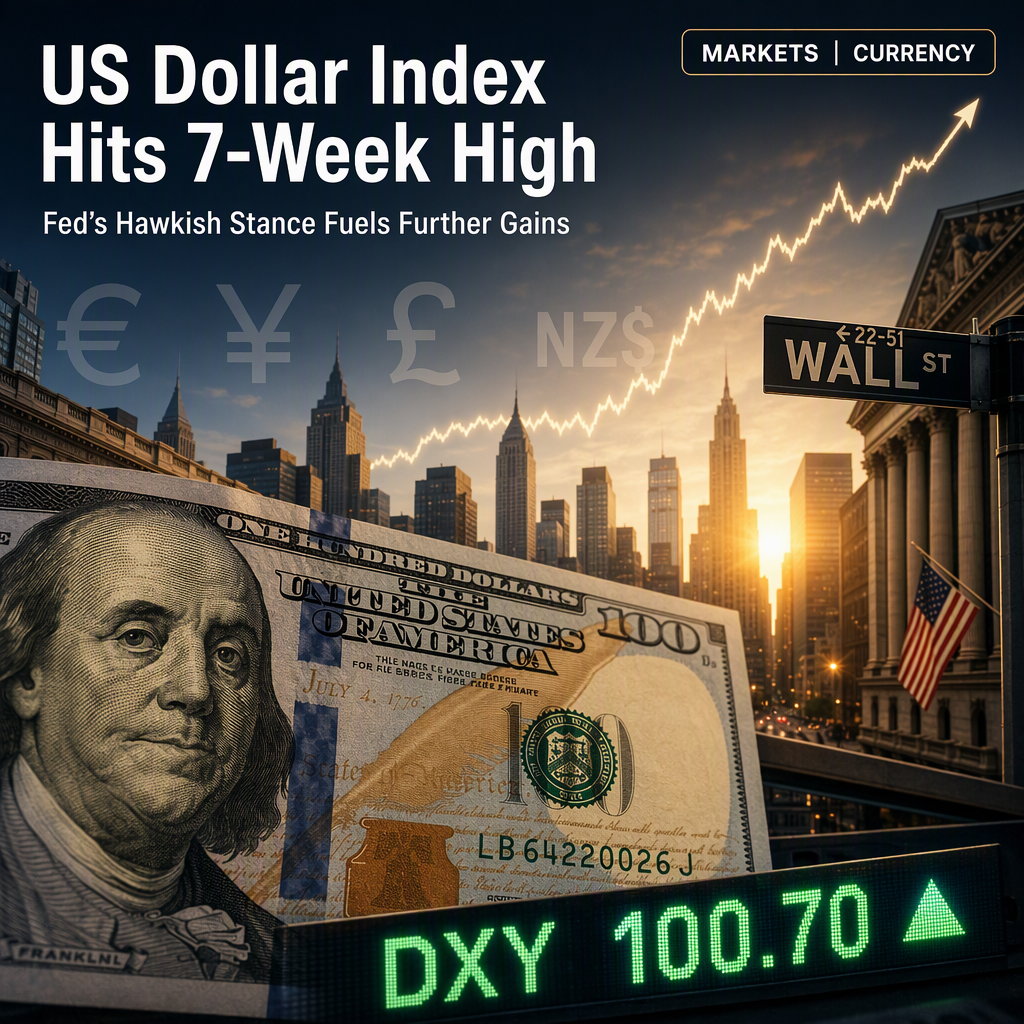
The US Dollar Index (DXY) climbed to near 100.70 on Wednesday, marking its highest level in over seven weeks, as the Federal Reserve maintained a hawkish stance on monetary policy [1]. In Asian trading, the DXY was up 0.15%, reflecting broad-based strength against major currencies, with the US Dollar showing the largest gain against the New Zealand Dollar at 0.42% [1]. According to the CME FedWatch tool, market participants are assigning nearly a 90% probability to at least one more interest rate hike by the Fed this year [1].
Recent statements from Federal Reserve officials have reinforced expectations for further tightening. St. Louis Fed President Alberto Musalem, though not a voter this year, stated that 'further rate hikes may be needed to curb inflation,' while Chicago Fed President Austan Goolsbee, a 2027 voter, warned that policy could become 'more aggressive and more and more front-loaded' if demand is deemed to be overheating [1]. Richmond Fed President Thomas Barkin also commented that last week's rate hike will help restore price stability [1].
Brown Brothers Harriman’s Elias Haddad noted that the combination of hawkish guidance from both current and future FOMC participants is sustaining the perception that 'more tightening is in the pipeline,' which supports the US Dollar’s growth and yield advantage over the Euro, Pound, and Yen [1]. The market’s reaction has been positive for the Dollar, with the DXY outperforming all major peers, particularly the New Zealand Dollar, Euro, and Canadian Dollar [1].
No specific forward-looking analyst projections beyond the cited FedWatch probability and BBH commentary were provided in the article [1].
CONCLUSION
The US Dollar Index's surge to a seven-week high reflects strong market confidence in further Fed tightening, bolstered by hawkish remarks from multiple Fed officials. With nearly 90% odds priced in for another rate hike, the Dollar is likely to maintain its strength in the near term. Market participants are closely watching Fed communications for further signals on the policy path.