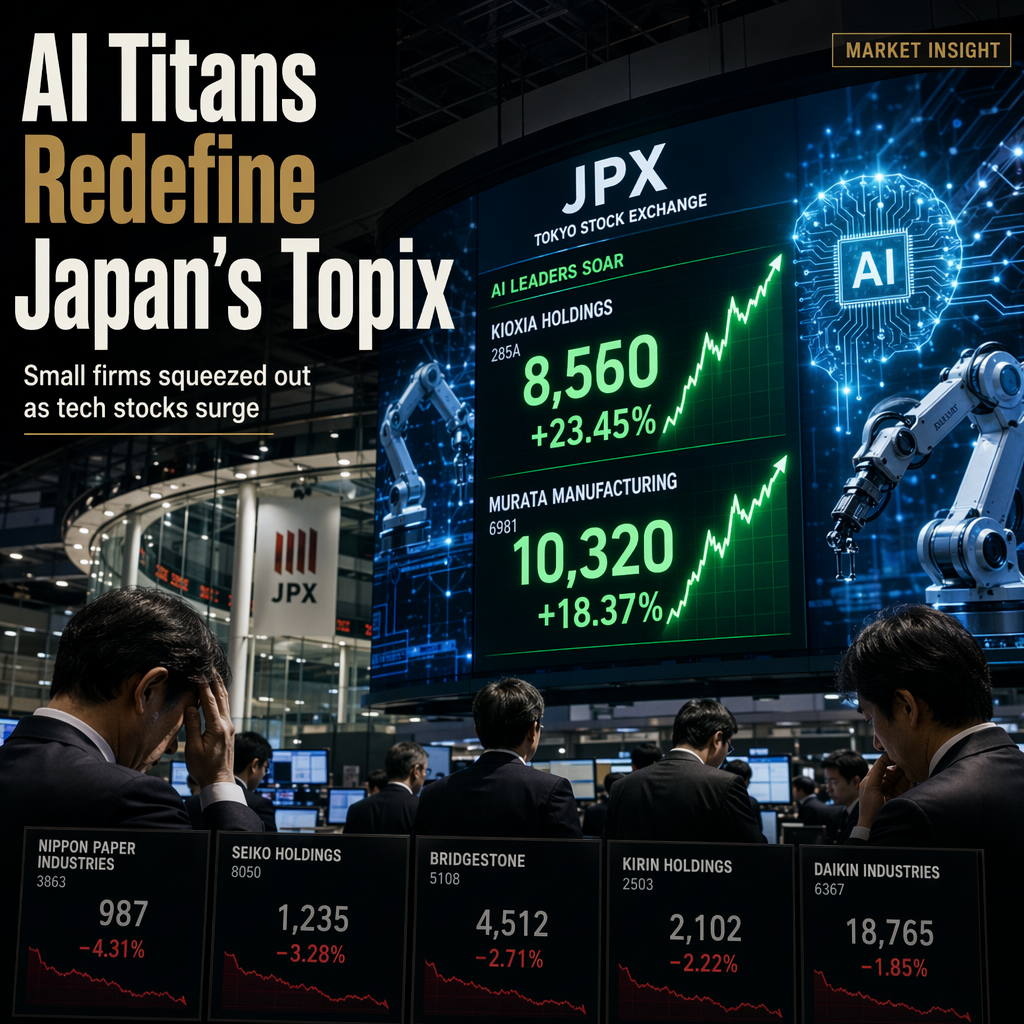
Japan's broad Topix index is undergoing a significant transformation as the explosive growth of AI-related stocks, particularly memory chip maker Kioxia Holdings and Murata Manufacturing, pushes smaller and midcap companies out of the index. At one point in 2026, Kioxia Holdings' market capitalization was more than 10 times its value in late 2025, highlighting the extraordinary expansion within the AI sector [1]. This surge in market capitalization among leading technology firms is attributed to both structural reforms at the Tokyo Stock Exchange and a market-wide focus on technological innovation [1].
The dominance of AI and semiconductor stocks has led to a shrinking roster of Topix constituents, as smaller firms struggle to compete for inclusion. Analysts note that the index composition is shifting toward larger, more influential players, fundamentally altering the landscape for index-based strategies and fund allocations [1]. Technical analysis and market sentiment reveal strong support for AI-related stocks, with resistance levels being continuously broken and investor enthusiasm remaining high [1].
The trading environment is described as highly favorable for large-cap technology companies, while smaller firms are experiencing declining liquidity and visibility. Market analysts warn that continued upward movement in stocks like Kioxia Holdings and Murata Manufacturing could further concentrate the Topix index and impact overall market dynamics [1]. One analyst stated, "the powerful rally in Japan's AI and memory chip sectors is likely to reshape the Topix for years to come," emphasizing the long-term implications for investors [1].
Traders are advised to closely monitor price levels for the leading AI stocks, as their performance may continue to drive structural changes within the index and influence broader market trends [1].
CONCLUSION
The rapid ascent of AI and semiconductor stocks is fundamentally altering the composition of Japan's Topix index, favoring large-cap technology firms at the expense of smaller companies. This trend is expected to have lasting effects on index strategies and market dynamics, with analysts highlighting the need for investors to adapt to the new landscape.