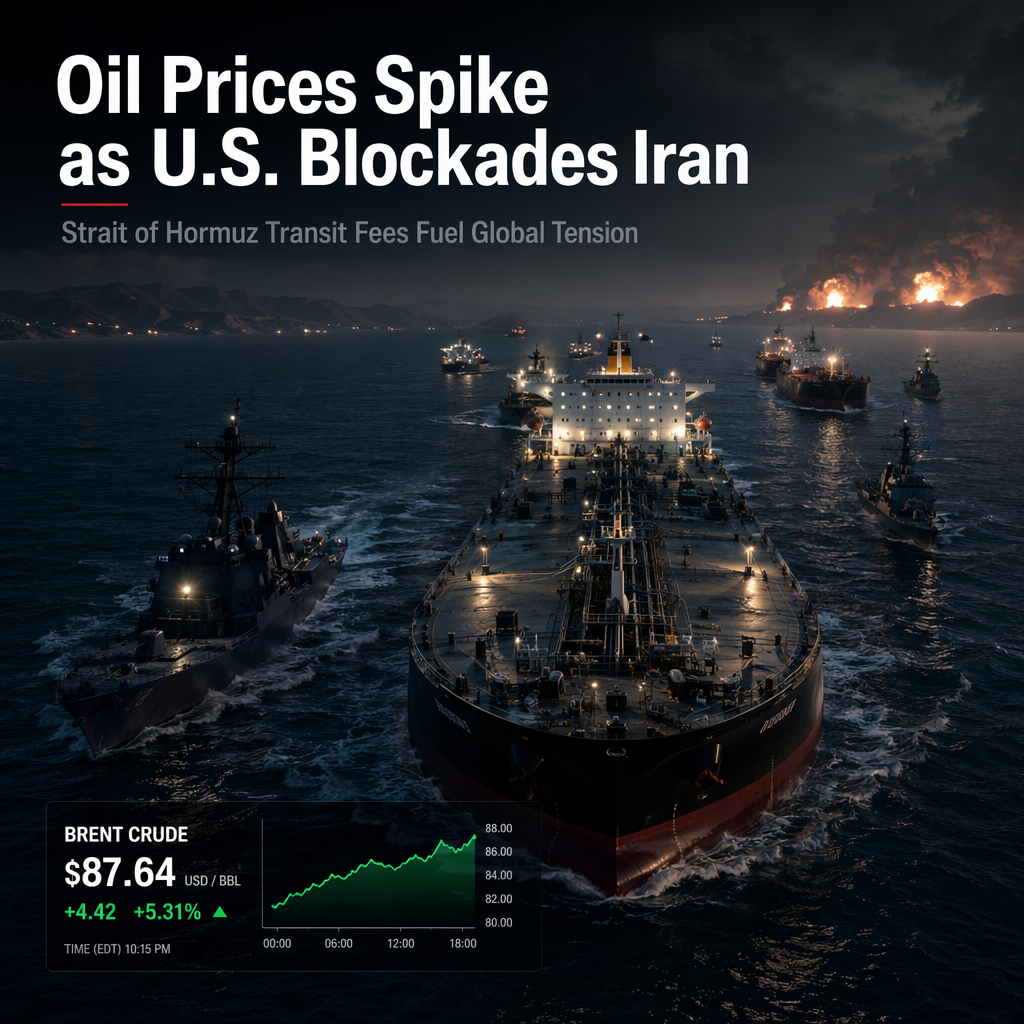
Brent crude oil prices soared by 9.6% to close at $83.30 per barrel on Monday, marking the largest daily gain since May 2020, after President Donald Trump announced the reinstatement of a U.S. naval blockade against Iran and demanded a 20% reimbursement on all cargo shipped through the Strait of Hormuz [1]. West Texas Intermediate futures also jumped 9.4% to settle at $78.14 [1]. The move follows a series of military escalations between the U.S. and Iran, including U.S. airstrikes on 140 Iranian targets over the weekend in response to an attack by Iran's Islamic Revolutionary Guard Corps on a container ship [1]. Iran retaliated with strikes on U.S. military facilities in Jordan, Kuwait, Bahrain, and Oman, according to Iranian state media, though the U.S. military maintains that the strait remains open to lawful transit [1].
President Trump stated that the blockade targets only Iranian ships or their customers, assuring that all other countries would have fair and open use of the Strait of Hormuz [1][2]. He further emphasized that the U.S. Navy would protect maritime traffic but insisted on a 20% fee for all cargo passing through the strait [1][2]. The International Maritime Organization (IMO), a United Nations agency, publicly opposed the imposition of such transit fees, stating there is "no legal basis" for mandatory tolls in the Strait of Hormuz and reaffirming the right to unimpeded passage for international shipping [2].
Industry voices have also criticized the U.S. fee demand. Herbjorn Hansson, CEO of Nordic American Tankers, called the 20% fee "unrealistic" and stressed the need for agreement between Iran and the U.S. on strait administration, noting that the current situation is causing suffering for both countries and the global community [2]. James Kraska, an international maritime law expert, asserted that tolls for transiting Hormuz violate international law and that Iran cannot unilaterally alter established traffic routes under existing treaties [2].
The security situation in the Strait of Hormuz remains tense, with Iran demanding ships use a northern route through its territorial waters, while the U.S. Navy continues to escort vessels through a southern corridor along Oman's coast [1][2]. The Joint Maritime Information Center, a U.S.-led coalition, confirmed that the southern route remains open but warned mariners to exercise "extreme vigilance" due to the severe security environment [1]. The recent escalation follows conflicting U.S. and Iranian interpretations of an interim peace deal signed on June 17, which included a 60-day moratorium on Iranian transit tolls [1][2].
CONCLUSION
The U.S. decision to reimpose a naval blockade on Iran and demand a 20% transit fee through the Strait of Hormuz has triggered a sharp spike in oil prices and drawn strong opposition from international maritime authorities. The ongoing military confrontations and legal disputes over shipping rights have heightened market uncertainty, with industry leaders and legal experts questioning the feasibility and legality of the new U.S. policy.