
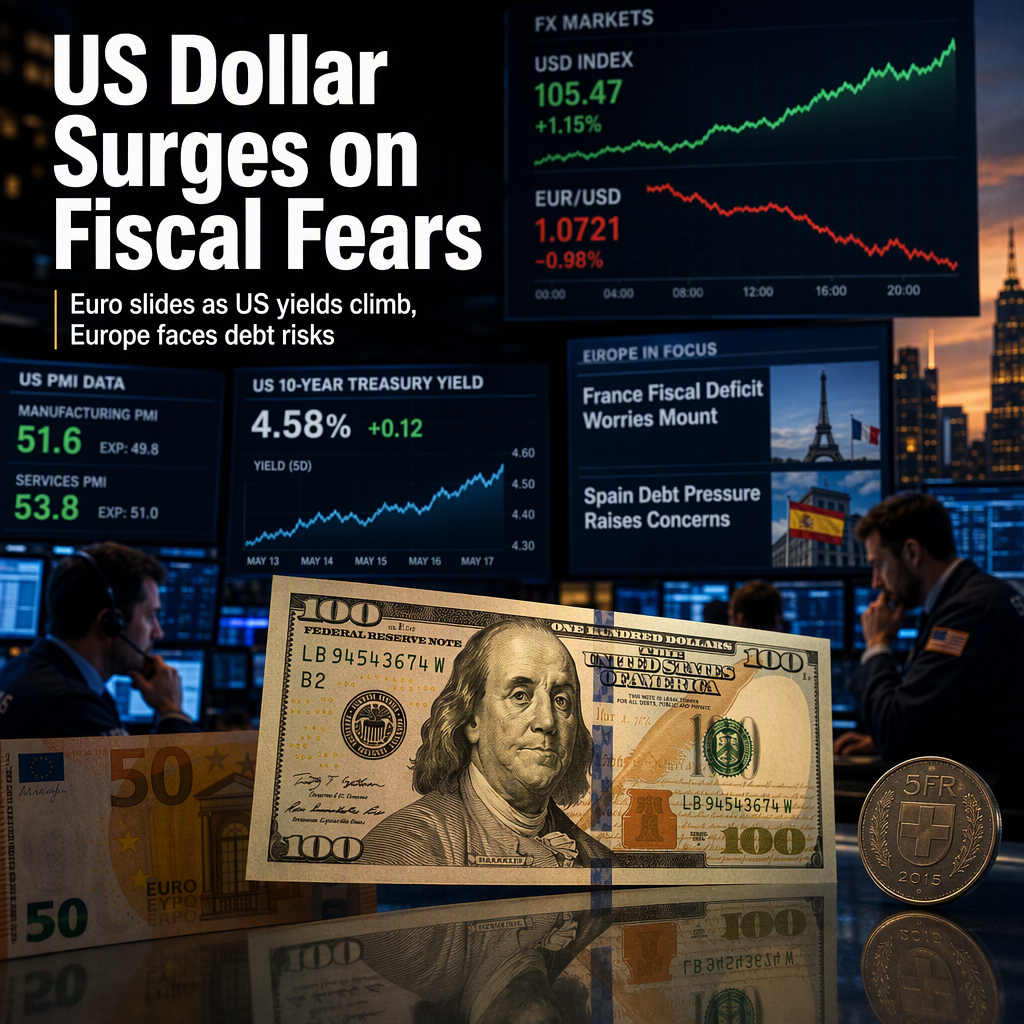
The US Dollar (USD) maintained its dominance in currency markets on Monday, with the EUR/USD pair falling 0.60% to trade around 1.1190–1.1189, and the USD/CHF pair edging higher to approximately 0.8316, snapping a two-day losing streak for the Greenback [1][2]. The Dollar's strength was underpinned by elevated US Treasury yields, with the benchmark 10-year yield holding near 5.30%, just below last week's peak of 5.34%, its highest level since 2002 [1][2].
Fresh business activity data released on Monday confirmed the resilience of the US economy. The final S&P Global Services Purchasing Managers Index (PMI) for September was revised up to 58.8 from the preliminary 58.7, while the ISM Services PMI eased to 54.9 from 55.4 in August, slightly below the market consensus of 55. Both readings remain well above the 50 threshold that separates expansion from contraction [1][2]. Despite these positive indicators, last week’s weaker-than-expected US employment report led traders to scale back expectations for a Federal Reserve (Fed) rate hike in October. The CME FedWatch tool now shows only a 20% probability of a rate increase at the upcoming meeting, down from nearly 70% a week earlier [1][2].
Persistent inflation risks, particularly in the services sector and from energy prices, continue to complicate the Fed’s efforts to bring inflation back to its 2% target, leaving the door open for potential tightening later this year [1][2]. The rise in US Treasury yields also reflects growing concerns over the US debt burden and broader fiscal position, which could eventually limit the Dollar’s ability to extend its gains [1][2].
On the European side, the Euro remains under pressure due to mounting political and fiscal uncertainty, especially in France, where high debt levels and a widening budget deficit have fueled bond market tensions. Political uncertainty is also spreading to Spain, where a snap election has been called amid protests over the housing crisis [1][2]. Despite some improvement in Eurozone economic data—such as the HCOB Eurozone Composite PMI rising to 53.1 and the Services PMI to 53.0 in September—these signals have not been sufficient to support the Euro against the stronger Dollar [1].
The Swiss Franc (CHF) saw increased safe-haven demand due to fiscal concerns in both the US and Europe, supported by Switzerland’s stronger fiscal position. However, the wide interest-rate gap with other major economies and the Swiss National Bank’s readiness to intervene in currency markets remain headwinds for the Franc [2].
CONCLUSION
The US Dollar continues to benefit from resilient US economic data and elevated Treasury yields, despite reduced expectations for an imminent Fed rate hike. Ongoing fiscal and political uncertainties in Europe, particularly in France and Spain, are weighing on the Euro, while the Swiss Franc's safe-haven appeal is tempered by monetary policy factors. Overall, the market impact is high as investors closely monitor central bank actions and fiscal developments on both sides of the Atlantic.