
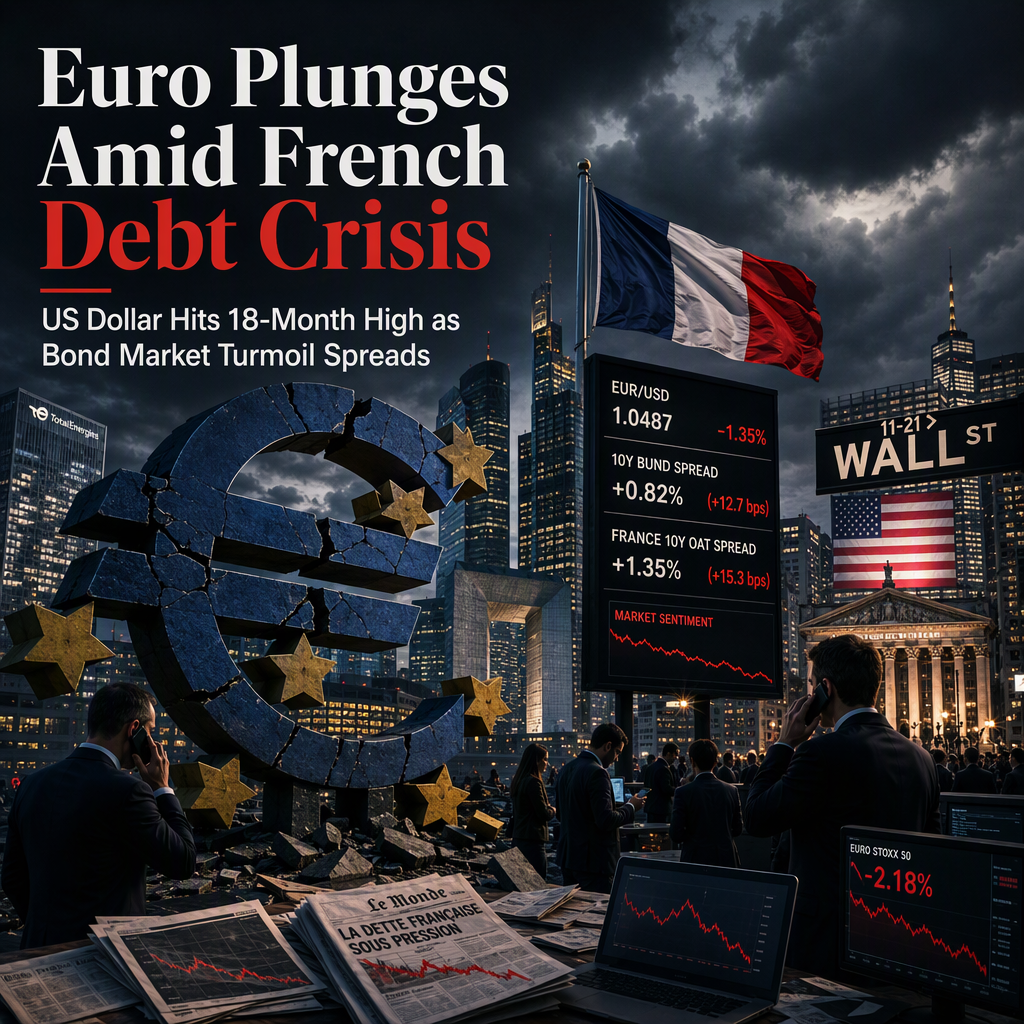
The Euro (EUR) has come under significant pressure, underperforming all major currencies and sending EUR/USD to an intra-day low of 1.1161, its weakest level since May 2025 [1][2]. This decline is attributed to mounting fiscal stress in France, where government debt stands close to 120% of GDP [2]. The crisis has spilled over into broader Eurozone sovereign bond markets, widening the yield spread between French and German 10-year bonds to about 1.5 percentage points, the largest gap since 2011 [1][2]. The European Central Bank's (ECB) Transmission Protection Instrument (TPI), designed to counter disorderly spread widening, faces complications as its activation requires member states to maintain 'sound and sustainable fiscal and macroeconomic policies.' France's deteriorating finances make intervention more difficult, though broader contagion could increase pressure on the ECB to act [1].
The Euro's sharp fall accounted for roughly three-quarters of the US Dollar Index's (DXY) surge to an 18-month high of 102.53 on Monday [2][3]. The DXY's rise was driven primarily by the Euro's weakness, as the Euro comprises 57.6% of the index [2]. After peaking, the DXY pulled back but remained above 102.00, with momentum gauges staying near maximum readings since late September [2]. Elevated US Treasury yields, with the 10-year yield near 5.32%—close to its highest since 2002—also supported the US Dollar [3]. However, the rise in yields is attributed not only to monetary policy expectations but also to concerns over the US fiscal position [3].
Market data releases added to the volatility. The Institute for Supply Management (ISM) Services PMI came in at 54.9, slightly below the 55 forecast and down from 55.4 previously [2][3]. The S&P Global Services PMI for September was revised up to 58.8, while the Composite PMI was confirmed at 58.4 [3]. The ISM release triggered a brief dip in the DXY, but the index quickly recovered [2].
Analyst commentary highlights that the Euro faces continued downside risk due to rising fiscal stress and expectations of a shallower ECB hiking cycle [1]. ECB Chief Economist Philip Lane noted that the increase in long-term interest rates represents a material tightening of financial conditions for the euro area [1]. Meanwhile, traders have scaled back expectations of another Federal Reserve rate hike this month after weaker-than-expected US employment data, but markets still anticipate further tightening later this year as inflation remains above target and energy prices persist [3].
Immediate support levels for EUR/USD are identified at 1.1200 and 1.1111 [1]. According to Brown Brothers Harriman, the Euro remains pressured by both fiscal risk and monetary policy divergence [1].
CONCLUSION
The Euro's sharp decline, driven by France's fiscal crisis and broader Eurozone contagion fears, has propelled the US Dollar Index to an 18-month high. With the ECB constrained in its policy response and US yields elevated, the market remains focused on fiscal risks and central bank actions. The outlook for the Euro is negative in the near term, while the US Dollar may retain support from ongoing policy divergence and risk aversion.