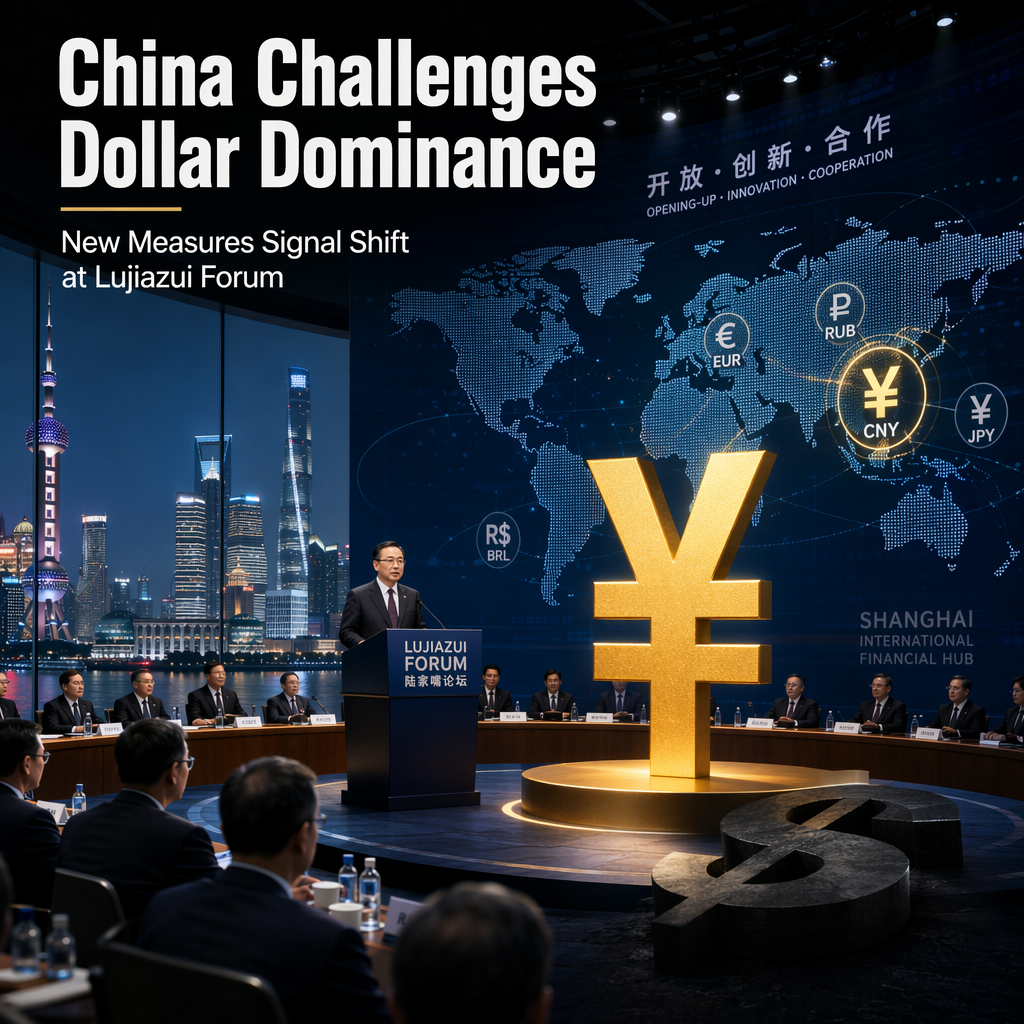
At the Lujiazui Forum in Shanghai earlier this month, Chinese officials announced a series of new initiatives aimed at reducing the country's reliance on the U.S. dollar and building an alternative global financial infrastructure [1]. The measures include expanding offshore renminbi (RMB) finance, deepening Shanghai's role as an international financial center, creating new liquidity facilities for foreign central banks and sovereign investors, expanding cross-border RMB trading, and further opening portions of China's financial sector to international participation [1].
The article emphasizes that while skepticism remains regarding the sincerity or achievability of these efforts, China is 'unquestionably serious' about challenging aspects of dollar dominance, even if it may not be able to fully replace the dollar in the near term [1]. The focus, according to the source, should be on China's methodical approach to building alternatives to the dollar-centric system, which could have significant geopolitical ramifications [1].
The article frames these developments not primarily as a monetary story, but as a geopolitical one, highlighting the extraordinary advantages the United States has enjoyed for nearly eighty years due to the dollar's central role in the global financial system [1]. These advantages include the ability to impose sanctions, restrict access to dollar clearing, and influence international compliance standards and capital flows [1].
No immediate market reactions or analyst opinions are provided in the article, nor are specific dates, numbers, or named entities beyond the forum itself and the general description of the measures [1].
CONCLUSION
China's latest moves at the Lujiazui Forum signal a serious, methodical effort to challenge the dominance of the U.S. dollar by building alternative financial infrastructure. While the immediate market impact is not specified, the long-term geopolitical implications could be significant if these initiatives gain traction.