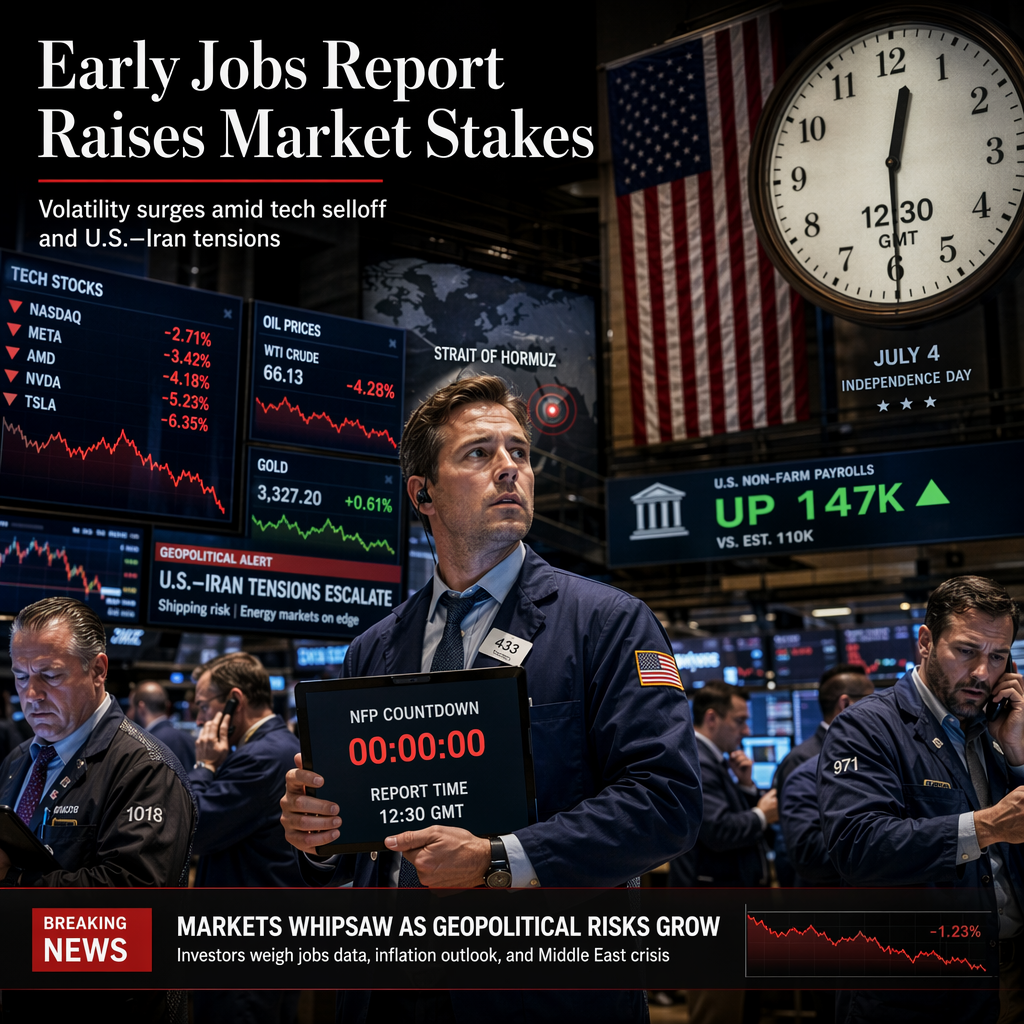
The U.S. Non-Farm Payrolls (NFP) report for June 2026 will be released earlier than usual, at 12:30 GMT on Thursday, July 2, due to the Independence Day market holiday on Friday, July 3 [1]. This jobs week follows a period of heightened market volatility, where a hotter-than-expected Core PCE inflation print last week led to a surprising dollar selloff, highlighting the risk of a 'buy-the-rumor, sell-the-news' reaction when data is already priced in [1].
Last week also saw a significant selloff in the most expensive technology stocks, which dragged both the S&P 500 and Bitcoin lower, demonstrating that off-calendar events can have a dominant influence on market direction [1]. In addition to economic data, geopolitical risks have resurfaced, with renewed U.S.–Iran tensions marked by tit-for-tat military strikes and threats to the Strait of Hormuz, keeping the geopolitical risk premium elevated [1].
The article outlines three market scenarios for the upcoming jobs report: a strong report could initially boost the dollar but may quickly fade if the data is already priced in or if dovish Federal Reserve commentary persists; gold may dip on initial dollar strength but rebound if risk-off sentiment dominates; stocks, especially tech, remain vulnerable; and oil and Bitcoin could follow broader risk trends [1]. Conversely, a weak report could trigger a dollar selloff, boost gold, and pressure equities, oil, and Bitcoin if economic concerns intensify [1]. An in-line report may result in a muted market response, with attention shifting to off-calendar risks such as geopolitics and tech sector volatility [1].
Key technical levels to watch include support and resistance zones for the Dollar Index (DXY), gold at psychological round numbers like $2,300/oz, and the S&P 500 at recent swing lows and all-time highs [1].
CONCLUSION
The early release of the U.S. jobs report, combined with recent tech sector volatility and renewed U.S.–Iran tensions, sets the stage for potentially significant market moves. Traders are cautioned to watch for both calendar and off-calendar shocks, as well as key technical levels across major asset classes. The market remains highly sensitive to both economic data and geopolitical developments.