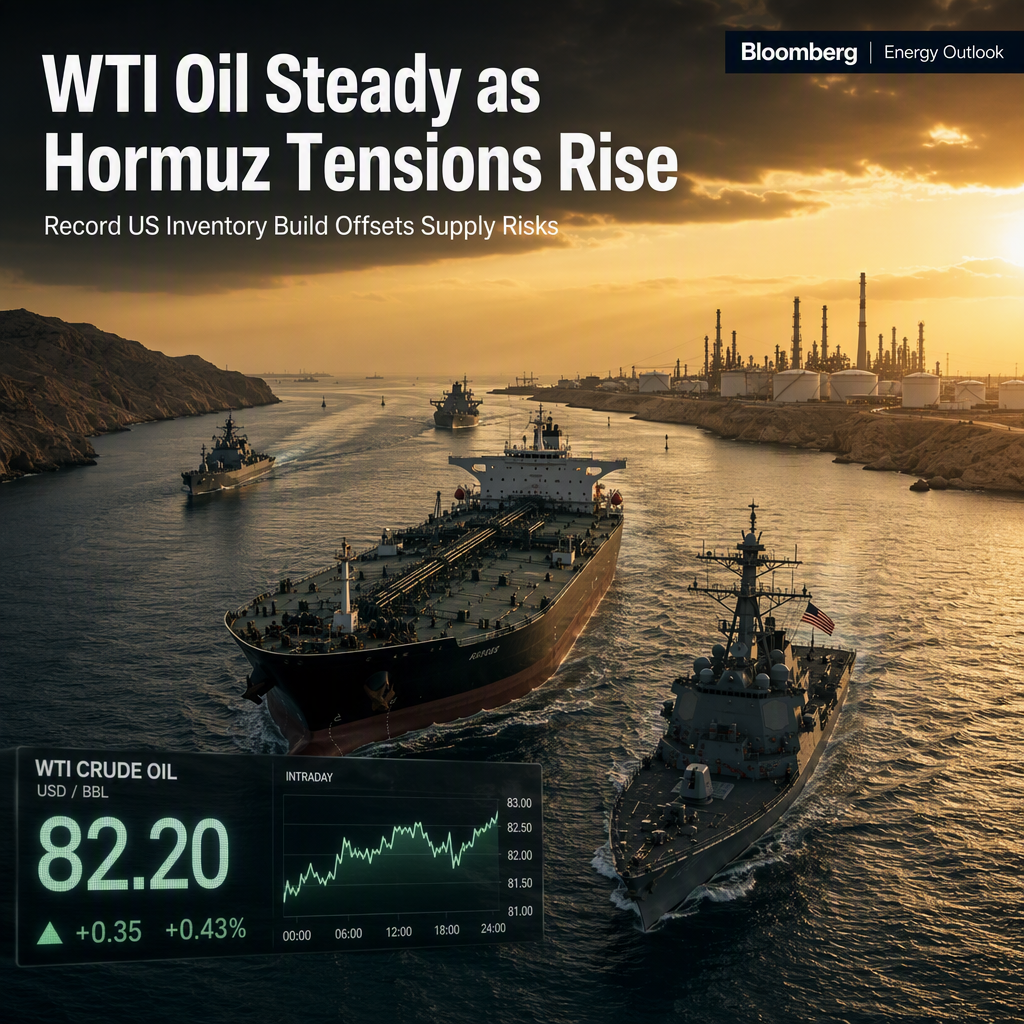
West Texas Intermediate (WTI) oil prices remained steady on Wednesday, trading around $82.20 per barrel and hovering near a one-and-a-half-week high, as traders balanced a significant increase in US crude inventories with ongoing supply risks in the Middle East [1]. According to the US Energy Information Administration (EIA), US crude inventories surged by 17.422 million barrels in the week ending August 7, marking the largest weekly increase since January 2023. This figure far exceeded both the previous week's rise of 2.479 million barrels and market expectations for a 1.4 million barrel decline [1].
Despite the sharp inventory build, market sentiment was largely influenced by developments in the Strait of Hormuz. US President Donald Trump asserted that Washington has "total control" over the strategic waterway, following an incident where US forces disabled a Panama-flagged cargo ship that attempted to breach the US naval blockade [1]. The continued closure of the Strait prompted the International Energy Agency (IEA) to revise its global oil supply and demand forecasts. The IEA now expects global oil supply to fall by 4.3 million barrels per day (bpd) in 2026 to around 102 million bpd, while world oil demand is forecast to decline by 1.6 million bpd—a contraction 510,000 bpd larger than previously estimated [1].
In a separate report, the EIA raised its forecast for the average WTI price in 2026 to $80.88 per barrel, up from $76.26 previously [1]. Technical analysis indicates a mildly bullish near-term bias, with WTI trading above both the 50-day and 200-day Simple Moving Averages (SMAs). The Relative Strength Index (RSI) stands near 53, suggesting neutral-to-positive momentum, while the MACD indicator is flattening near the zero line, pointing to market consolidation [1]. Key resistance is identified at the 100-day SMA near $86, with further upside potential toward $90 and $100 if this level is breached. On the downside, immediate support is at $80, followed by the 50-day SMA at $78 and the 200-day SMA at $75 [1].
CONCLUSION
Despite a record US crude inventory build, WTI oil prices remain supported by ongoing supply risks in the Middle East, particularly around the Strait of Hormuz. Revised forecasts from the IEA and EIA suggest tighter supply and higher prices ahead, while technical indicators point to a consolidating but mildly bullish market.