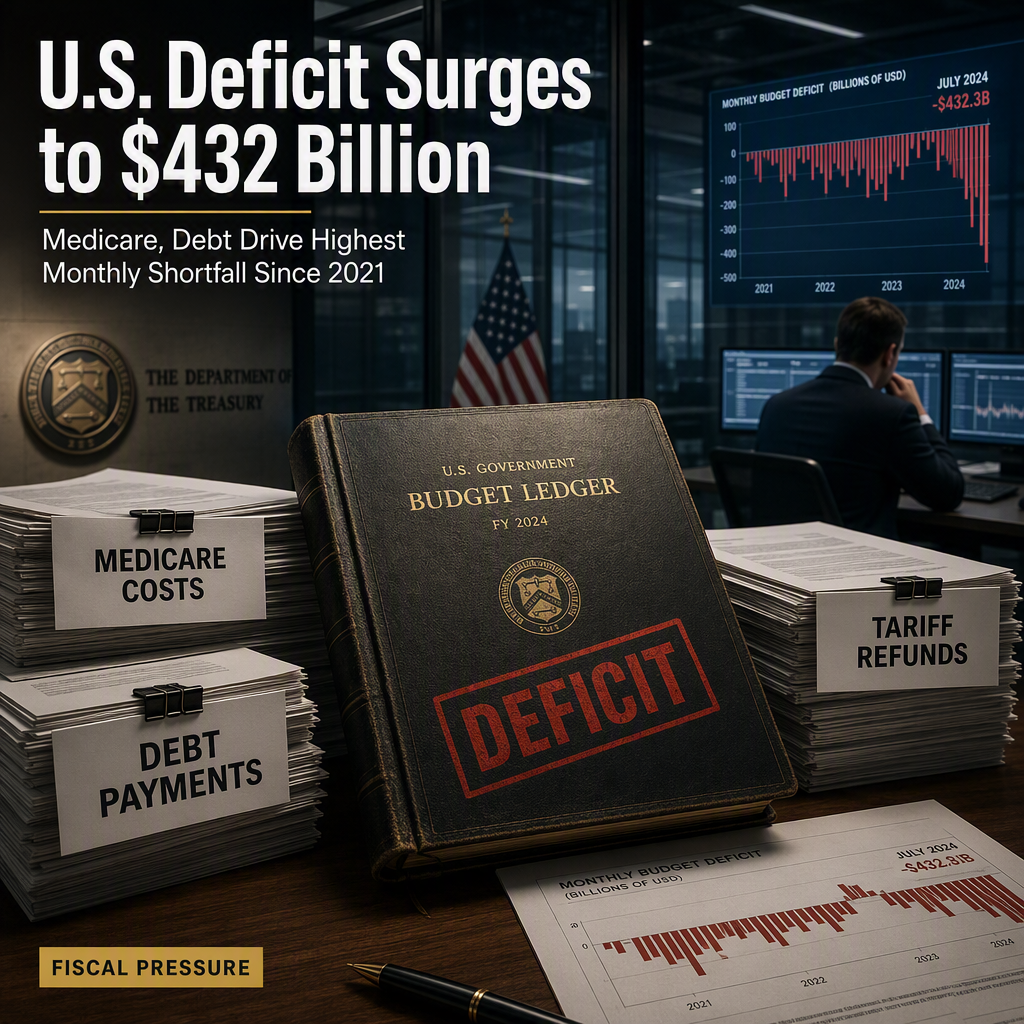
The U.S. budget deficit soared to $432.3 billion in July, marking the highest monthly shortfall since March 2021, according to the Treasury Department [1]. This represents a 48% increase from the same period a year ago and pushes the cumulative deficit for the first ten months of the fiscal year to nearly $1.8 trillion, surpassing the total for the same period in 2025 [1]. The surge was primarily attributed to a sharp rise in Medicare costs, which reached $174 billion in July—up from $103 billion in June—and now total $955 billion for the fiscal year, making it the largest single expenditure for the month [1]. Other significant outlays included $141 billion for Social Security and $104 billion in net interest on the national debt [1].
Tariff refunds also contributed to the deficit, costing $33 billion as the administration continued to provide rebates for levies deemed illegal by the Supreme Court [1]. Additionally, the budget absorbed a $99 billion impact due to the timing of benefit payments, as the first of the month fell on a nonbusiness day, accelerating outlays for Supplemental Security Income and Medicare [1].
Debt financing remains a major burden, with the U.S. paying $1.17 trillion in interest on the $39.9 trillion national debt so far this fiscal year, of which $32.1 trillion is held by the public [1]. This is up from $1.01 trillion in debt servicing costs during the same period last year, while net interest payments have reached $931 billion [1].
On the monetary policy front, President Donald Trump has refrained from criticizing the Federal Reserve since his nominee, Kevin Warsh, became chairman in May [1]. While markets had previously anticipated rate hikes to combat inflation—which has exceeded the Fed's 2% target for over five years—recently subdued inflation data and weak payroll reports have dampened those expectations. However, futures traders are not pricing in any chance of a rate cut for the next five years [1].
CONCLUSION
The U.S. budget deficit's sharp rise in July, driven by escalating Medicare costs and debt servicing, signals mounting fiscal pressures. With no rate cuts expected in the near future and debt costs rising, the market faces heightened uncertainty regarding the government's fiscal trajectory.