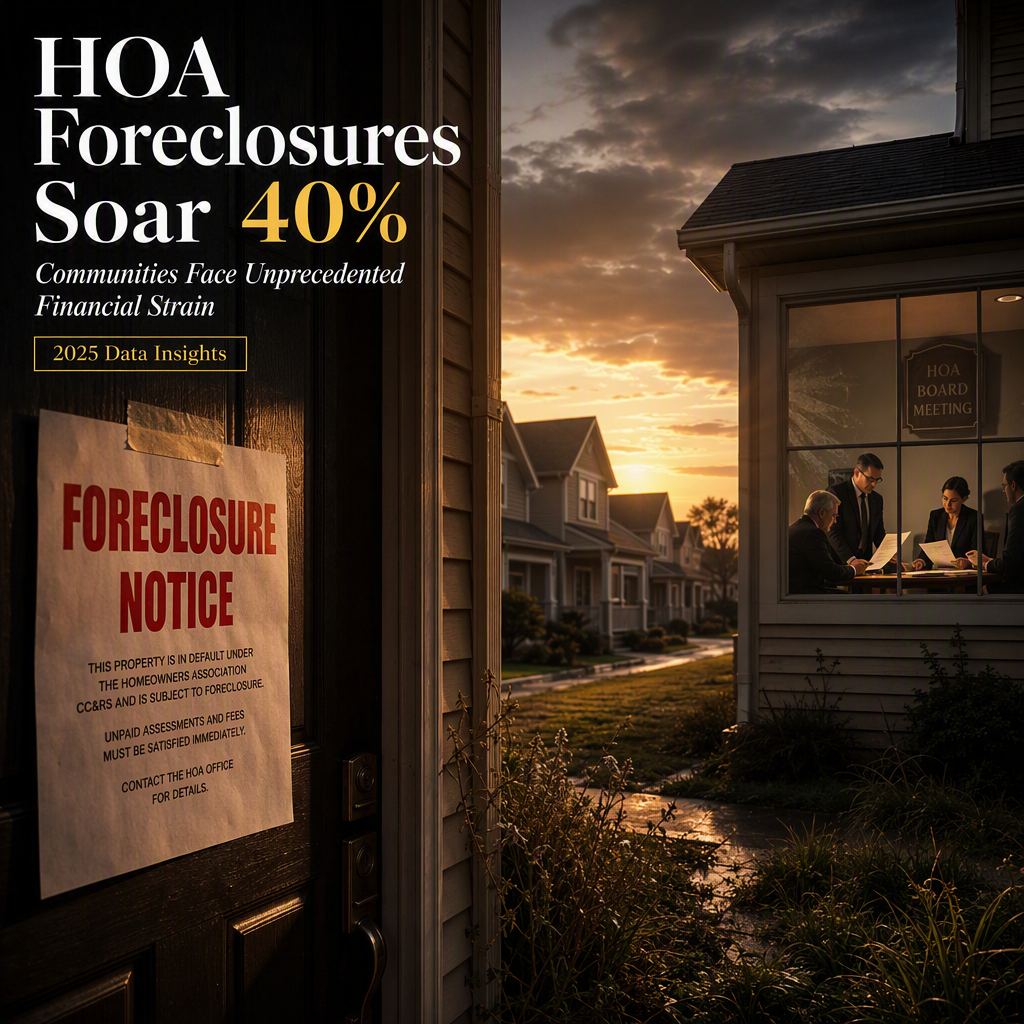
Homeowners associations (HOAs) across the United States are intensifying foreclosure actions against homeowners who are delinquent on their dues, as communities confront growing financial pressures. Real estate experts attribute this trend to rising operating costs, shrinking reserve funds, and concerns that unpaid assessments could jeopardize the ability of associations to cover essential expenses such as maintenance, repairs, insurance, and landscaping [1].
According to real estate analytics firm ATTOM, HOA-related foreclosures have increased nearly 40% compared to two years earlier, outpacing the rise in overall mortgage foreclosure rates, as reported by The Wall Street Journal [1]. Brian Fox, co-founder of Benutech, a real estate technology firm tracking HOA delinquency trends, stated that HOAs are being forced into more aggressive collections to avoid their own financial collapse [1].
Benutech Data Insights revealed that in 2025, HOAs filed 284,933 liens against homeowners, which equates to roughly one lien every 90 seconds. This figure marks an 8.6% increase from 2024, highlighting the growing prevalence of legal claims placed on properties due to unpaid assessments, fees, or fines [1]. In many states, these unpaid liens can ultimately result in foreclosure [1].
The financial strain is not limited to homeowners; nearly three-quarters of association-governed communities are underfunded, with 74% of associations less than 70% funded, according to a late-2025 report by Reserve Study. This underfunding raises concerns about the ability of HOAs to pay for expected repairs and capital projects [1]. Additionally, 93% of surveyed associations reported increases in property and casualty insurance premiums, with more than half experiencing hikes between 11% and 25%, and about 10% facing increases exceeding 100% [1]. These rising costs are further pressuring HOA budgets and intensifying the need to collect assessments from homeowners [1].
CONCLUSION
The sharp rise in HOA foreclosures and liens reflects mounting financial stress within both associations and their communities. With underfunded reserves and escalating insurance and operating costs, HOAs are resorting to more aggressive collection tactics to maintain financial stability. This trend signals ongoing challenges for homeowners and associations alike.