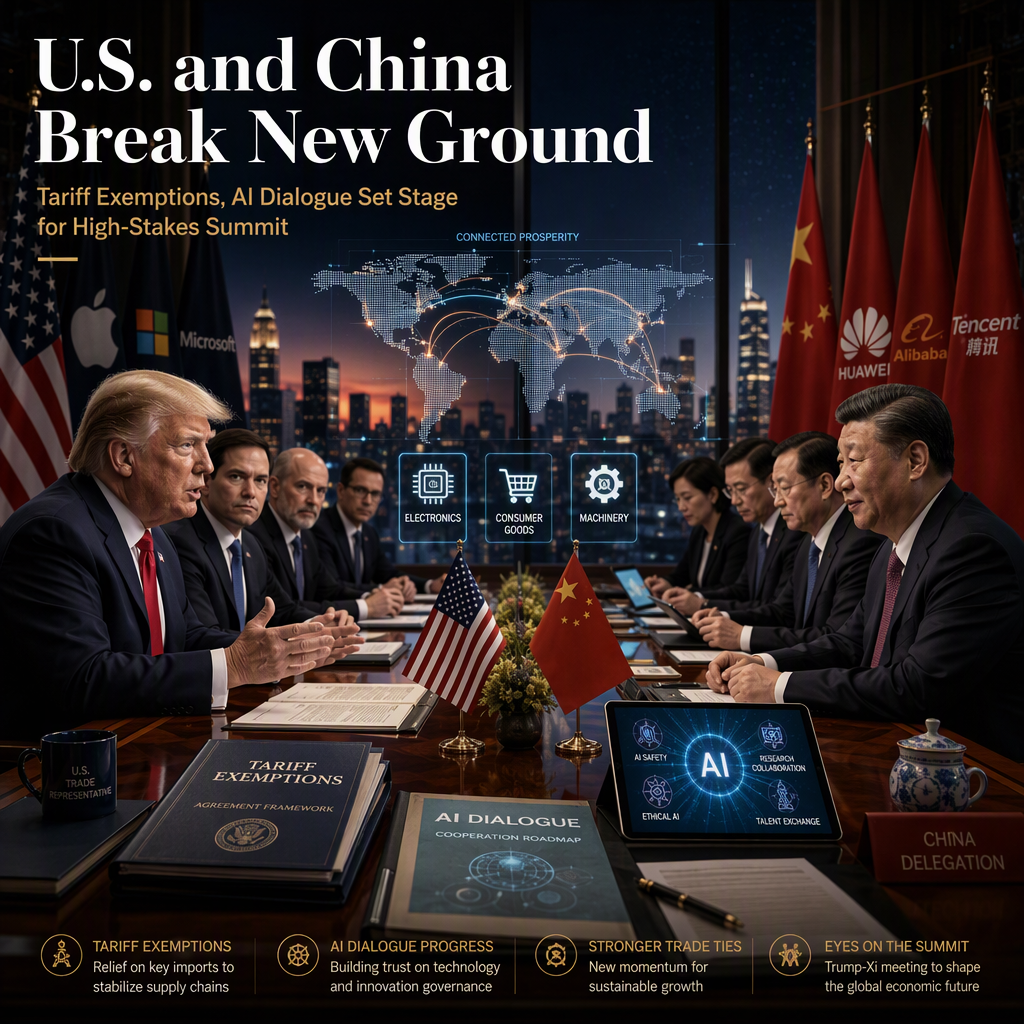
The United States and China have reached agreements to exempt certain 'nonsensitive' goods from future tariff actions and to establish a formal dialogue channel on artificial intelligence, according to U.S. Treasury Secretary Scott Bessent following a meeting with China's Vice Premier He Lifeng [1]. These developments are positioned as foundational steps ahead of a high-stakes summit between U.S. President Donald Trump and Chinese President Xi Jinping scheduled for later this week [1][2].
While no specific financial data, tariff rates, or detailed product lists were disclosed, analysts cited in the U.S. source suggest that the carve-out of nonsensitive goods could benefit sectors with significant cross-border supply chains, such as electronics, consumer goods, and machinery [1]. The establishment of an AI dialogue is also viewed positively by technology investors, as it may reduce regulatory uncertainty in the sector [1]. The U.S. Treasury Department noted that sensitive areas remain under negotiation, and market participants are advised to monitor upcoming statements for further details [1].
According to Chinese sources, optimism is higher in China than in the U.S. regarding the bilateral relationship ahead of the summit [2]. The two sides are expected to extend a trade truce that is set to expire in November, though the duration of the extension remains unclear [2]. At a previous summit in May, China agreed to increase purchases of U.S. agricultural products and Boeing jets, and both countries planned new mechanisms for trade and investment cooperation [2]. Recently, China has increased purchases of American soybeans, reportedly completing nearly half of the committed annual sum of 25 million tons this year [2]. However, Boeing CEO Kelly Ortberg tempered expectations for a large-scale jetliner order from China, suggesting that any purchases would likely be incremental [2].
The agreements on tariff carve-outs and AI dialogue are seen as critical steps toward de-escalating trade tensions and improving diplomatic channels between the two countries [1]. Market participants are closely watching for further announcements from both governments, as previous disputes have contributed to volatility in equities and currency markets [1].
CONCLUSION
The recent agreements between the U.S. and China on tariff exemptions for nonsensitive goods and the creation of an AI dialogue channel mark significant progress ahead of the Trump-Xi summit. While concrete financial details remain unavailable, these steps are viewed as positive signals for global markets and cross-border industries. Investors and traders are advised to monitor forthcoming government statements for additional specifics and potential market impacts.