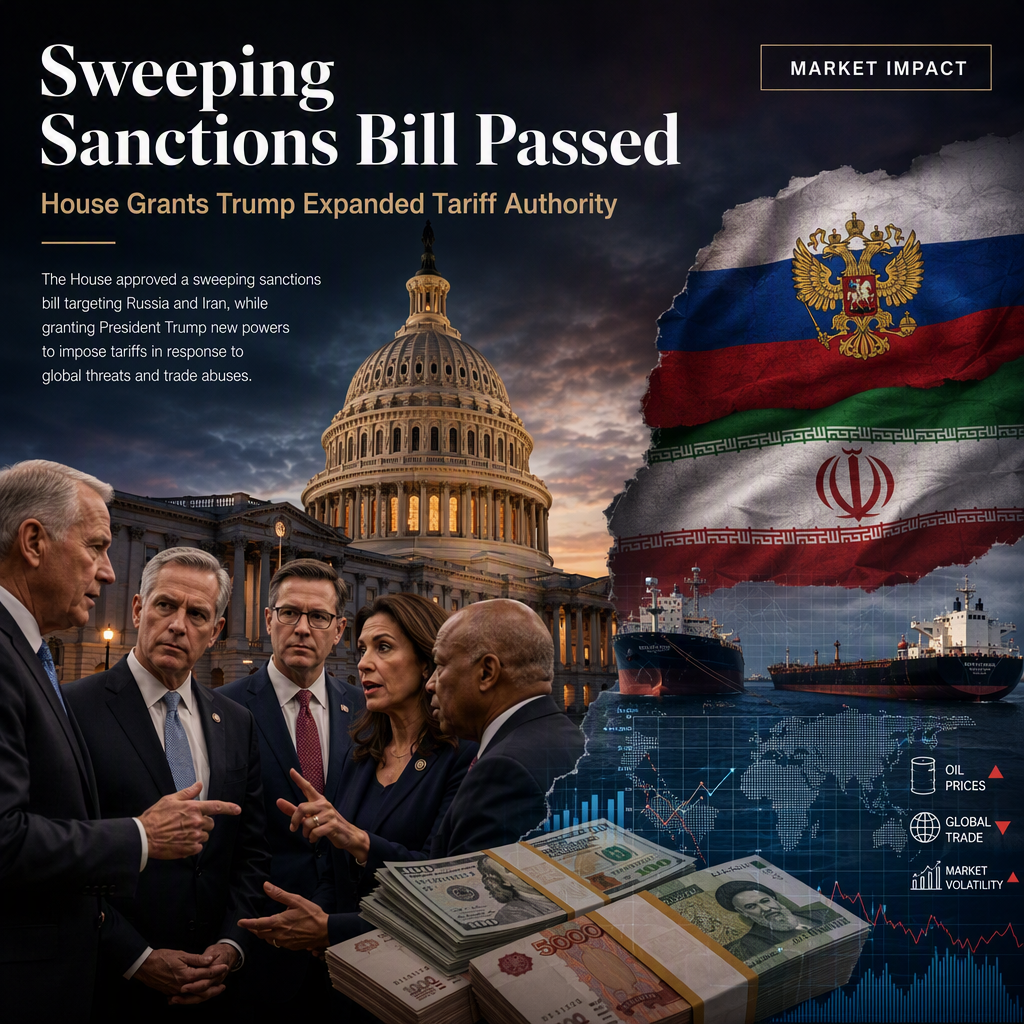
The U.S. House of Representatives passed the Lindsey O. Graham Sanctioning Russia and Iran Act of 2026, a comprehensive sanctions package targeting Russia and Iran, with several Democrats joining Republicans despite strong opposition to a provision granting President Donald Trump expanded tariff authority over countries supporting Russia's war in Ukraine [1]. The bill, named after the late Senator Lindsey Graham, was led in the House by Rep. Michael McCaul, R-Texas, and aims to cripple Russia's war machine by sanctioning Russian officials, oligarchs, banks, financial institutions, and the so-called 'shadow fleet' that facilitates Russian energy exports [1].
Key components of the legislation include the ability to impose tariffs of up to 500% on Russian imports and up to 100% on the top five countries purchasing Russian energy [1]. The bill also reintroduces sanctions targeting Iran's weapons and energy sectors, with the intention of incentivizing a lasting peace deal in the Middle East [1]. Despite these measures, Democrats voiced concerns about the broad tariff authority given to Trump, with Rep. Richard Neal, D-Mass., warning that the legislation does not guarantee tariffs will be used against Russia and could potentially be used against Ukraine [1]. House Minority Leader Hakeem Jeffries, D-N.Y., criticized the bill for its loopholes, suggesting that the sanctions relief envisioned may never materialize [1].
The bill has undergone several revisions to secure White House approval, but its primary focus remains on undermining Russia's financial capacity to sustain its military operations in Ukraine [1]. Rep. McCaul emphasized the importance of targeted tariffs, stating that while sanctions can be evaded, tariffs cannot, according to President Zelenskyy's team [1]. The passage of this bill is seen as a significant move in U.S. foreign policy, with potential market implications for energy prices and international trade, given the high tariff rates and expanded presidential authority [1].
CONCLUSION
The House's approval of the sanctions bill marks a major escalation in economic measures against Russia and Iran, granting President Trump substantial tariff authority despite Democratic reservations. The legislation's aggressive tariff provisions and expanded scope are likely to impact global energy markets and international trade dynamics. However, concerns remain about the bill's effectiveness and the potential for unintended consequences due to its broad presidential powers.