
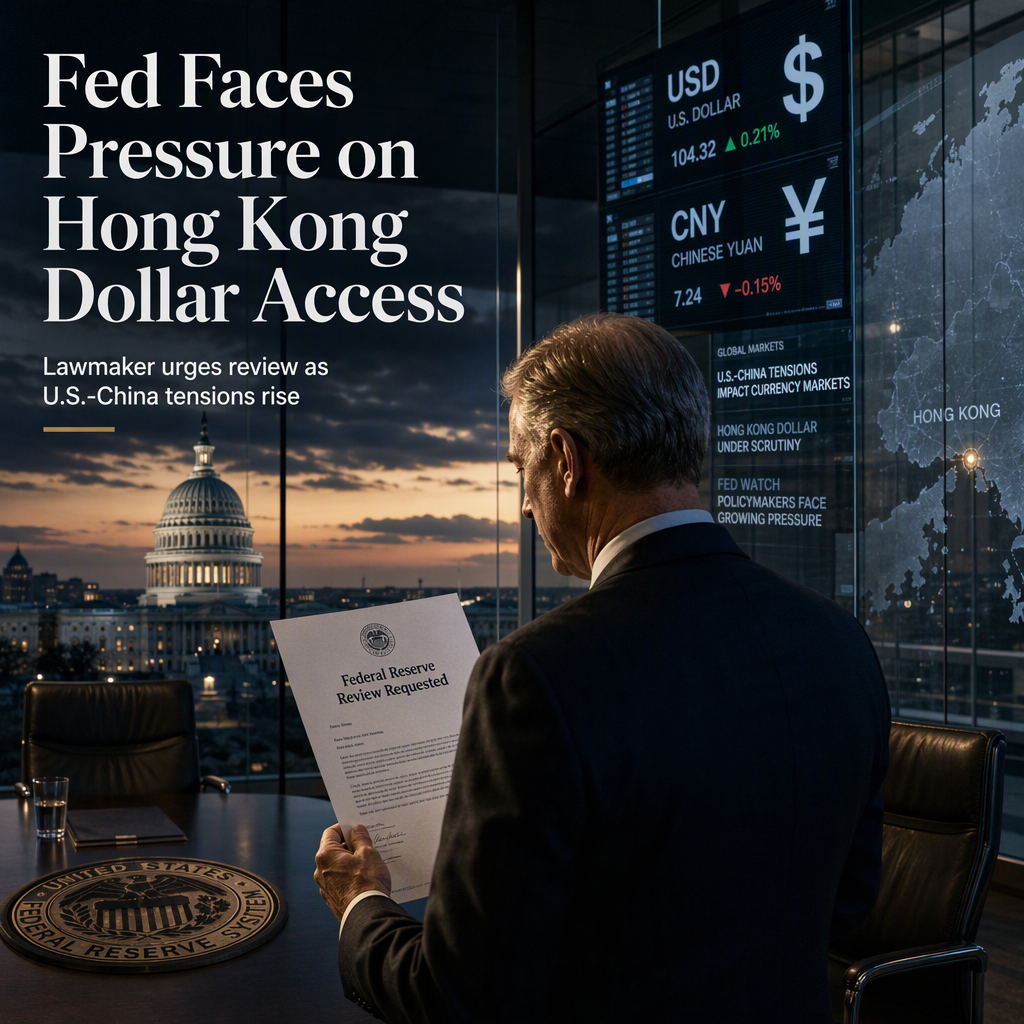
House China committee Chairman John Moolenaar has called on the Federal Reserve to review the Hong Kong Monetary Authority's access to the Foreign and International Monetary Authorities (FIMA) Repo Facility, which provides short-term dollar liquidity to foreign monetary authorities using their U.S. Treasury holdings as collateral [1]. This request, revealed in a letter sent to the Fed last week and obtained by CNBC, comes as China intensifies efforts to promote the renminbi in global finance and expands Hong Kong’s role in that initiative [1].
The FIMA facility was established to allow central banks to access dollars during crises without selling their U.S. Treasurys, thereby avoiding downward pressure on Treasury prices [1]. Since 2020, Hong Kong has made minimal use of the facility, suggesting that any immediate financial impact from restricting access would be relatively small [1]. However, economists warn that such a move could reduce one of the mechanisms that reinforces demand for dollars and U.S. Treasurys [1].
The Fed has acknowledged receipt of Moolenaar's letter and plans to respond, according to a spokesperson [1]. Shehzad Qazi, managing director of China Beige Book, noted that Fed Chairman Kevin Warsh is unlikely to take action that could be perceived as interfering with China policy at a sensitive time, but described the congressional push as an example of novel approaches Congress might take regarding U.S.-China relations [1].
The broader context includes ongoing tensions between the U.S. and China, despite a recent meeting in Washington between President Donald Trump and Chinese President Xi Jinping that was described as having a 'cheerful tone' [1].
CONCLUSION
The call to review Hong Kong's access to the Fed's dollar liquidity facility highlights ongoing U.S.-China financial tensions and congressional scrutiny of Hong Kong's role in China's global currency ambitions. While immediate market impact is expected to be limited due to Hong Kong's minimal use of the facility, the move signals potential for further policy actions affecting dollar liquidity and U.S.-China financial relations.