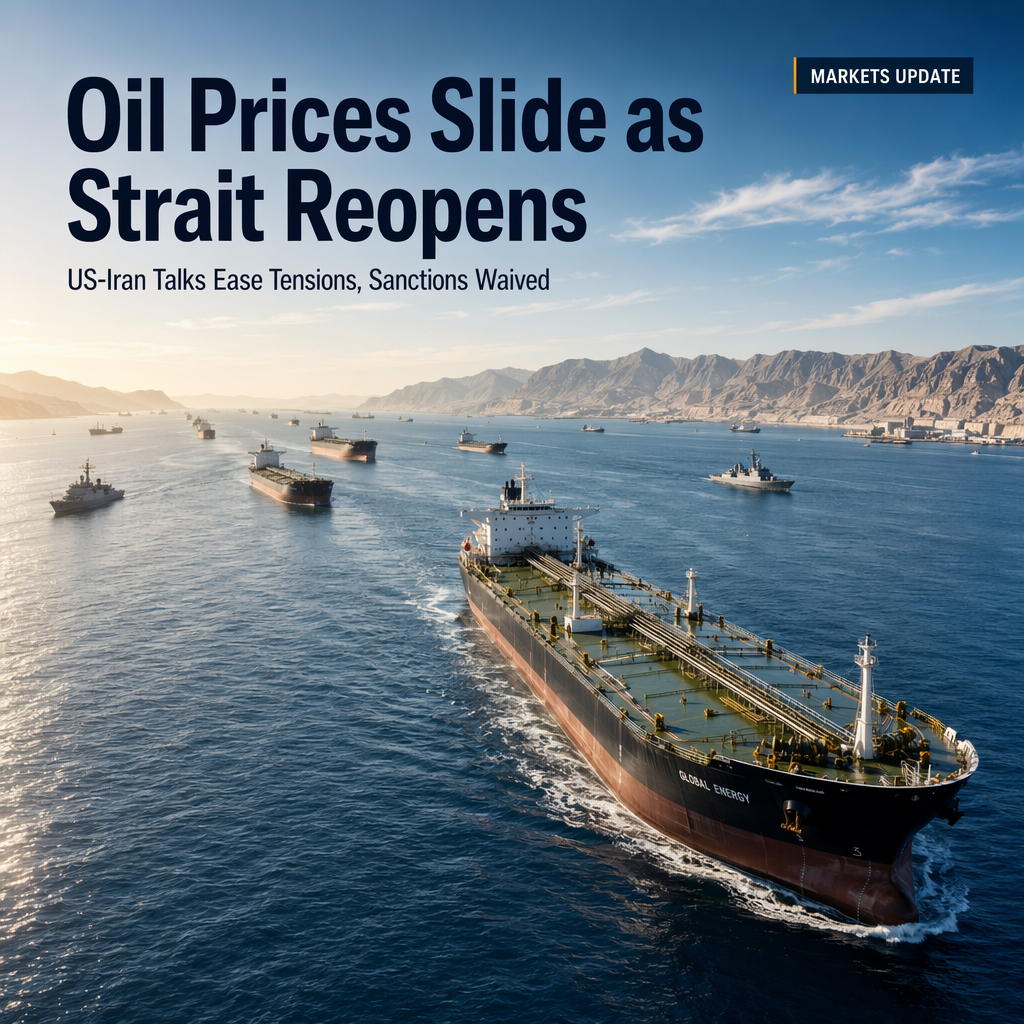
West Texas Intermediate (WTI) crude oil prices declined sharply on Monday, trading around $74.50 per barrel, down 2.54% on the day, marking the first time prices have fallen below $75 since early March [1][2]. International Brent crude also dropped 4% to about $77 per barrel, both reaching new lows since the Iran conflict began, though still above their immediate pre-war prices of $62 and $68 per barrel, respectively [2]. The drop in oil prices was triggered by several key developments: the United States issued a 60-day waiver of sanctions on the purchase of Iranian oil, as announced by Treasury Secretary Scott Bessent [2], and mediators from Qatar and Pakistan reported a roadmap for US-Iran negotiations aimed at reaching a final agreement within 60 days [1].
Iran has committed to ensuring free and open transit in the Strait of Hormuz, according to a statement by Bessent [2]. US Vice President JD Vance also commented that mechanisms are in place to keep the Strait open and prevent further regional escalation [1]. Iranian Foreign Minister Abbas Araghchi described the talks as making "great progress," particularly regarding oil and petrochemical exports [1]. The Strait of Hormuz remains crucial for global energy markets, with roughly 20% of global energy supplies passing through it [1]. Ship traffic through the Strait began to recover over the weekend, with Kpler reporting a daily average of 23 transits from June 19 to June 21, up from single-digit levels during the height of the war in April, but still below the pre-war average of 130 vessels per day [2]. Kpler noted that most ships used routes designated by Iran or turned off their transponders while transiting [2].
Despite the positive developments, the geopolitical situation remains fragile. US President Donald Trump threatened to intensify strikes against Iran if Tehran-backed groups continued actions in Lebanon, prompting Iranian negotiators to temporarily suspend talks in Switzerland, according to several media reports [1]. On Saturday, Iran threatened to re-close the Strait over ongoing Israeli attacks in Lebanon [2]. The market, however, currently favors a scenario where oil flows remain uninterrupted and relations between the US and Iran gradually normalize, leading traders to reassess the likelihood of supply disruptions [1].
Other commodities are also returning to pre-war levels, with Argus data showing the price of urea, a key fertilizer ingredient, has fallen 50% from its April peak [2].
CONCLUSION
WTI and Brent crude prices have fallen sharply as US-Iran negotiations progress and sanctions are temporarily lifted, easing fears of supply disruptions through the Strait of Hormuz. Ship traffic is recovering, though not yet at pre-war levels, and other commodities are also seeing price declines. While optimism prevails, ongoing regional tensions and threats could still impact market stability.