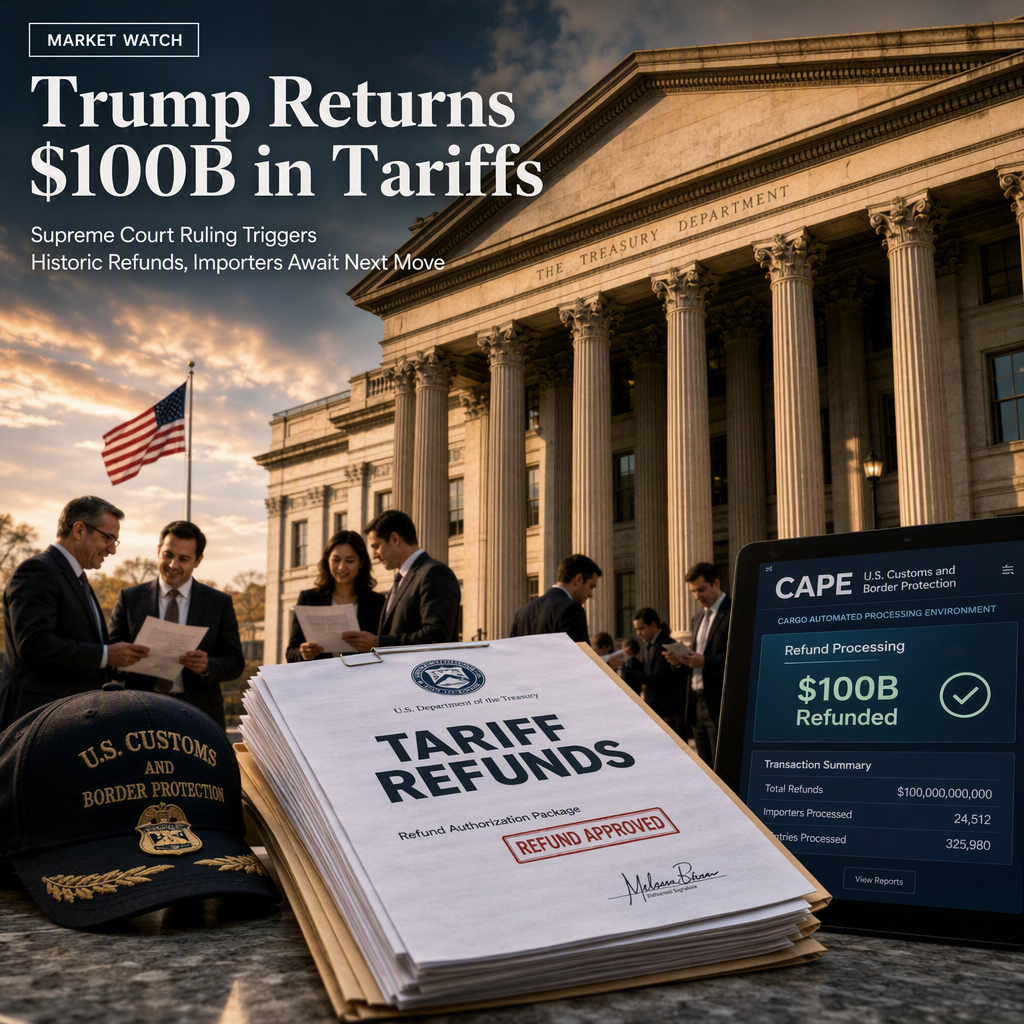
The Trump administration has refunded approximately $100 billion of tariff revenue that was collected before the Supreme Court struck down President Donald Trump's 'liberation day' duties, according to a filing in the U.S. Court of International Trade on Tuesday [1]. This amount represents about 60% of the roughly $166 billion the government says it collected from the tariffs imposed in 2025 under the International Emergency Economic Powers Act (IEEPA) [1]. The Supreme Court ruled in late February that IEEPA did not authorize these tariffs, and about two weeks later, federal Judge Richard Eaton ordered that all tariffs collected under IEEPA be refunded to importers [1].
President Trump, who made tariffs a central part of his economic and foreign policy, expressed frustration over the court rulings but stated that his administration is pursuing alternative legal avenues to re-establish similar tariffs [1]. These new methods are already facing legal challenges [1]. In the interim, the administration has been processing refunds for the defunct IEEPA tariffs. U.S. Customs and Border Protection (CBP) implemented the Consolidated Administration and Processing of Entries (CAPE) system in late April to manage and deliver these refunds [1]. As of July 31, CAPE had received 252,496 refund declarations covering more than 25 million import entries, with nearly $129 billion in potential and certified refunds accepted for processing [1]. Of this, about $100 billion has been completed, certified, and sent to the Treasury Department for disbursement [1].
The refund process is ongoing, with more than 330,000 importers having paid IEEPA tariffs on over 53 million entries [1]. The administration's progress is being monitored through court filings, including a lawsuit by Freestyle World, a California-based importer seeking class action status on behalf of smaller businesses that claim difficulties in obtaining refunds through the CAPE system [1]. The government argues that the request for class certification is both late and invalid [1].
Market implications are significant, as the refund of such a large sum could impact importers' cash flows and potentially influence trade dynamics. However, the uncertainty surrounding the administration's attempts to reimpose tariffs through other legal means, and the ongoing court challenges, add to the unpredictability for businesses involved in international trade [1].
CONCLUSION
The Trump administration's refund of $100 billion in tariffs marks a major reversal following the Supreme Court's decision to strike down the IEEPA duties. While the refund process is substantial and ongoing, the administration's efforts to re-establish tariffs through alternative legal channels introduce continued uncertainty for importers and the broader market.